
Example report sections generated with mllabiome.
Install is recommended with uv:
uv venv
source .venv/bin/activate
uv pip install mllabiome
For local development from a checked-out source tree:
uv venv
source .venv/bin/activate
uv pip install -e ".[dev]"
uv run pytest -q
from mllabiome import mll- MPDR — Microbiome Profile Data Representation: one taxonomic resolution plus one count transformation.
- MPMA — Microbiome Profile Modelling Algorithm: one MPDR plus one learner.
- MPMAs Ensemble: a selected and aggregated pool of qualified MPMAs.
The implementation is split by responsibility:
mllabiome/
  transformations.py   abundance transformations and display abbreviations
  resolutions.py       taxonomic-resolution parsing and MPDR materialisation
  learners.py          learner construction and user-supplied estimator handling
  configs_sweep.py     configured MPMA sweep
  ensemble.py          ensemble-facing public API
  ensemble_sweep.py    MPMAs Ensemble search
  explainability.py    strict multi-method explainability
  data.py              microbiome/metadata loading
  figures.py           sweep and explainability figures
  metrics.py           prediction metrics
  pipeline.py          end-to-end execution
A sweep is an ordinary Python config. Running the config executes:
configured MPMA sweep -> ensemble sweep -> out-of-fold explainability -> report
Configuration files are intentionally editable: add or remove resolution sets, transformations, and learners by editing the Python lists or commenting/uncommenting entries. Runs are resumable; completed MPMA/split evaluations are kept and newly enabled or missing configurations are evaluated on rerun.
mllabiome examples/sweep_config.pyStage entry points are available for restart/reuse:
mllabiome examples/sweep_config.py --stage evaluate
mllabiome examples/sweep_config.py --stage ensemble
mllabiome examples/sweep_config.py --stage explainUse plain Python lists and functions: define resolution sets, build count transformations, build models.
from pathlib import Path
from sklearn.ensemble import RandomForestClassifier
from mllabiome import mll

_RESOLUTION_SETS = [
    # ("genus", ("genus",)),
    ("species", ("species",)),
    # ("genus-species", ("genus", "species")),
    # ("family+species", ("family", "species")),
]

def _build_count_transformations():
    T = mll.Transformation
    return [
        # T("none"),             # RA
        T("arcsin_sqrt"),        # $\arcsin\sqrt{x}$
        # T("scikit-bio_clr"),   # CLR-mult
        # T("robust"),           # Robust
        # T("rank_col"),         # ECDF-rank
    ]

def _build_models():
    M = []
    M.append(("RF_1000_msl5", RandomForestClassifier(
        n_estimators=1000, min_samples_leaf=5, n_jobs=1, random_state=42,
    )))
    # M.append(("RF_500_msl3", RandomForestClassifier(
    #     n_estimators=500, min_samples_leaf=3, n_jobs=1, random_state=42,
    # )))
    return M

TITLE = "example mllabiome sweep"
EXPERIMENT_DIR = Path("examples/runs/EXAMPLE")

DATA = mll.Data(
    abundance_path=Path("data/microbiome.tsv"),
    metadata_path=Path("data/metadata.tsv"),
    format="metaphlan_tsv",
    sample_id_col="sample_id",
    target_col="label",
    label_map={"control": 0, "case": 1},
    class_labels=("control", "case"),
    positive_class=1,
)

EVALUATION = mll.Evaluation(
    protocol="repeated_nested_cv",
    outer_folds=5,
    inner_folds=3,
    repeats=2,
)
GATE = mll.QualificationGate(enabled=False, metric="nMCC", threshold=0.51)
ENSEMBLE = mll.Ensemble(sizes=(3,), optimize_metric="nMCC")
EXPLAINABILITY = mll.Explainability(targets="auto", top_k=30)
Transformation(name) uses a provided abundance transformation. Transformation(name, fn) applies a custom fn(X) independently to train and test. Transformation(name, fn, True) applies fn(X_train, X_test) and is intended for fold-fitted transformations where parameters must be estimated from the training fold only.
Provided transformations expose only compact labels for outputs:
count_transformation: implementation key used in configs and result files.transformation_abbreviation: figure/table label used in sweep summaries.
Transformation abbreviations are written alongside every MPMA row in configs.tsv and downstream result tables. No separate transformation-space table is emitted by default.
Data(format=...) supports:
"metaphlan_tsv": a taxonomic profile table with clades/features as rows and samples as columns, plus a separate metadata table. The first column is used as the feature/clade index."wide_csv": one row per sample, with metadata columns plus numeric feature columns in the same CSV."auto": choosesmetaphlan_tsvwhen a TSV profile and metadata file are supplied, otherwisewide_csv.
"matrix_tsv", "profile_tsv", and "csv" are accepted aliases for compatibility, but examples use the clearer names above.
Label encoding should be explicit:
DATA = mll.Data(
    abundance_path=Path("examples/data/PTSD/PTSD_profiles.tsv"),
    metadata_path=Path("examples/data/PTSD/PTSD_metadata.tsv"),
    format="metaphlan_tsv",
    sample_id_col="sampleId",
    target_col="group",
    label_map={"Placebo": 0, "Active": 1},
    class_labels=("Placebo", "Active"),
    positive_class=1,
)
Repeated nested-CV is stratified by the target label by default. To additionally balance a metadata column, set stratify_col on Data; the splitter then stratifies on the composite target-plus-column label.
DATA = mll.Data(
    abundance_path=Path("examples/data/PTSD/PTSD_profiles.tsv"),
    metadata_path=Path("examples/data/PTSD/PTSD_metadata.tsv"),
    format="metaphlan_tsv",
    sample_id_col="sampleId",
    target_col="group",
    stratify_col="batch",
    label_map={"Placebo": 0, "Active": 1},
    class_labels=("Placebo", "Active"),
    positive_class=1,
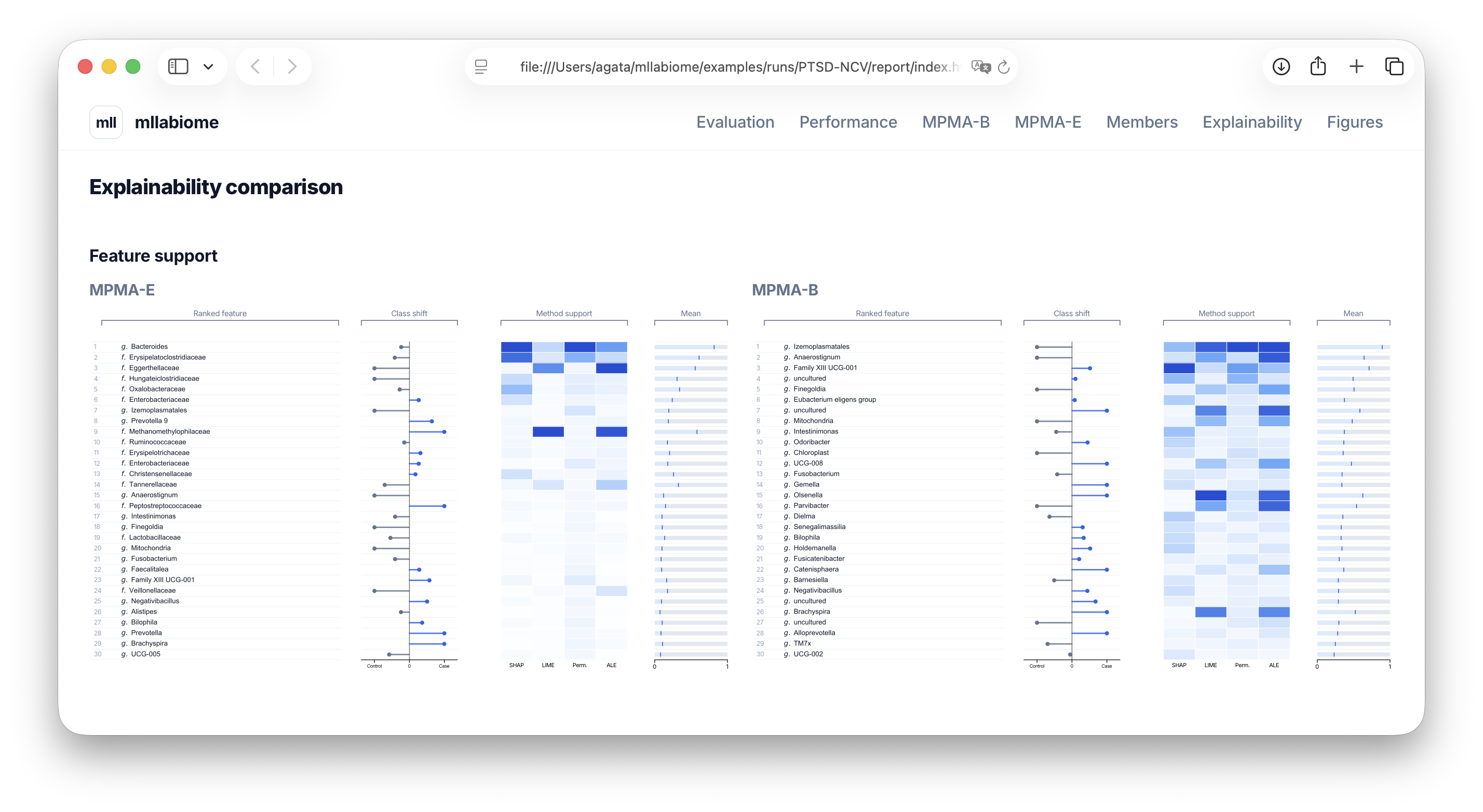
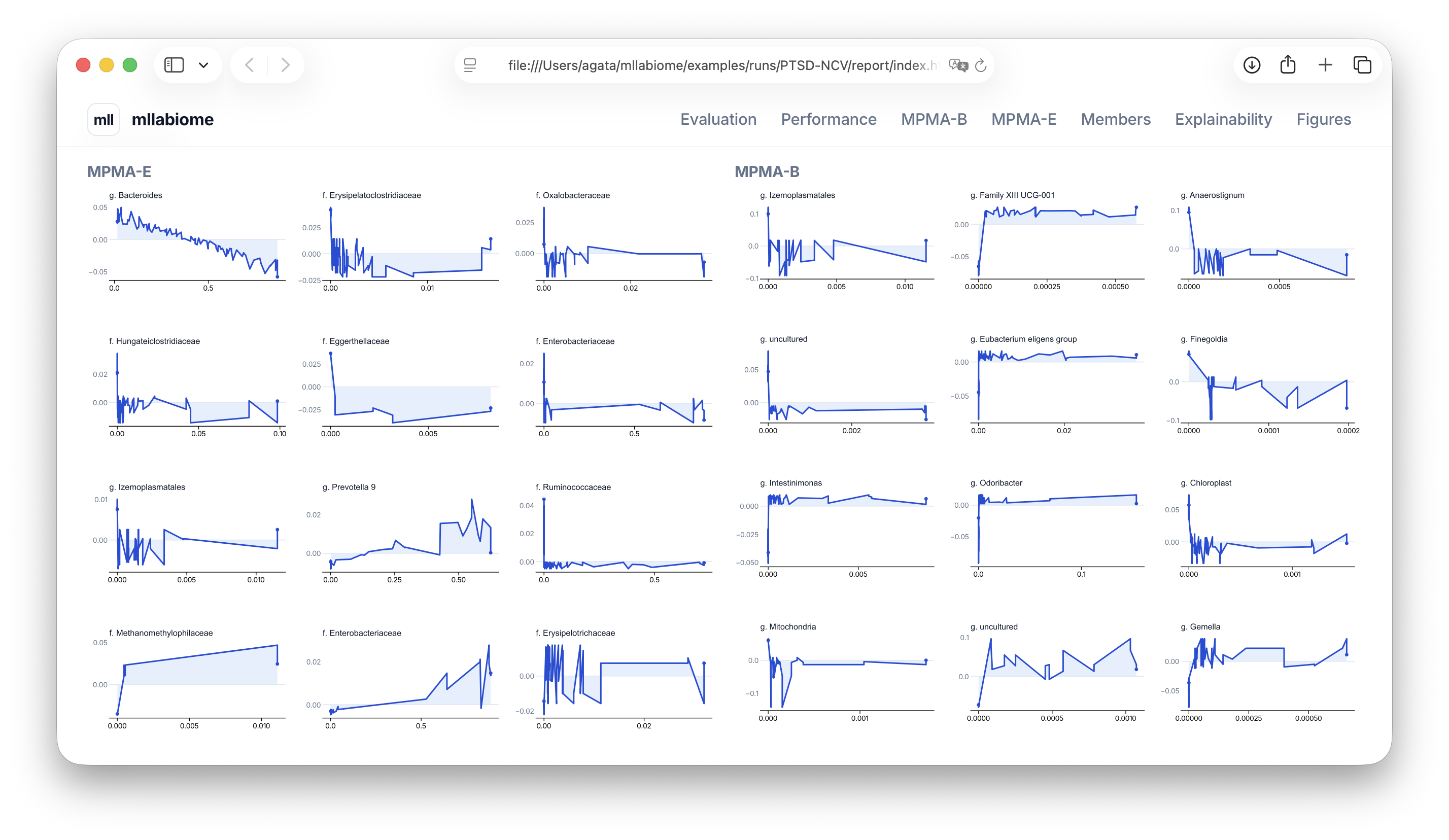
)By default, explainability uses targets="auto", which runs the standard comparison suite: MPMA-E when an ensemble has been selected, MPMA-B, and the strict Baseline RF when that baseline exists. For each target, the configured methods run on outer-test, out-of-fold predictions: every explained row is predicted by a model fitted only on that row's corresponding outer-training fold. The configured methods run SHAP, LIME, one-dimensional ALE, permutation importance, and two-dimensional ALE interactions. The package does not replace one requested method with another. If a required dependency is unavailable, or if a method cannot explain the selected target, the stage raises an error.
EXPLAINABILITY = mll.Explainability(
    targets="auto",
    top_k=30,
    # default methods=("shap", "lime", "ale", "permutation", "interactions")
)
For a targeted rerun, users may explicitly reduce methods; nothing is substituted automatically.
Each run writes tables and figures under experiment_dir:
configs.tsv,configs.dbtables/mpma_rankings.tsvtables/qualification_gate.tsvtables/representation_impact_cells.tsvfigures/mpma_top_metric.pngfigures/representation_impact.{png,pdf,svg}ensembling/final_model_comparison.tsvensembling/selected_unit.jsonensembling/ensemble_candidates.pngexplainability/<target>/oof_predictions.tsvexplainability/<target>/feature_importance_{shap,lime,ale,permutation}.tsvexplainability/<target>/feature_importance.tsvexplainability/<target>/ale_curves.tsvexplainability/<target>/feature_interactions_current.csvexplainability/<target>/feature_interactions_corrected.csvexplainability/<target>/feature_interactions_fixed_pairs.csvexplainability/<target>/feature_interactions_corrected_fixed.csvexplainability/<target>/feature_interactions_by_target_all_methods.csvexplainability/<target>/figures/feature_importance.pngexplainability/<target>/figures/interaction_network_current.png
Licensed under the Apache License, Version 2.0. See LICENSE.
Runnable example configurations are available under examples/:
mllabiome examples/ptsd_configs_sweep.py
mllabiome examples/ptsd_configs_sweep.py --stage evaluate
mllabiome examples/ibs_lodo_configs_sweep.py --stage evaluate