NEWS:
- Agentomics to be presented at ISMB 2026
- Agentomics has been published in Bioinformatics journal link to published paper
- Agentomics now supports any data type and supplementary material
Made for biomedical data, Agentomics outperformed human experts and created new state-of-the-art models for problems in Protein Engineering, Drug Discovery, and Regulatory Genomics.
How it works
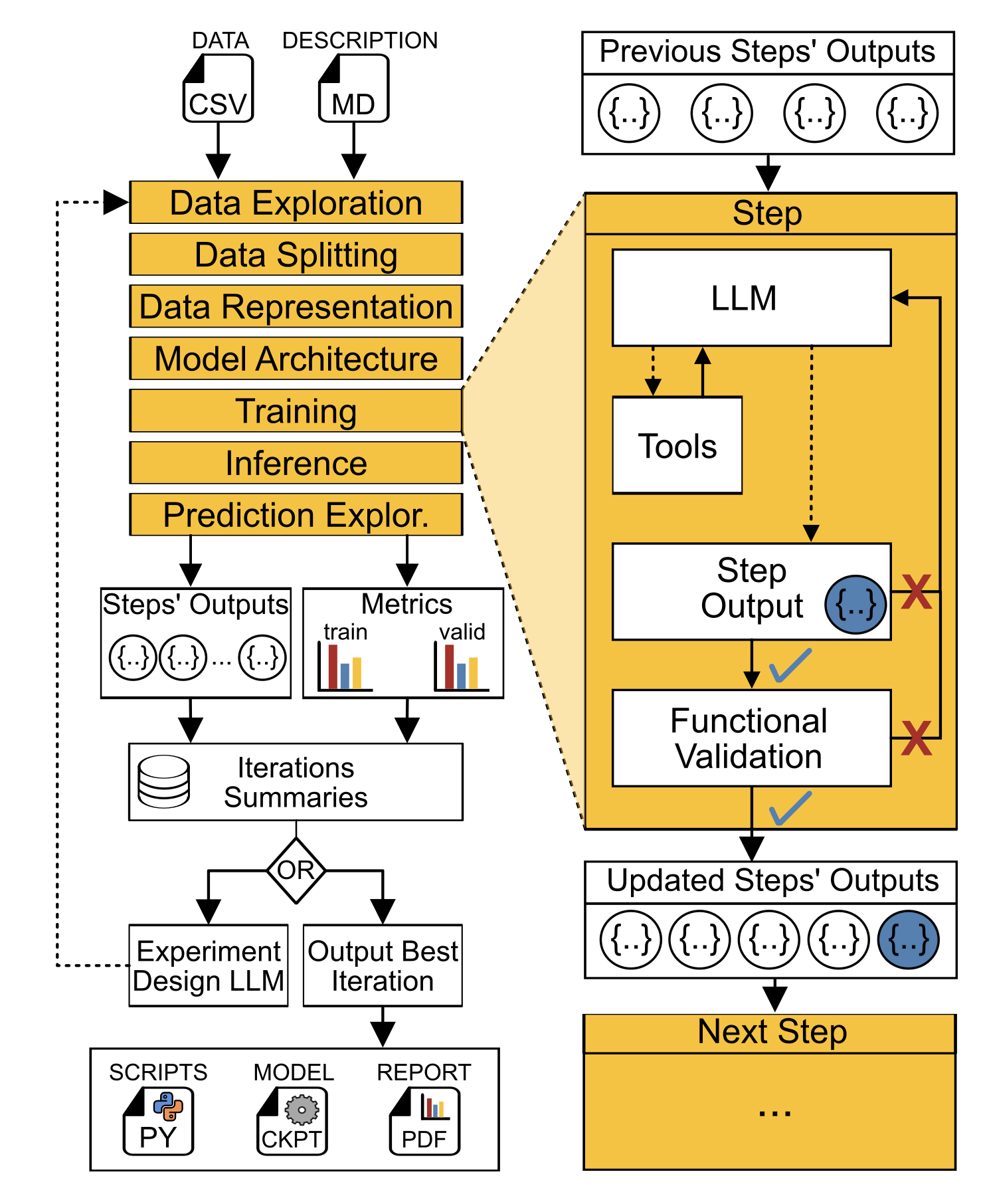
- Input is a folder-based dataset split + optional data description
- Agentomics autonomously experiments with various ML models and strategies
- Output is a trained model ready for inference and a detailed PDF report summarizing the development process and achieved metrics
For more details see: link to published paper
Install Docker, then:
pip install agentomicsSet at least one supported provider credential. For example: OPENROUTER_API_KEY or OPENAI_API_KEY or ANTHROPIC_API_KEY
export OPENROUTER_API_KEY=... Download an example dataset into ./datasets
To see all available examples add the --list option
agentomics-download-datasetStart an Agentomics run and follow instructions
agentomics-runRecommended model: gpt-5.1-codex-max
Outputs are saved to outputs/<agent_id>/, including PDF reports in outputs/<agent_id>/reports/pdf.
See Installation, Datasets, CLI Options, and Running Inference for details.
Agentomics can be run via:
- your local Codex subscription via
codex login - a supported provider API key such as OpenRouter, OpenAI, Anthropic, or a configured OpenAI-compatible provider
- local Ollama models for offline/private runs
For more details visit https://biogemt.github.io/agentomics-ml/
- Generic: Agentomics can use folder-based inputs for classification and regression tasks.
- Secure: Agents execute code securely in Docker with read-only mounts to your file system and are only allowed to write in a Docker Volume.
- Reproducible: Outputs include models, scripts, and conda environments needed to run inference or re-train models with one bash command.
- Trustworthy: If you provide a test set, Agentomics fully abstracts LLMs from accessing it, allowing you to rely on programmaticly computed and reported test set metrics.
- Various LLM providers: OpenAI, OpenRouter, or local models via Ollama
- Reliability: Thanks to our functional validators, Agentomics creates a working model 100% of the time (when using recommended settings).
Each completed run is written to outputs/<agent_id>/. The key paths are:
outputs/<agent_id>/
├── best_iteration_snapshot/
│   ├── model_training/
│   │   ├── train.py
│   │   └── training_artifacts/
│   ├── model_inference/
│   │   └── inference.py
│   └── runtime_info/
│       └── environment.yml
├── run/
│   ├── shared/
│   │   ├── config.json
│   │   └── splits/
│   └── iteration_*/
└── reports/
    ├── markdown/
    └── pdf/
Use best_iteration_snapshot/ for inference or re-training. run/ keeps the
full iterative workspace, and reports/ contains the human-readable summaries.
Agentomics is in active development. We welcome any raised Issues and suggestions. You can also Email Us.
Features coming soon:
- Better local model support and configuration
- Remote GPU support for GCP
If you use Agentomics in your work, please cite:
Martinek et al. (2026). Agentomics: An Agentic System that Autonomously Develops Novel State-of-the-Art Solutions for Biomedical Machine Learning Tasks. Bioinformatics (https://doi.org/10.1093/bioinformatics/btag250)
MIT. See LICENSE.