Know exactly what every PR changes visually, and sign it off. StyleProof captures the browser's computed styles (not pixels), diffs your PR's HEAD against its base branch, and posts a per-change report on the PR, so a styling change never ships without someone confirming it was intended.


Pixel-snapshot tools miss most CSS regressions: they can't force :hover / :focus / :active, can't see hidden or off-screen elements, can't reach between-breakpoint rules, and blur away sub-pixel drift. StyleProof reads the computed style of every element instead — every resolved longhand, every pseudo-element, the deltas :hover / :focus / :active apply (forced via CDP, no mouse), swept across each @media breakpoint.
On every PR, StyleProof diffs the PR head's computed-style map against the base branch's, and posts a Markdown comment:
- A lean summary comment linking to a committed side-by-side report — the report is the complete source of truth (one section per distinct change, with a before/after cropped screenshot cropped from the same rectangle so the two sides line up exactly, plain-English bullets that tell you what to look for —
columns: 2 → 3,recoloured cyan → amber— and the exact property changes). The comment never duplicates the report, so the two can't drift, and it renders identically on public and private repos. - A single Approve all changes checkbox in the comment, driving a
StyleProofcommit status: red until one tick signs off every change, green when there are none. The reviewer who ticks it is recorded inline (approved by @them), sourced from the commit status so it survives a report re-run. - Clean runs leave a receipt too. When no visual changes are detected, StyleProof still creates or updates the PR comment with
✓ No visual changes detected., so a green status has a visible record instead of only a silent check. - New surfaces don't block. A surface that exists only on the PR head (no baseline to diff — e.g. the bootstrap PR that first adds the capture spec, or a brand-new page) is shown in the report under a
🆕 new surfaceheading but never holds the status red and needs no sign-off. It becomes part of the baseline once merged. - The diff is always head-vs-base, so the report is exactly what this PR changes — whether the maps are restored from the
styleproof-mapscache or recaptured in CI on a cache miss. See Quickstart.
StyleProof diffs the surfaces your spec lists — so a page nobody added to the list is invisible to the gate. Its change has no base capture and no head capture, so it never appears in any diff, and the status goes green having never looked at it. This is the one thing the captures can't catch on their own: a capture that was never taken.
Declare your app's route/view universe in expected and StyleProof emits a coverage-guard test in your normal suite (it runs even without STYLEMAP_DIR — it's a static check, no browser). It fails the moment a route exists with no surface, so a new page can't ship uncaptured:
import { defineStyleMapCapture } from 'styleproof';
import { ROUTES } from '../app/routes'; // your registry — wherever routes live

defineStyleMapCapture({
  dir: process.env.STYLEMAP_DIR,
  surfaces: SURFACES,
  expected: ROUTES.map((r) => r.id), // every route StyleProof should cover
  exclude: { checkout: 'auth-gated — capture fixture pending' }, // visible, reviewed opt-outs (key → reason)
});
A route that's neither a captured surface nor an exclude entry fails the guard; an exclude key that isn't in expected (a renamed/removed route) fails too, so the opt-out ledger can't quietly rot. Captured surfaces beyond expected are fine — one route can have several states (landing, landing-nav-open). Omit expected and behaviour is unchanged.
Next.js: wired for you. Run styleproof-init in a Next.js project and the generated spec discovers your routes (App Router app/ + Pages Router pages/) at run time and wires both the surfaces and expected to them — so it's protected out of the box, and a page you add later is covered automatically with nothing to keep in sync:
import { defineStyleMapCapture, discoverNextRoutes } from 'styleproof';

const ROUTES = discoverNextRoutes(); // [{ key, path, dynamic }, …] from app/ + pages/
defineStyleMapCapture({
  surfaces: ROUTES.filter((r) => !r.dynamic).map((r) => ({
    key: r.key,
    go: (p) => p.goto(r.path),
    widths: [1280, 768, 390],
  })),
  expected: ROUTES.map((r) => r.key),
  exclude: Object.fromEntries(
    ROUTES.filter((r) => r.dynamic).map((r) => [
      r.key,
      `dynamic route ${r.path} — add a surface with a concrete param`,
    ]),
  ),
  dir: process.env.STYLEMAP_DIR,
});
discoverNextRoutes(cwd?) reads the filesystem only (route groups (group) and @slots stripped, [param]/[...catchall] flagged dynamic) — a heuristic, not a router; edit the generated spec for exotic routing. For any other framework, point expected at your own route registry as above.
Single-route SPAs: crawl the nav instead. Filesystem discovery can't see a surface that isn't a page — a tab SPA where every view is /?tab=overview on one app/page.tsx, or anything client-routed. There the surfaces exist only in the rendered nav, as its links. defineCrawlCapture discovers them at run time: it loads a root URL, reads its same-origin <a href>s, and captures each — so the surface set is the nav, with no list to hand-maintain (and so none to drift).
import { defineCrawlCapture } from 'styleproof';

defineCrawlCapture({
  from: '/', // crawl the app root for links
  match: /\?tab=/, // keep just the tab views (omit to take every same-origin link)
  widths: [1440, 1024, 768],
  dir: process.env.STYLEMAP_DIR,
});
Each discovered link becomes a surface keyed by its URL (/?tab=overview → overview; pass key for a different scheme). The app only has to render its nav as real <a href> links — a button-only nav (<button onClick>) exposes nothing to crawl. Replay, self-check and clock-freeze behave exactly as for explicit surfaces; one Playwright test runs the whole sweep (the link set isn't known until the page renders).
Live UI states: capture each state, not an average. StyleProof automatically
detects semantic live-state candidates (aria-live, role=status, role=alert,
aria-busy=true) and keeps stable ones in the normal diff. If a stream, poll, or
live region represents product states you want certified (loading, loaded,
empty, error), list only those pinned states with liveStates. StyleProof
writes separate captures such as dashboard-loading@1440 and
dashboard-loaded@1440, so the base branch's loading state compares to the
feature branch's loading state, and loaded compares to loaded.
defineStyleMapCapture({
  dir: process.env.STYLEMAP_DIR,
  surfaces: [
    {
      key: 'dashboard',
      go: (page) => page.goto('/dashboard'),
      widths: [1440, 768],
      liveStates: [
        {
          key: 'loading',
          setup: (page) =>
            page.route('**/api/widgets', (route) => route.fulfill({ json: { status: 'loading', widgets: [] } })),
        },
        {
          key: 'loaded',
          setup: (page) =>
            page.route('**/api/widgets', (route) =>
              route.fulfill({ json: { status: 'loaded', widgets: [{ label: 'Revenue' }] } }),
            ),
        },
      ],
    },
  ],
});One change — the hero CTA recoloured cyan → amber — appears as a single section in the report: a side-by-side before/after cropped screenshot, the same crop again with magenta boxes marking exactly what changed, a one-line summary, then the exact property change folded under a toggle. A change too small to see at 1:1 (say a 2px icon tweak) also gets a magnified zoom crop, so a sub-pixel change can't slip past a reviewer.
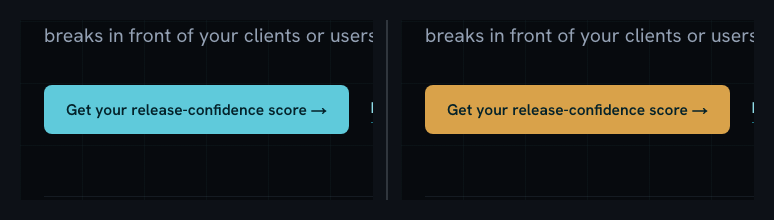
📄 See a full live report — rendered by the current code with real images (clean before/after, the highlighted twin, a magnified zoom for a sub-pixel change, and a 🆕 new surface). It's regenerated and verified on every PR (npm run demo:report), so it always reflects exactly what StyleProof produces today.
As it renders in the committed report (a plain-English bullet first — naming the theme token and showing the hex with a live colour swatch — then the exact table inside the toggle). The PR comment itself stays lean — a summary plus the approval box — and links here:
### `a.btn-solid` · 1 element restyled
_landing @ 1280_

- **`a.btn-solid`** — background `brand-cyan` (`#5fcadb`) → `brand-amber` (`#f59e0b`)

▾ Show the property change
   | Property         | Before    | After     |
   | background-color | #5fcadb   | #f59e0b   |
StyleProof reads the browser's computed styles — the values it actually resolves — never your source CSS. Tailwind, CSS Modules, styled-components, Sass, vanilla CSS, inline styles: all produce the same computed output, and that's what it diffs. Elements are keyed by DOM structure, not class name, so a refactor that rewrites every class still lines up element-for-element.
Omit widths on a surface and StyleProof reads your app's real @media breakpoints from the loaded CSSOM at capture time and sweeps one viewport per band — no config. It's framework-agnostic for the same reason the diff is: it reads the rules the browser actually parsed, not your source, so Tailwind / CSS Modules / Sass / vanilla all resolve to the same @media boundaries. And it's authoritative or it fails — an unreadable cross-origin stylesheet throws rather than silently miss a band; it never guesses. Pin widths explicitly when you want a fixed sweep, or to cover a JS-only (matchMedia) breakpoint that has no CSS rule.
The same engine has a second mode that proves a change touched nothing visual: with fail-on-diff: true, any difference at all fails the job. It's the job StyleProof was born for — certifying a CSS-to-Tailwind migration rendered byte-for-byte identical. Reach for it on any change whose whole promise is "the output is unchanged": a utility-class migration, a design-system swap, a dependency or build-tooling bump. Zero diff is the contract; one drifting longhand is a regression to investigate, not a change to approve.
npm install -D styleproof @playwright/test
npx playwright install chromium
Requires Node ≥ 18 (ESM), @playwright/test ≥ 1.40 (peer dep). Forced states are Chromium-only.
After installing (above), one command sets up the whole gate:
npx styleproof-initIt scaffolds:
- a capture spec (
e2e/styleproof.spec.ts) describing your surfaces (a Next.js app gets its routes and the coverage guard wired automatically — see below); - a
playwright.config.tsthat builds and serves a production build (never a flaky dev server) and captures surfaces in parallel (fullyParallel); .gitignoreentries for.styleproof/,test-results/, andplaywright-report/;- a cache-first CI workflow that restores reusable maps from the
styleproof-mapsbranch and generates the report without a browser when both maps are already built.
Describe your surfaces — omit widths and StyleProof sweeps your real @media breakpoints automatically:
import { defineStyleMapCapture } from 'styleproof';

defineStyleMapCapture({
  surfaces: [
    {
      key: 'landing',
      go: (page) => page.goto('/'), // StyleProof settles the page (in-flight data, fonts, animations) before it reads
      // no `widths` → auto-detected from your @media bands; set `widths: [1280, 768, 390]` to pin them
    },
  ],
  dir: process.env.STYLEMAP_DIR,
});
The manual loop is deliberately three commands:
npx styleproof-init
npx styleproof-map
npx styleproof-diff
styleproof-map captures the current commit into .styleproof/maps/current,
writes a manifest, and uploads the bundle
to the dedicated styleproof-maps branch when the working tree was clean and a
git remote is available. Nothing under .styleproof/ belongs in the PR branch.
HAR recordings are removed before upload by default so private API responses do
not land in the map store. Keep them locally only for an explicit record/replay
workflow with styleproof-map --keep-har (or STYLEPROOF_KEEP_HAR=1).
styleproof-diff restores the base and head maps from styleproof-maps
automatically: in GitHub Actions it uses the PR base/head SHAs; locally it checks
branch.<name>.gh-merge-base, then the current GitHub PR base via gh pr view
(handy for stacked PRs), then origin/main, origin/master, main, and
master. Pin the base with styleproof-diff main or styleproof-diff master.
That's the whole loop. Build the map outside CI when possible by running
styleproof-map after committing. On the PR, CI first restores the base/head
bundles and only generates the report — no build, no browser. If either bundle
is missing or incompatible, CI recaptures both sides in the same pinned
environment before reporting. Correctness wins over a stale cache, but the hot
path is report-only.
Same-environment note. Computed styles depend on the browser build and installed fonts, so maps are only comparable when captured in the same runtime environment. StyleProof records a compatibility key to select the right cached bundle and refuses to compare maps captured under different browser/platform settings; CI then recaptures both sides instead of producing a bogus report.
Want the local side-by-side report (not just a pass/fail diff)? Run npx styleproof-report after styleproof-map; it uses the same inferred base ref and
the same cached-map defaults as styleproof-diff. Pin the base with
styleproof-report main or keep the manual form with styleproof-report before after --out report.
Want the side-by-side report + one-click approval? styleproof-init scaffolds
this for you. If you wire it by hand, restore or capture two dirs first, then use
the Action on those dirs:
# .github/workflows/styleproof.yml
- uses: actions/checkout@v4
- run: npx styleproof-map --restore --sha "${{ github.event.pull_request.base.sha }}" --dir base --base-dir __stylemaps__
- run: npx styleproof-map --restore --sha "${{ github.event.pull_request.head.sha }}" --dir head --base-dir __stylemaps__
- uses: BenSheridanEdwards/StyleProof@v3
  with:
    baseline-dir: __stylemaps__/base
    fresh-dir: __stylemaps__/head
    require-approval: true # review-gate mode (omit / use fail-on-diff: true to certify)
Then copy example/styleproof-approve.yml to .github/workflows/ on your default branch (GitHub only runs issue_comment workflows from there, so the approval checkbox is inert until it's merged).
Prefer to always capture in CI? For a repo with many outside contributors on different machines, StyleProof can capture both base and head in CI and diff them there. See Forks and Dependabot for that flow (it's also the fork-safe split). The default cache-first flow is faster for same-repo teams because local styleproof-map can build the head map before CI starts.
Want to skip work safely? Skip the whole StyleProof workflow only for changes that cannot affect rendered output, such as docs-only edits, using your CI provider's native path filters. Do not skip individual surfaces from a StyleProof run based on a changed-file guess: shared CSS, tokens, resets, themes, layout primitives, and runtime styling can repaint any surface, and a missed surface would certify green without being measured. If you want faster feedback, order the highest-signal surfaces first in your spec, but still let the full sweep finish before treating the gate as passed.
on:
  pull_request:
    paths-ignore:
      - '**/*.md'
      - 'docs/**'
- '.github/ISSUE_TEMPLATE/**'If you always capture in CI rather than restoring maps from styleproof-maps (a better fit when many outside contributors push from different machines), the simplest setup runs the whole gate in one pull_request job that captures base + head and diffs them. That job needs a write token to push the report branch, post the comment, and set the StyleProof status. That's fine for same-repo PRs, but fork and Dependabot PRs run with a read-only GITHUB_TOKEN (GitHub's security default for untrusted PRs). So the job can't post the status — and a required StyleProof check then sits pending forever, blocking the PR even though a dependency or fork change usually touches no UI at all.
Fix it by splitting capture from reporting, the way the approve workflow is already split out:
example/styleproof-capture.ymlrunson: pull_requestwith a read-only token and no secrets — safe to run untrusted PR code. It only builds, captures the style maps, and uploads them as an artifact.example/styleproof-report.ymlrunson: workflow_run(after capture finishes) from your default branch with a write token. It downloads the artifact and does the diff, comment, and status — but never checks out or runs the PR's code, only the trusted style-map data.
That last point is why this works where pull_request_target does not: StyleProof builds and serves the PR's head, so running it under pull_request_target would hand a write token (and your secrets) to untrusted code — the exact supply-chain risk StyleProof exists to help you catch. The workflow_run split keeps the privileged half away from PR code entirely.
Where the PR identity comes from. The report stage comments on the PR and sets the StyleProof status against a specific PR number and head commit, so those values have to be trustworthy. It takes them from the trusted workflow_run event — head_sha, then the event's pull_requests, with a commit→PR lookup against that same trusted head SHA for fork PRs (whose association the event doesn't carry directly) — and never from the downloaded artifact. The artifact is produced by the untrusted capture job, so treating anything in it as identity would let a malicious PR point the privileged comment and status at a victim PR or an arbitrary commit (a confused-deputy attack). The artifact therefore carries only the style-map captures, consumed purely as diff input.
Copy both capture and report files to .github/workflows/ (the report one must be on your default branch, like styleproof-approve.yml), then require the StyleProof status in branch protection. A single combined pull_request job that captures base + head and diffs them is fine for repos that never see fork or bot PRs; this split is only needed for untrusted PRs.
Deterministic by default — no fixtures required. A style diff only means something if both sides saw the same inputs; otherwise live-data drift (a backend blip, a 5m ago timestamp, a status chip that flips) reads as a style change on a PR that touched no CSS. StyleProof handles this for you:
- Record / replay. The base capture records each surface's data responses (anything matching
**/api/**) to a HAR; the head capture replays them, so the head renders its code against the base's data — the app's own JS/CSS still load live. Backend down during a run? Both sides replay the same recording, so there's no phantom diff. Point the head capture at the base's recording withSTYLEPROOF_REPLAY_FROM=<base dir>(set on the head capture); tune the data boundary withSTYLEPROOF_REPLAY_URL/replayUrlif your API isn't under/api. - Frozen clock.
Date.now()/new Date()are pinned to a fixed instant, so time-derived styling (stale > 1h → red) can't drift. Timers keep running, so settling still works. - Self-check — captures each surface twice and fails if they differ, so a replay gap or unseeded randomness surfaces as a clear "non-deterministic capture" error, never as a phantom change on an unrelated PR. On by default while recording (where live nondeterminism shows up); off on the replay run, which renders against the recorded HAR and is deterministic by construction.
STYLEPROOF_SELFCHECK=1forces it on for both;selfCheck: falseopts out. - Framework noise is skipped by default. Non-visual and framework-injected elements never count as a change —
<meta>/<title>/<script>/<style>/… (which Next.js streams into the body then hoists) and live regions like Next'snext-route-announcer. A real stylesheet change still shows up in the affected elements' computed styles, not in the<style>tag. Add your own selectors withignore— they extend this default, they don't replace it. - Layout-equivalent margin noise is normalised. If the browser reports
horizontal auto-centering margins (
margin-left/margin-rightand logical equivalents) differently but the captured document-space rectangle is identical, StyleProof treats that as the same rendered layout, including in forced:hover/:focus/:activedeltas. If the box moves or resizes, the margin change still reports.
Replay covers data the page fetches. If your app server-renders differently per environment (SSR feature flags, locale), still capture both sides with the same server env so the rendered HTML matches.
Live pages just work when the intended state is deterministic. Before each capture, StyleProof settles the page, and the settle is network-aware: it holds while the page's data requests are in flight (excluding long-lived EventSource/WebSocket streams, which never finish) and until the computed-style map stops changing. So async content (a fetch backfilling a grid, an SSE stream) is captured loaded, not mid-load — and, crucially, it can't false-settle on the loading state before a slow backend's response arrives. That's the failure mode of a fixed wait: against a slow server (e.g. a dev server under CI load) a timer settles on the loading skeleton one run and the loaded deck the next — a phantom diff / self-check flake. Waiting on the actual request removes it.
Anything still moving on its own after that is detected as a volatile region and excluded from direct element comparison, so a stream or ticker never reads as a change just because its value changed. That is not the same as certifying every state of the live UI: an ignored or volatile subtree can still change html/body layout if its height changes. When those states matter, make them deterministic liveStates (loading, loaded, empty, error) and capture each on both branches. Self-check and reports automatically mention detected live-state candidates when volatile layout drift appears. defineStyleMapCapture arms the request tracker before each go() automatically; for a direct captureStyleMap call, arm one before you navigate with trackInflightRequests(page) and pass { pendingRequests }. Disable or tune with { stabilize: false } / { stabilize: { quietFor, timeout, waitForRequests } }.
At a glance — almost everything is automatic. The few knobs exist only for what StyleProof can't know about your app, and each says why:
| Handled for you — zero config | How |
|---|---|
| In-flight data, fonts, late layout | network-aware settle holds until requests finish and the computed styles stop changing |
| Animations, transitions, real hover/focus, caret | frozen / neutralised before the map is read; forced states are captured separately |
Clock-derived styling (stale > 1h → red) |
Date.now() / new Date() frozen to a fixed instant |
Framework & non-visual noise (<script>, route announcers) |
skipped by default |
| Layout-equivalent horizontal auto margins | ignored only when the captured element rectangle is unchanged |
Semantic live-state candidates (aria-live, role=status) |
auto-detected and kept in the diff when stable |
| Live / volatile regions (tickers, third-party embeds) | auto-detected as still-moving and excluded from direct element comparison |
| Non-deterministic capture (replay gap, unseeded randomness) | self-check flags it while recording, with a named error |
| You set this — only because it's app-specific | Why it exists |
|---|---|
STYLEPROOF_REPLAY_FROM (record / replay) |
Base and head capture at different times against a live backend; replaying the base's recorded data pins the head to the same inputs, so the diff is your code, not data drift. The one piece of real setup. |
replayUrl / STYLEPROOF_REPLAY_URL |
Your data endpoints aren't under **/api/**. |
ignore: ['.selector'] |
You want a region gone explicitly — auto-exclude already handles most live regions, but a known-noisy element reads clearer named. |
liveStates: [{ key, setup, go }] |
A live feature has real states to certify. Capture each state on base and head (surface-loading, surface-loaded) instead of relying on a single moving page state. |
variants: [{ key, setup, go }] |
Non-live deterministic variants, such as nav-open or modal-open states. |
clockTime |
Your styling keys off a specific date, not just "now". |
stabilize: { quietFor, timeout } |
An unusually slow surface needs a longer quiet window before the map is read. |
StyleProof is computed-styles first, and stays that way: a CSS-only refactor that also rewrites text is still certified identical, and live text (a clock, "2m ago") never reads as a change. But a pure-style diff is blind to copy, and copy isn't always cosmetic: new or longer text can overflow or clip its box, silently breaking the layout. A visual-confidence tool that can't see that isn't quite complete. So the content layer exists as an explicit opt-in, off by default, and advisory — it never feeds the certification or the gate.
Turn it on in two places:
// styleproof.spec.ts — record each element's own text alongside its computed style
defineStyleMapCapture({ surfaces: SURFACES, dir: process.env.STYLEMAP_DIR, captureText: true });
# render the advisory content section (each change with a before/after crop)
styleproof-report before after --out report --include-contentThe report then carries a separate 📝 Content changes (advisory) section: every element whose own text changed, with the before/after strings and a side-by-side crop, so a silent copy edit (and any overflow it causes) is visible in review. It does not affect changed, the StyleProof status, or the diff exit code, by design. With capture left at its default (captureText off), there's no text in the maps and the section is always empty, so existing setups are completely unaffected.
Notes: only an element's own text is recorded (so a parent and child never double-report the same string); text churn in a live region is auto-excluded by the same settle pass that guards styles; and the certification CLI (styleproof-diff) is deliberately left content-blind.
For a React app, knowing which component rendered an element is often the fastest way to read a change. Off by default, opt in with captureComponent:
// styleproof.spec.ts — record the React component + props behind each element
defineStyleMapCapture({ surfaces: SURFACES, dir: process.env.STYLEMAP_DIR, captureComponent: true });
Capture reads the React fiber in-page (__reactFiber$*/__reactProps$* on React 17+, __reactInternalInstance$* on ≤16) and records the component display name plus a sanitized subset of its props (primitives only — children, handlers, and objects are dropped) on ElementEntry.component. The report then names the element — React component: Button (variant=primary, size=sm) — instead of showing a bare <button>.
Like the content layer it is advisory: never fed to the certification diff or the gate, so captures stay deterministic. Component names are mangled in minified production builds, so it's most useful against a dev / non-minified target; on a non-React page the fiber keys are absent and the field is simply omitted.
When a PR adds an element, StyleProof now reports its full resting computed style (background, padding, font, radius, …), value-only, in addition to any interaction-state deltas — previously an added element surfaced only its :hover/:focus changes. The new element already gates via its added finding; this only enriches what you see, in both the report and the styleproof-diff CLI.
Action BenSheridanEdwards/StyleProof@v3 — key inputs:
| Input | Default | Purpose |
|---|---|---|
fresh-dir |
required | PR-head captures restored from styleproof-maps or freshly captured in CI. |
baseline-dir |
required | Base-branch captures dir restored from styleproof-maps or freshly captured in CI. |
require-approval |
false |
Review-gate mode: set the StyleProof status instead of failing. |
fail-on-diff |
true |
Certify mode: fail on any diff. Ignored when require-approval is true. |
status-context |
StyleProof |
Commit-status name. Must match the approve workflow and branch protection. |
Outputs: changed ("true" when anything changed), report-url. Other inputs (report-branch, github-token) have sensible defaults — see action.yml.
Policy file styleproof.config.json (optional, at the repo root) — gate policy that isn't workflow plumbing:
| Key | Default | Purpose |
|---|---|---|
blocking |
false |
Review-gate mode only: on unapproved visual changes, also fail the job (red ✗), so the check blocks even without a branch-protection rule requiring the status. See below. |
A commit status only blocks a merge where a branch-protection rule requires it — which needs GitHub Pro or a public repo. On a free private repo the StyleProof status is advisory. Set "blocking": true in styleproof.config.json to also fail the report job on unapproved changes, so the PR shows a red check regardless:
{ "blocking": true }It's asynchronous by design: approval is a checkbox tick handled by a separate workflow, so to clear the red you tick Approve all changes, then re-run the StyleProof job — the re-run sees the sign-off on the commit status and passes. (A new push that changes styles re-opens it.)
Capture spec defineStyleMapCapture({ surfaces, … }) — determinism is on by default; you rarely set more than surfaces and dir:
| Option | Default | Purpose |
|---|---|---|
surfaces |
required | Page states to certify — each { key, go, widths?, ignore?, height?, liveStates?, variants? }. go(page) drives to a settled state. Omit widths to auto-detect the app's @media breakpoints and sweep one width per band. |
liveStates |
none | Optional pinned live product states. Each { key, setup?, go?, widths?, height?, ignore? } becomes <surface>-<state> and is labeled as a live state in reports. |
variants |
none | Optional non-live deterministic states under a surface. Each { key, setup?, go?, widths?, height?, ignore? } becomes <surface>-<variant> so base/head compare matching states. |
expected |
none | Your route/view universe. Emits a coverage-guard test (runs without a capture dir) that fails when a route has no surface and isn't excluded — so a new page can't ship uncaptured. |
exclude |
{} |
key → reason for routes deliberately not captured. Keeps the guard green for known gaps; a key absent from expected fails the guard, so the ledger can't go stale. |
dir |
STYLEMAP_DIR |
Output label (base/head); the spec is inert until set, so it sits safely beside your other specs. |
replayFrom |
STYLEPROOF_REPLAY_FROM |
Baseline dir whose recorded responses to replay. Unset → this run records its HAR for the comparison to use. |
replayUrl |
**/api/** (…REPLAY_URL) |
URL glob for the data boundary to record/replay; everything else (JS/CSS/fonts) loads live so the code runs. |
freezeClock |
true |
Pin Date.now()/new Date() so time-derived styling can't drift; timers keep running so settling still works. |
clockTime |
2025-01-01T00:00:00Z |
The frozen instant. |
selfCheck |
on while recording | Capture each surface twice and fail on any difference — proves the capture is deterministic. Off on the replay run; STYLEPROOF_SELFCHECK=1 forces both. |
screenshots |
true |
Save full-page screenshots for the report's before/after crops. |
baseDir |
__stylemaps__ |
Output root directory. |
Non-visual and framework-injected elements (<meta>/<title>/<script>/<style>/… and next-route-announcer) are skipped automatically; a surface's ignore adds to that default, it doesn't replace it.
Capture env vars (wire CI without editing the spec):
| Env | Purpose |
|---|---|
STYLEMAP_DIR |
Output label; the capture is skipped entirely when unset. |
STYLEPROOF_BASEDIR |
Output root dir (runner default __stylemaps__; styleproof-map CLI default .styleproof/maps). |
STYLEPROOF_SCREENSHOTS |
0 to skip full-page screenshots. The CLI keeps screenshots by default so reports can crop maps restored from cache. |
STYLEPROOF_REPLAY_FROM |
Baseline dir to replay recorded data from — set this on the head capture. |
STYLEPROOF_REPLAY_URL |
Override the **/api/** data-boundary glob. |
STYLEPROOF_SELFCHECK |
1 to capture each surface twice and fail if the two differ. |
STYLEPROOF_UPLOAD |
1 to require map-store upload; 0 to capture locally only. |
STYLEPROOF_CACHE_BRANCH |
Map store branch (default styleproof-maps). |
CLIs (every flag accepts --flag value and --flag=value; --help lists all):
styleproof-init— scaffold the gate: the capture spec, aplaywright.config.ts(production-buildwebServer, parallel capture),.gitignorecache entries, and the cache-first report workflow. One command. Generated commands follow the repo's lockfile (bun.lock/bun.lockb,pnpm-lock.yaml,yarn.lock, or npm by default) instead of assuming npm.styleproof-map— capture the current commit's computed-style map through Playwright. By default it writes.styleproof/maps/current, keeps screenshots for reports, writes a manifest, and uploads tostyleproof-mapsoutside CI when the working tree was clean and a git remote exists. Pass--no-upload,--restore --sha <commit>,--spec,--dir,--base-dir, or--no-screenshotsfor custom flows.styleproof-diff— the certify gate. With no args, it restores cached maps for the current commit and inferred base (GITHUB_BASE_REF,branch.<name>.gh-merge-base,gh pr view, then main/master fallbacks);styleproof-diff main/styleproof-diff masterpins the base;styleproof-diff <beforeDir> <afterDir>keeps the manual two-directory form for CI fallback captures. Exits0certified (identical),1on a diff,2on a usage/capture error,3when only new surfaces are present (no baseline to diff against). A clean run prints0 changed surfaces across N captured surface(s), and--jsonincludescompared.styleproof-report— render the diff to a Markdown report with before/after crops. With no args, it reports cached maps for the current commit against the inferred base;styleproof-report main/styleproof-report masterpins the base;styleproof-report <beforeDir> <afterDir> --out <dir>keeps the manual two-directory form. Add--include-contentfor the opt-in, advisory content section (see above).
A programmatic API is also exported — captureStyleMap, diffStyleMaps, generateStyleMapReport, and the breakpoint helpers detectViewportWidths / widthsFromBoundaries, among others. For the capture internals, the approve-workflow trust model, and how to contribute, see CONTRIBUTING and the example/ workflows.
MIT © Ben Sheridan-Edwards