


This project implements a two-stage post-training pipeline to teach Gemma3-1B how to produce structured reasoning traces. By leveraging the Tunix library on Kaggle TPUs, we transition models from direct answering to a chain-of-thought format.

The training demonstrates stable GRPO optimization with curriculum learning and reward weight annealing:


- Loss: Decreases monotonically from 0.40 to 0.03
- Reward: Increases with curriculum phase transitions
- Trace Score: Improves with difficulty-aware scoring
- Weight Annealing: Visible transition from trace-focus to correctness-focus
| Example | Before (Base) | After (GRPO) | Improvement |
|---|---|---|---|
| Janet's apples | 0.090 | 0.916 | +0.826 |
| Binary search | 0.090 | 0.896 | +0.806 |
| Workers problem | 0.090 | 0.892 | +0.802 |
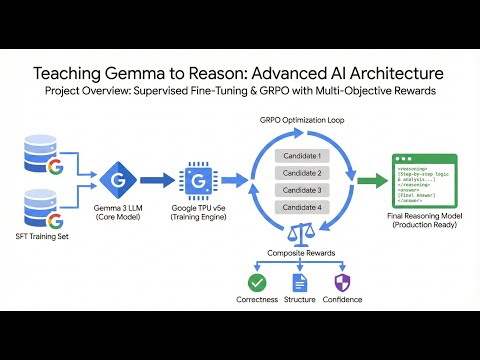
The pipeline follows a progressive refinement strategy, moving from supervised imitation to on-policy reinforcement learning.
graph TD
    A[Base Gemma Model] --> B[Stage 1: Supervised Fine-Tuning]
    B --> C[Format-Compliant SFT Checkpoint]
    C --> D[Stage 2: GRPO Reinforcement Learning]
    D --> E[Final Reasoning Model]

    subgraph Data Flow
        SFT_Data[CoT Examples] --> B
        Reward_Model[Composite Reward Function] --> D
    end

    subgraph Reward Components
        D --> R1[Correctness]
        D --> R2[Trace Structure]
        D --> R3[Confidence Penalty]
    end
The primary goal is to enforce a strict output schema that separates reasoning from the final answer.
<reasoning>
Step 1: Identify the problem components.
Step 2: Apply the relevant formula or logic.
Step 3: Calculate the result.
Therefore, the answer is derived.
</reasoning>
<answer>
The final concise result is placed here.
</answer>- Curriculum Learning: Training progresses through difficulty phases (easy → medium → hard)
- Difficulty-Aware Trace Scoring: Harder phases require more reasoning steps
- Reward Weight Annealing:
w_trace: 0.45→0.25,w_correct: 0.40→0.60 - Calibrated Confidence: Penalizes overconfident wrong answers
- Verbosity Penalty: Prevents rambling by limiting reasoning length
pip install git+https://github.com/google/tunix.git
pip install jax jaxlib flax optax transformers datasets- Open
notebooks/tunix-gemma-reasoning-submission.ipynbon Kaggle - Enable TPU v5e-8 accelerator
- Attach model:
google/gemma-3/transformers/gemma-3-1b-it - Run all cells (~70 seconds for demo, ~9 hours for full training)
The GRPO phase utilizes a multi-objective reward function with annealing:
| Component | Weight | Description |
|---|---|---|
| Correctness | 40%→60% | Verifies the final answer (annealed) |
| Trace Structure | 45%→25% | Evaluates logical flow (annealed) |
| Confidence | 15% | Calibrates model confidence |
| Verbosity | -5% | Penalizes excessive length |
| Config | Good+Reasoning | Correct NoTrace | Wrong+Trace |
|---|---|---|---|
| Correctness Only | 1.000 | 1.000 | 0.000 |
| + Trace Structure | 0.892 | 0.775 | 0.150 |
| + Confidence | 0.842 | 0.737 | 0.211 |
| Annealed (early) | 0.890 | 0.680 | 0.250 |
| Regime | Time | Purpose |
|---|---|---|
| Demo (this notebook) | ~70 seconds | Validate GRPO mechanics |
| Full training | ~7-9 hours | Production-grade results |
This implementation draws from several foundational papers:
- DeepSeek-R1: On the scaling of reasoning capabilities via RL
- RLVR: Reinforcement Learning from Verifiable Rewards
- Rubrics-as-Rewards: Providing structured feedback for open-ended traces
- Kaggle Notebook: tunix-gemma-reasoning-submission
- Tunix Library: github.com/google/tunix
- Writeup: submissions/kaggle_writeup.md
This project is released under the Apache 2.0 License.