


Read the preview (198 pages, 74.4 MB) · Download · Volumes · Cite · Verify · 中文
A hard problem is not attacked where it stands; a theory is raised around it until the problem becomes natural and gives way.
— Series Note
Arithmetic Spectral Descent — Obstruction Theory, Hodge–Krein Realization, and a Falsifiable Architecture for the Riemann Hypothesis — is a monograph in four volumes bound as one. It is the third work in the WiseMotif Monograph of Mathematical Intelligence and belongs to the Grothendieckian Programme as a self-contained system: one of the Programme's research subjects, a problem on which its method of recursive mathematical discovery is carried through in full. A proposed structure is tested; what survives is abstracted and the question is posed again, in the manner of Grothendieck's rising sea.
The problem is the Riemann Hypothesis, and the question is whether local arithmetic can descend to a spectral object that bears the zeros of the zeta function and controls where they lie.
The Riemann Hypothesis remains open. This work does not claim a proof of it, of the generalized Riemann hypotheses, or of any equivalent statement. It records a programme aimed at the conjecture, the tests to which that programme was subjected, the parts that failed, the theorems obtained from those failures, and the construction problems that remain once every failure has been accounted for.
| 4 volumes, bound as one |
10 · 60 parts · chapters |
1,549 pages |
23 scoped no-go theorems |
1 conditional theorem AHK-1–3 ⟹ RH |
2 open obligations, 10 falsification tests |
102 · 340 vector figures · references |
Almost every natural mechanism that one might use to locate the zeros either uses information that does not distinguish ζ from functions whose zeros lie off the line, or discards, at some step, exactly the information that would be needed at the line. A proof must keep that information from the first step to the last. The book is, before anything else, a study of where it is lost.
The title names the movement it examines. Spectral: the hope, from Hilbert and Pólya onward, that the zeros are the spectrum of an operator. Arithmetic: the operator must come from the arithmetic of ℤ, not be written down after the zeros are known. Descent: the passage from local to global — whether the local data descend to a single arithmetic object carrying the zeros as its spectrum, together with a form that controls where that spectrum can lie.
The single substantive choice of the book is the replacement of a positivity condition by an index condition. Definiteness proves too much (a positive polarization already forces the critical line and normality), it is incompatible with the pole, and it has margins where the problem has none: Rodgers and Tao proved Λ ≥ 0, so the Riemann Hypothesis is the equality Λ = 0. An index is an integer; it cannot be nearly right.
| The method | What the book does |
|---|---|
| Bar | proves, before any construction, where specified mechanisms lose the information needed at the critical line |
| Test | runs every mechanism on a firewall of four published counter-models: Davenport–Heilbronn, Beurling, Selberg, Epstein |
| Decompose | splits Weil's function-field proof into its actual inputs, so that each can be sought over ℤ separately |
| Audit | measures what the sphere spectrum, cyclotomic homology and prismatic cohomology supply, and what they do not |
| Reduce | proves the conditional chain from an index-one Hodge–Krein realization to the Riemann Hypothesis |
| Certify | separates certified finite computation from asymptotic claims; publishes the scripts and data |
| Pose | states the two remaining obligations precisely enough to be attacked, rejected or falsified |
Each volume asks one question and ends with something a reader can take away and use. The four volumes and the apparatus are bound as one book. Each cover below places its volume at the centre of the D₆ spectral honeycomb, with the formula its cell carries on the front cover of the book.
 I · Barrier Theory Parts I–II · 12 chapters · pp. 1–268 What specified proof mechanisms cannot do. Twenty-three scoped no-go theorems, a four-object firewall, and the Explicit-Formula Barrier Requirement identify the precise points at which specified proof mechanisms lose the information needed at the critical line — among them the corrected support-doubling threshold δ > ½. Contents · PDF |
 II · The Proof Architecture Parts III–V · 18 chapters · pp. 269–625 From the paradigm to a construction problem. The function-field proof is first decomposed into its actual geometric inputs; the sphere base, cyclotomic and prismatic structures, and the proposed adelic stack are then audited against that model, ending in a typed list of obligations AS0–AS6. Contents · PDF |
 III · Reductions of RH and GRH Parts VI–VIII · 18 chapters · pp. 626–970 Conditional chains and the equivalence audit. Positivity calibrated against the function-field case; the Amplification Invariance Theorem; the Krein Index Theorem and the Index-One Exhaustion Theorem, a complete derivation of RH from three realization hypotheses that are specified, audited — and not constructed. Contents · PDF |
 IV · The Remaining Obligations Parts IX–X · 12 chapters · pp. 971–1,213 Construction, certification, and falsification. Certified finite computations are separated from asymptotic claims, and the two remaining programme obligations are decomposed into attackable problems, decision gates, and falsification tests F1–F10. Contents · PDF |
 The Apparatus · Appendices A–J 10 appendices · glossary · indexes · pp. 1,214–1,476 What the argument needs but the chapters should not interrupt themselves to supply: prerequisites, the complete proof of the Krein Index Theorem, the full signature protocol and tables, the no-go compendium, errata, the status system, the algorithms ALG-01–ALG-26, the generalized hypotheses, Problem A2⋆, chronology, open problems, four indexes. Contents · PDF |
 The complete monograph Volumes I–IV · Appendices A–J · 1,549 pages The four volumes and the apparatus bound as one, around Theorem D, the Krein index bound #{Re λ > ½} ≤ min(n₊, n₋). Continuous pagination and bibliography, because the logical dependencies cross the internal divisions. PDF · Apparatus · 90.7 MB |
- Krein Index Theorem (Theorem D). If a nondegenerate Hermitian form G of inertia (n₊, n₋) and an operator Θ satisfy Θ*G + GΘ = G, then the number of eigenvalues of Θ with Re λ > ½, counted with algebraic multiplicity, is at most min(n₊, n₋).
- Index-One Exhaustion Theorem. With stable spectral exhaustion, centered duality and compatible negative index at most one, AHK-1 ∧ AHK-2 ∧ AHK-3 ⟹ RH — a proved conditional implication. The equivalence audit shows why the three hypotheses are not by themselves weaker than the conclusion: arithmetic content must enter through AHK-4 to AHK-6.
- Amplification Invariance Theorem. For Dirichlet series whose singular support contains k-fold sums of zeros, σ_c − Re(amplified singularity) = k(½ − δ) identically, independently of normalization: amplification alone gains nothing in the zero exponent.
- Support doubling, corrected. The counterfactual zero signal grows like e^{δS} while the absolute arithmetic envelope grows like S e^{S/2}, so the threshold is δ > ½, not the spurious δ > ¼ obtained by confusing supp g with supp(g ∗ g̃).
- Criticality. Since Rodgers–Tao proved Λ ≥ 0, a perturbation-stable strict positivity statement, a uniform spectral gap or a finite strict sum-of-squares certificate cannot by itself prove RH.
- The generalized hypotheses. For the extended Selberg class, AHK-1_L–AHK-3_L hold if and only if F has at most one nontrivial zero with Re ρ > ½; the residual gap is exactly the Landau–Siegel problem.
- Finite evidence, kept as such. Sixty-three pole-removed Guinand–Weil Gram matrices have exactly one measured negative direction in every configuration; the measurement is finite evidence and cannot be inserted into the conditional theorem.
It is a work of obstruction theory and of precise reduction: where specified proof mechanisms fail, a proved conditional chain, a certified computation stack, and two obligations stated precisely enough to be attacked, rejected or falsified — the Arithmetic Hodge–Krein Realization Problem and Problem A2⋆. Every claim carries its status where it is made: [T] theorem, [C] conditional, [O] open construction, [E] evidence, [N] proved impossibility within stated hypotheses, [K] known background.
It is not a proof of the Riemann Hypothesis. No system satisfying AHK-1 to AHK-3 is constructed in this work. The no-go theorems exclude specified classes of mechanisms, not all possible proofs. A failed test can end a branch of the programme; no number of passed finite tests can establish one.
The routes are those of How to read this book.
| You are | Start with |
|---|---|
| an analytic number theorist | Parts I, II, VII and VIII |
| a homotopy theorist | Parts III, IV and V |
| interested only in the positive line | Chapters 43–48 (and Appendix C, the complete proof of the Krein Index Theorem) |
| a referee | Chapters 1, 6, 48 and 60; Chapter 5 states what would falsify the book |
| concerned with certified computation | Chapters 12, 46 and 49–54, Appendix D and the numerics/ folder |
| after the open problems only | Parts VIII and X |
The preview contains the front matter — Series Note, Preface, Abstract, How to read this book, notation, the status-label key, the contents — and the whole of Part I.
This work is Series 03 of the WiseMotif Monograph of Mathematical Intelligence: a self-contained system and the first research subject of the Grothendieckian Programme. The first two works of the series are bound closely together. From the third work on, each is a self-contained system on one problem, on which the Programme's method of recursive mathematical discovery is carried through in full. The Programme as a whole is set out in Series 00, its overview, which stands before the seven works and is not one of them. The overview and the seven works, in series order:
 |
Series 00 · The Grothendieckian Programme Recursive Mathematical Discovery in the Age of Machine Reasoning The Programme's overview: it stands before the seven works and is not one of them; it sets out the idea of the Programme, its architecture and what the seven share, and adds no mathematical result to them. one book · 53 pages · doi:10.5281/zenodo.23669107 |
 |
Series 01 · GAI-MUA: The Grothendieckian Machine A Mathematical Universe Architecture for Verifiable and Self-Evolving Artificial Intelligence The central part of the Programme: how mathematical worlds are constructed, compared and carried from one setting to another, and how a machine may hold them as typed, versioned and verifiable objects. 6 volumes · 14,905 pages · doi:10.5281/zenodo.23480696 |
 |
Series 02 · GM-Omega-Infinity: Topos-Native Intelligence A Sheaf-Theoretic Architecture for Verifiable Machine Intelligence The meta-reasoning kernel: what an intelligence must be, internally, if it is to reason inside such worlds. 5 volumes · 4,020 pages · doi:10.5281/zenodo.23538544 |
 |
Series 03 · Arithmetic Spectral Descent — this work Obstruction Theory, Hodge–Krein Realization, and a Falsifiable Architecture for the Riemann Hypothesis Research subject 1: the Riemann Hypothesis. 4 volumes · 1,549 pages · doi:10.5281/zenodo.23564898 |
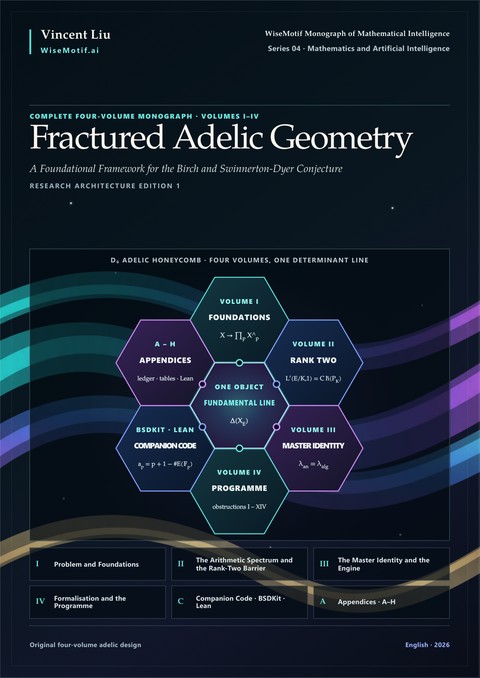 |
Series 04 · Fractured Adelic Geometry A Foundational Framework for the Birch and Swinnerton-Dyer Conjecture Research subject 2: the conjecture of Birch and Swinnerton-Dyer. 4 volumes · 571 pages · doi:10.5281/zenodo.23585887 |
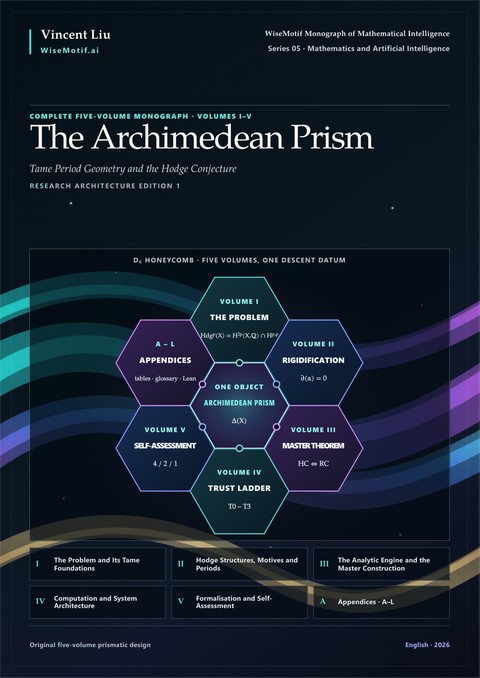 |
Series 05 · The Archimedean Prism Tame Period Geometry and the Hodge Conjecture Research subject 3: the Hodge Conjecture. 5 volumes · 1,309 pages · doi:10.5281/zenodo.23597954 |
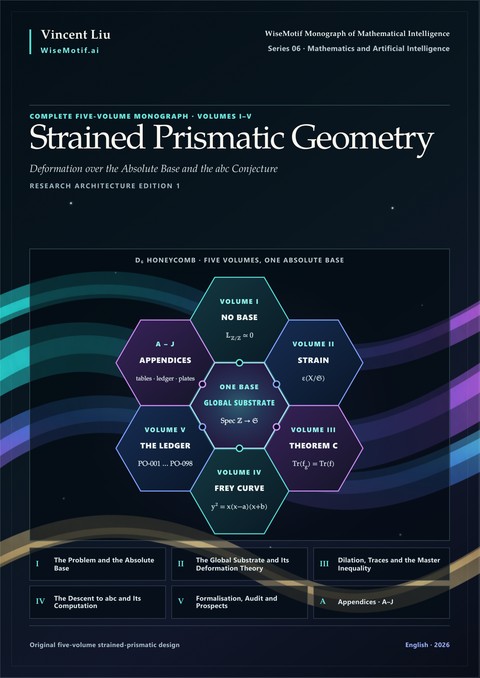 |
Series 06 · Strained Prismatic Geometry Deformation over the Absolute Base and the abc Conjecture Research subject 4: the abc conjecture. 5 volumes · 1,666 pages · doi:10.5281/zenodo.23610034 |
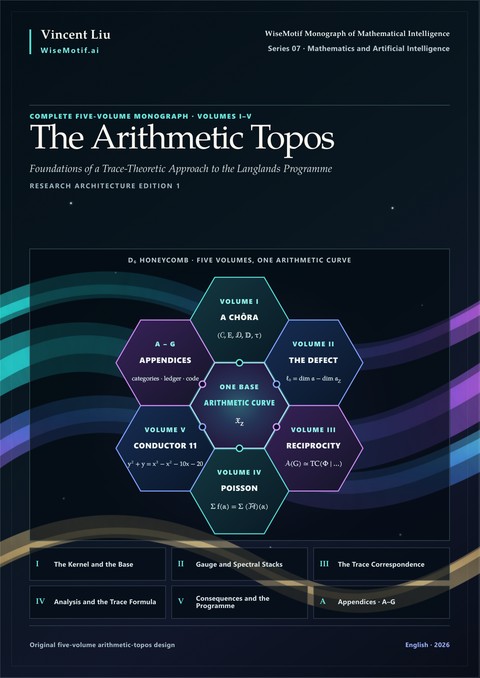 |
Series 07 · The Arithmetic Topos Foundations of a Trace-Theoretic Approach to the Langlands Programme Research subject 5: the Langlands programme. 5 volumes · 2,001 pages · doi:10.5281/zenodo.23629681 |
| File | Pages | Size |
|---|---|---|
| Complete monograph — Volumes I–IV and apparatus | 1,549 | 90.7 MB |
| Preview — front matter and Part I | 198 | 74.4 MB |
| Numerical scripts and data — every computation in the book, Apache-2.0 | — | 93.4 KB |
The same files, with identical checksums, are archived at Zenodo: doi:10.5281/zenodo.23564899.
Covers are 600 ppi full-bleed; all fonts are embedded; the PDFs are linearised for fast opening. The scripts and data
are also in numerics/, with a reproduction guide.
Liu, V. (2026). Arithmetic Spectral Descent — Obstruction Theory, Hodge–Krein Realization, and a Falsifiable Architecture for the Riemann Hypothesis (Research Architecture Edition 1, version 1.0.0). Zenodo. https://doi.org/10.5281/zenodo.23564898
@book{liu2026arithmeticspectraldescent,
  author    = {Liu, Vincent},
  title     = {Arithmetic Spectral Descent --- Obstruction Theory, {Hodge--Krein} Realization, and a Falsifiable Architecture for the {Riemann} Hypothesis},
  series    = {WiseMotif Monograph of Mathematical Intelligence, Series 03},
  edition   = {Research Architecture Edition 1},
  version   = {1.0.0},
  year      = {2026},
  publisher = {Zenodo},
  doi       = {10.5281/zenodo.23564898},
  url       = {https://doi.org/10.5281/zenodo.23564898}
}
GitHub's Cite this repository button uses CITATION.cff. The concept DOI 10.5281/zenodo.23564898 always resolves to the latest version; cite the version DOI 10.5281/zenodo.23564899 to refer to these exact files.
Every file of the release is listed in SHA256SUMS, signed with OpenPGP and timestamped twice (RFC 3161 and
OpenTimestamps on Bitcoin). The signing key is the same as for Series 01 and Series 02.
Signing key fingerprint: DA1A 1AEF D8B2 C17C FF3F 1D1B 3905 0F50 7A4F EC17
GitHub releases of this repository are immutable. Copies obtained elsewhere that do not match SHA256SUMS are not
authentic. Three levels of verification: VERIFY.md.
The work is licensed under CC BY-NC-ND 4.0: you may share it unchanged, with attribution, for
non-commercial purposes. Code listings and machine-readable schemas printed in the work, and the numerical scripts and
data in numerics/, are additionally available under the Apache License 2.0. Translations and other uses
require written permission. Details: NOTICE.md · Name use: TRADEMARKS.md.
Text and data mining rights are reserved under Article 4(3) of Directive (EU) 2019/790. Training or fine-tuning machine-learning models on the work is not permitted without written permission. Individual readers may use AI tools to read, search, explain or translate the work for their own study. Full policy: TDM-AND-AI-POLICY.md.
A programme that cannot fail is not a mathematical programme, and this one is written to make failure easy to report. Three kinds of contribution matter most:
- Refutation — a counterexample to a theorem, a mechanism the firewall should have caught, or a run of one of the falsification tests F1–F10 that cuts an edge of the dependency graph.
- Construction — progress on the Arithmetic Hodge–Krein Realization Problem or on Problem A2⋆; a construction satisfying AHK-1 and AHK-2 but not AHK-3 would already be progress.
- Reproduction — an independent run of the numerics, with interval arithmetic where the book reports floating point.
Report errors through an errata issue. Accepted corrections are acknowledged by name in the next edition (see ERRATA.md).
WiseMotif Monograph of Mathematical Intelligence · Series 03 · Mathematics and Artificial Intelligence
Series 00: The Grothendieckian Programme ·
Series 01: GAI-MUA: The Grothendieckian Machine ·
Series 02: GM-Omega-Infinity: Topos-Native Intelligence ·
Series 04: Fractured Adelic Geometry ·
Series 05: The Archimedean Prism ·
Series 06: Strained Prismatic Geometry ·
Series 07: The Arithmetic Topos
The official site of Grothendieck Lab and of the Grothendieckian Programme: grothendiecklab.com
© 2026 Vincent Liu