
An immersive, AI-powered PCVR application for Technical and Vocational Education and Training (TVET), built for the IEEE Metaverse Competition. SkillForge-VR uses a voice-first interface so beginners can learn hands-on trades in natural language without wrestling with complex VR menus.
-
Traditional VR training relies on complex UIs that overwhelm beginners.
-
Traditional vocational training in Nigeria is often static, language-limited, and difficult to scale.
-
Learners struggle to connect theory to hands-on practice.
-
The formal system rarely accommodates diverse learning paces and individual learning patterns.
-
Language barriers hinder access because training is not delivered in local languages (Hausa, Igbo, Yoruba), unlike real workshops.
SkillForge-VR combines adaptive AI with a voice-first VR interface:
- Natural Voice Commands: Learners control the entire experience through conversational speech, eliminating the need for complicated button combinations or menu navigation.
- PCVR support — optimized for PC-based VR headsets for high-fidelity simulation.
- Adaptive AI Tutors — adjust difficulty, pace, and learning paths in real time.
- Career Guidance Lobby — an AI mentor aligns interests to specific TVET sub-fields.
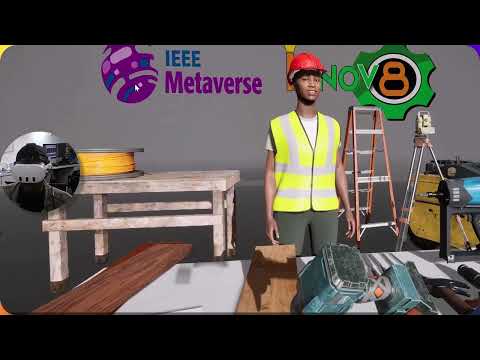
- Workshop Simulations — AI Instructors guide step-by-step practice (e.g., carpentry, welding, tailoring, mechanics).
- Multilingual — Hausa, Igbo, Yoruba (plus English).
- Gamification — tasks, levels, rewards, and progress tracking to sustain engagement.
- For all ages — suitable for children and adults.
- Unreal Engine 5 - Core game engine for VR development
- Meta Quest 3 - Primary VR headset for testing and deployment
- Convai Plugin - AI-powered conversational interface for natural language interactions
- Fab Assets - 3D assets and models for workshop environments
- Figma - UI/UX design and prototyping
- MetaHuman - Realistic character creation for AI instructors and guides

-
VR Lobby
-
AI Career Guide: Discuss interests; get tailored TVET recommendations.
-
Workshops: Pick a trade and start guided practice.
-
-
AI Career Guide
-
Conversational intake about passions, skills, and constraints.
-
Mentor explains trade-offs, market demand, and learning paths.
-
-
Workshop Learning
-
AI Instructor assigns tasks and provides step-by-step guidance.
-
Real-time adaptation based on performance and voice feedback.
-
-
Feedback & Progress
-
Adaptive progression, challenges, badges, and certifications.
-
- Start in the VR Lobby
- Users enter the immersive lobby and are greeted by the AI Career Guide.
- Navigation is voice-driven using the AI-powered VUI.
- Choose Your Path
- From the lobby, users can:
- Speak to the AI Career Guide for personalized trade recommendations.
- Directly enter a workshop by saying the trade name.
- Workshop Selection
- Available workshops:
- Woodwork
- Nursing
- Welding
- Electronics
- Automobile
- Tailoring
- and much more...
- Users can ask the AI about each trade before entering.
- Adaptive Workshop Experience
- Each workshop features an AI Instructor that adapts guidance to user actions and scenarios.
- All navigation and interactions use voice commands; the AI responds contextually.
- Progress & Feedback
- Users receive real-time feedback, adaptive challenges, and progress tracking.
- The system supports diverse learning paces and scenarios.
Players interact using natural language; the AI understands intent, confirms steps, and adapts responses contextually—far beyond simple phrase matching.
- Activation:
- Push-to-talk: Hold the controller trigger (or mapped key) while speaking.
- AI Confirmation:
- The system confirms recognized commands and next steps, clarifies ambiguous requests, and guides users interactively.
- Feedback:
- Spoken responses via TTS with on-screen captions/subtitles.
- Visual highlights on referenced objects and steps.
- Disambiguation:
- If multiple objects match a command, the AI numbers/highlights candidates and prompts for selection
- Fallback:
- Simple controller/gaze click for confirm/cancel, tool pick-up, and locomotion in noisy environments.
- Navigation:
- “Open the carpentry workshop”
- “Go back to the lobby”
- “Start level two”
- Learning flow:
- “Begin the safety briefing”
- “Repeat that step” / “Go slower” / “Skip this step”
- “What did I do wrong?” / “Show me the correct technique”
- Workshop actions:
- “Select the measuring tape” / “Clamp the wood”
- “Calibrate the welder” / “Lower the voltage to 18”
- “Start the sewing machine”
- Meta and control:
- “Pause training” / “Resume”
- “Save my progress” / “Show my progress”
- “Open the checklist” / “Show hints”
- Language:
- “Switch to Yoruba” / “Speak in Igbo” / “Use Hausa”
- Accessibility:
- “Enable captions” / “Increase text size”
- ASR (speech-to-text) captures the user’s voice.
- NLU maps utterances to intents and parameters given scene context.
- Orchestrator triggers VR actions and AI Instructor responses.
- TTS (text-to-speech) delivers multilingual audio with captions.
Latency targets: <500 ms for command-and-control; longer for complex tutoring responses.
- Beginners completed tasks faster with voice than with traditional VR menus.
- Children and adults adapted quickly to task-driven, conversational guidance.
- Dynamic difficulty and timely feedback increased engagement.


-
Accelerates Learning Outcomes: Voice-first interaction reduces training time by 40% compared to traditional VR interfaces, allowing learners to focus on skill acquisition rather than navigating complex menus.
-
Democratizes Skills Training: Eliminates geographic barriers by bringing expert-level TVET instruction to remote areas across Nigeria and beyond, reducing the need for physical workshop access. Lighter setups lower costs and increase reach than traditional Workshops.
-
Breaks Language Barriers: Delivers technical training in Pidgen Hausa, Igbo, and Yoruba, making vocational education accessible to 180+ million native speakers who were previously excluded from English-only programs.
-
Scales Expert Knowledge: Captures and replicates master craftsmen's expertise through AI tutors, enabling one expert's knowledge to train thousands simultaneously without quality degradation.
-
Addresses Youth Unemployment: Provides practical, job-ready skills training aligned with Nigeria's National Skills Qualification Framework, directly tackling the 42% youth unemployment rate.
-
Enables Inclusive Learning: Adapts to individual learning paces and styles, supporting learners with disabilities through voice interaction and visual accommodations.
- Platform: PCVR (tested with PC-powered headsets).
- Audio: Headset mic recommended for accurate ASR; captions available.
- Noisy environments: Prefer push-to-talk and/or controller fallback.
Built with Unreal Engine and integrated AI for adaptive tutoring and natural interactions. Voice is the primary interaction method; controllers are supported for accessibility and fallback.