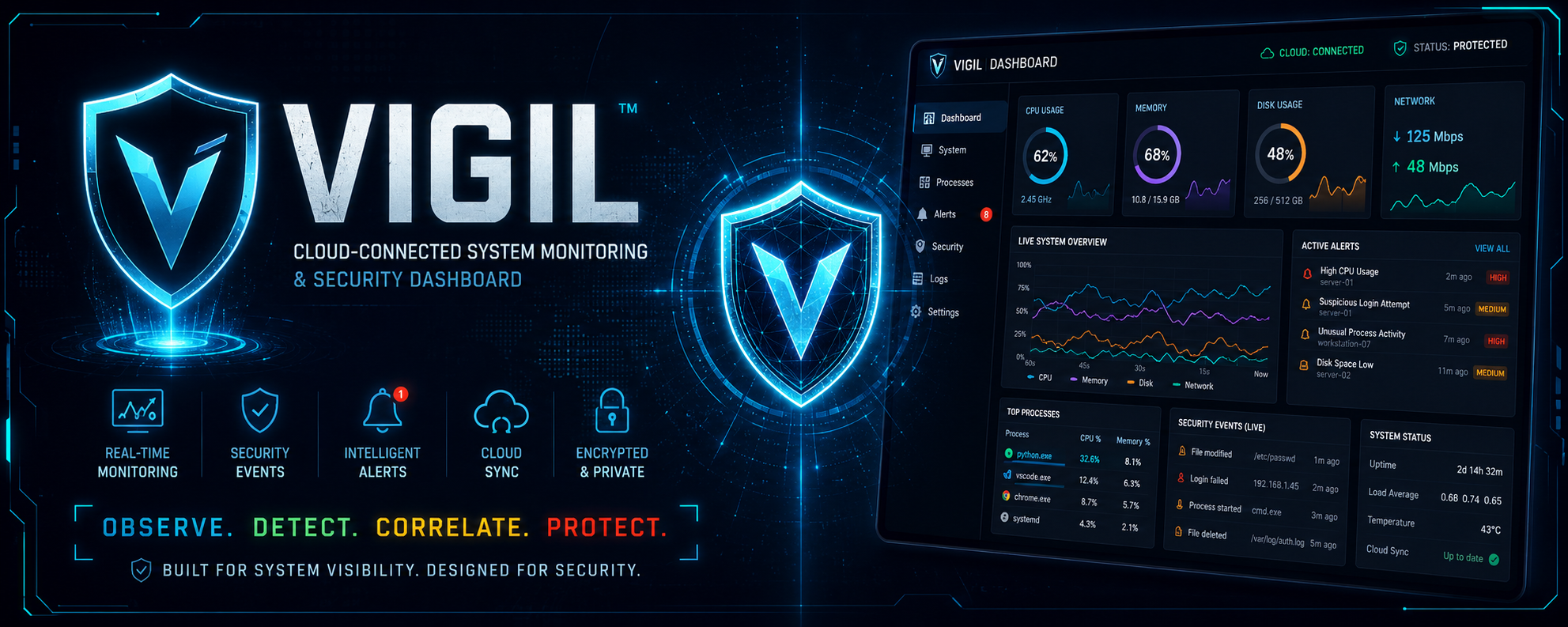
A real-time desktop monitoring platform for system performance, security events, intelligent alerting, and cloud synchronization.





VIGIL is a desktop-based system monitoring and security observability platform designed to provide real-time visibility into machine health, performance, security activity, and operational alerts.
It continuously collects system telemetry such as:
- CPU utilization
- Memory utilization
- Disk activity and storage usage
- Network traffic
- Running processes
- System uptime
- Load averages
- File-system activity
- Authentication-related events
- Process activity
VIGIL combines this information with an alert management and correlation engine, allowing multiple events to be analyzed and consolidated into meaningful alerts instead of simply displaying raw telemetry.
The platform also supports encrypted cloud synchronization through Supabase, allowing monitoring data and alerts to be synchronized beyond the local machine while maintaining configurable privacy controls and an offline synchronization queue.
Monitor the health and performance of the machine in real time.
- CPU utilization
- Per-core CPU information
- RAM usage
- Disk usage
- Disk read/write activity
- Network upload/download activity
- Running process information
- Process CPU and memory consumption
- System uptime
- Load averages
- Historical metric tracking
VIGIL provides security-oriented event monitoring in addition to traditional performance monitoring.
Supported monitoring includes:
- File-system activity
- Authentication events
- Process activity
- Security event logging
- Event severity classification
- Event searching
- Recent event history
- Security-event statistics
Security events can automatically flow into the alert management system.
VIGIL includes a dedicated alert-management subsystem instead of treating every threshold violation as an independent notification.
Alerts support:
| Capability | Description |
|---|---|
| Severity | INFO, LOW, MEDIUM, HIGH, CRITICAL |
| Categories | Performance, Security, System, Correlation |
| Status | New, Acknowledged, Resolved, Suppressed |
| Deduplication | Detects duplicate alerts |
| Suppression | Suppresses matching alert conditions |
| Escalation | Escalates important unresolved alerts |
| Correlation | Combines related events |
| Acknowledgement | Allows operators to acknowledge alerts |
| Resolution | Tracks resolved alerts |
| History | Maintains alert history and statistics |
Rather than overwhelming the operator with individual events, VIGIL can correlate related alerts and generate higher-level correlated alerts.
This is particularly useful when multiple symptoms originate from the same underlying condition.
For example:
High CPU
   ↓
Process consuming excessive resources
   ↓
System performance degradation
   ↓
Related alerts correlated
   ↓
Single meaningful incident
VIGIL integrates with Supabase/PostgreSQL for cloud-based data synchronization.
Cloud synchronization supports:
- Machine registration
- System metrics
- Security events
- Alerts
- Offline synchronization queue
- Batch synchronization
- Sync status tracking
- Sync history
- Machine health/status information
- Configurable privacy levels
If the cloud connection is temporarily unavailable, data can remain queued locally and synchronized later.
Sensitive information can be protected before being synchronized to the cloud.
VIGIL includes:
- Encryption support
- Configurable privacy levels
- Sensitive-data filtering
- Data hashing
- Environment-based secret management
- Local/cloud separation
- Configurable data retention
Secrets such as Supabase credentials are intended to be supplied through environment variables rather than committed directly to source control.
The desktop dashboard provides visual representations of system activity.
Live graphs can display:
- CPU usage
- Memory usage
- Disk activity
- Network activity
- Historical system metrics
Graphs dynamically update as new monitoring data is collected.
The project includes an export subsystem for working with collected monitoring information and generating data suitable for further analysis.
The project also includes Pandas-based data processing support.
VIGIL follows a modular architecture separating monitoring, security, alert processing, synchronization, configuration, and presentation.
┌─────────────────────────────────────────────┐
│              VIGIL Desktop UI               │
│                                             │
│  Dashboard │ Graphs │ Processes │ Alerts   │
└──────────────────────┬──────────────────────┘
                       │
                       ▼
┌─────────────────────────────────────────────┐
│             Core Monitoring Layer           │
│                                             │
│  SystemMonitor                              │
│  SecurityLogger                             │
│  AlertManager                               │
│  Correlation Engine                         │
└──────────────────────┬──────────────────────┘
                       │
              ┌────────┴────────┐
              ▼                 ▼
┌─────────────────────┐  ┌───────────────────┐
│ Local Data / Queue  │  │ Security & Crypto │
│                     │  │                   │
│ SQLite / Local DB   │  │ Encryption        │
│ Sync Queue          │  │ Privacy Filtering │
└──────────┬──────────┘  └───────────────────┘
           │
           ▼
┌─────────────────────────────────────────────┐
│              CloudSync Layer                │
│                                             │
│        Supabase PostgreSQL Backend          │
└─────────────────────────────────────────────┘
main.py
   │
   ├── ConfigManager
   │
   ├── SystemMonitor
   │      ├── CPU
   │      ├── Memory
   │      ├── Disk
   │      ├── Network
   │      └── Processes
   │
   ├── SecurityLogger
   │      ├── File Monitoring
   │      ├── Authentication Monitoring
   │      └── Process Monitoring
   │
   ├── AlertManager
   │      ├── Deduplication
   │      ├── Suppression
   │      ├── Escalation
   │      └── Correlation
   │
   ├── CloudSync
   │      ├── Privacy Filtering
   │      ├── Encryption
   │      ├── Offline Queue
   │      └── Supabase Synchronization
   │
   └── VigilDashboard
          ├── Metrics
          ├── Graphs
          ├── Processes
          └── Alerts
- Python 3.10+
- PySimpleGUI — Desktop user interface
- PyYAML — Configuration management
- psutil — System and process monitoring
- watchdog — File-system monitoring
- Pandas — Data processing and export
- Matplotlib — Live monitoring graphs
- Supabase
- PostgreSQL
- aiohttp — Asynchronous HTTP communication
- cryptography — Encryption
- python-dotenv — Secure environment configuration
- pytest
- pytest-asyncio
- Black
- Pylint
- MyPy
- pre-commit
vigil/
│
├── main.py
├── config.yaml
├── requirements.txt
├── .env.template
│
├── src/
│   │
│   ├── core/
│   │   ├── alert_manager.py
│   │   ├── cloud_sync.py
│   │   ├── config_manager.py
│   │   ├── correlation_engine.py
│   │   ├── encryption.py
│   │   ├── export_manager.py
│   │   ├── security_logger.py
│   │   ├── supabase_client.py
│   │   └── system_monitor.py
│   │
│   ├── ui/
│   │   ├── dashboard.py
│   │   ├── themes.py
│   │   └── components/
│   │
│   ├── utils/
│   │   ├── diagnostic.py
│   │   ├── encryption.py
│   │   ├── helpers.py
│   │   └── logging.py
│   │
│   └── config/
│       └── default_config.yaml
│
├── scripts/
│   ├── install.sh
│   ├── setup_supabase.py
│   ├── diagnose.sh
│   └── vigil.service
│
├── tests/
│   ├── test_integration.py
│   ├── test_unit_system_monitor.py
│   ├── test_unit_supabase_client.py
│   ├── test_system_monitor_basic.py
│   └── diagnostic.py
│
└── assets/
git clone https://github.com/your-username/vigil.git
cd vigilpython -m venv venvActivate it:
Linux / macOS
source venv/bin/activateWindows
venv\Scripts\activatepip install -r requirements.txtCreate your environment file from the provided template:
cp .env.template .envThen configure your Supabase credentials:
SUPABASE_URL=https://your-project.supabase.co
SUPABASE_SERVICE_KEY=your-service-role-key

MACHINE_NAME=
ENCRYPTION_KEY=

LOG_LEVEL=INFO
DATA_RETENTION_DAYS=30| Variable | Purpose |
|---|---|
SUPABASE_URL |
Supabase project URL |
SUPABASE_SERVICE_KEY |
Supabase service-role/API credential |
MACHINE_NAME |
Custom machine identifier |
ENCRYPTION_KEY |
Encryption key |
LOG_LEVEL |
Application logging level |
DATA_RETENTION_DAYS |
Metric retention period |
Important: Never commit
.envor production Supabase credentials to GitHub.
The repository contains the database schema required by VIGIL:
src/core/supabase_schema.sql
The schema provides tables for:
machines
    │
    ├── system_metrics
    │
    ├── security_events
    │
    └── alerts

sync_queue
It also includes:
- Indexes
- Row-Level Security policies
- Database functions
- Update triggers
- Machine-status helpers
- Metric cleanup functionality
- Latest-metric views
Run the schema in your Supabase PostgreSQL SQL editor before enabling cloud synchronization.
Start the application with:
python main.pyThe application initializes:
Configuration
      ↓
Alert Manager
      ↓
System Monitor
      ↓
Security Logger
      ↓
Cloud Sync
      ↓
Desktop Dashboard
Once running, VIGIL begins collecting system telemetry and monitoring configured security events.
Run the complete test suite using:
pytestRun a specific test:
pytest tests/test_unit_system_monitor.pyIntegration tests:
pytest tests/test_integration.pyThe repository also contains diagnostic utilities for troubleshooting installation and runtime issues.
For Linux environments, the project provides:
./scripts/diagnose.shInstallation helper:
./scripts/install.shA systemd service definition is also included:
scripts/vigil.service
This allows VIGIL to be configured as a background Linux service.
VIGIL's monitoring pipeline can be summarized as:
Operating System
       │
       ▼
   psutil / watchdog
       │
       ▼
 SystemMonitor ───────────────┐
       │                      │
       │                      ▼
       │                CloudSync Queue
       │                      │
       ▼                      │
 AlertManager                 │
       │                      │
       ├── Deduplication      │
       ├── Suppression        │
       ├── Escalation         │
       └── Correlation        │
       │                      │
       ▼                      │
 SecurityLogger ──────────────┤
       │                      │
       ▼                      ▼
   Dashboard             Supabase
                              │
                              ▼
                         PostgreSQL
VIGIL is designed around several security principles:
Credentials are loaded from environment variables rather than hard-coded configuration.
Sensitive information can be encrypted before cloud synchronization.
Cloud synchronization supports configurable privacy levels to determine what information should be synchronized.
Security events can contain hashes that help verify data integrity.
The Supabase schema enables PostgreSQL Row-Level Security policies for application tables.
The primary cloud data model contains:
Stores registered monitoring machines and their current status.
Stores CPU, memory, disk, network, process, and load information.
Stores security-related events such as file, authentication, and process activity.
Stores generated and correlated alerts with severity and lifecycle state.
Provides reliable synchronization when cloud connectivity is unavailable.
VIGIL was designed around five primary goals:
1. Visibility
Provide a single interface for understanding system health and security activity.
2. Responsiveness
Collect and display live telemetry without blocking the user interface.
3. Reliability
Continue collecting information even when cloud connectivity is unavailable.
4. Security
Protect sensitive monitoring information through encryption and privacy controls.
5. Extensibility
Maintain a modular architecture so additional monitors, alert types, data sources, and cloud integrations can be added independently.
The project separates responsibilities into independent modules:
Core
 ├── Monitoring
 ├── Security
 ├── Alerting
 ├── Correlation
 ├── Synchronization
 ├── Encryption
 └── Configuration

UI
 ├── Dashboard
 ├── Themes
 └── Components

Utils
 ├── Logging
 ├── Diagnostics
 ├── Helpers
 └── Encryption
This separation makes the project easier to test, maintain, and extend.
Potential areas for future development include:
- Multi-machine centralized monitoring
- Web-based management dashboard
- Advanced anomaly detection
- Machine-learning-based threat detection
- More security event sources
- Role-based access control
- Real-time cloud notifications
- Email/Slack/Discord alert integrations
- Advanced incident timelines
- Container and server monitoring
- Expanded Windows/macOS security telemetry
- More granular Supabase authorization policies
VIGIL is intended for legitimate system monitoring, security observability, administration, and educational purposes.
Only monitor systems and data that you own or have explicit authorization to monitor.
Because system and security monitoring capabilities vary across operating systems, some monitoring features may behave differently depending on platform permissions and available system APIs.
This project is licensed under the MIT License.
See the LICENSE file for details.
Muhammad Abdullah
Computer Science Student & Full-Stack AI Developer
Interested in:
- Artificial Intelligence
- Cybersecurity
- Systems Programming
- Full-Stack Development
- Software Engineering
- Intelligent Monitoring Systems