Hey Drone enthusiasts!! If you are a beginner in dronetech then it is the ultimate guide to start your drone journey. So ladies and gentlemen, welcome aboard Drone 101. Please tighten your seat belts and get ready for takeoff as we embark on an exciting journey into the world of drones. 🚀
An unmanned aerial vehicle (UAV), commonly known as a drone, is an aircraft without any human pilot, crew, or passengers on board.Drones, or Unmanned Aerial Vehicles (UAVs), offer significant benefits across various industries by providing unique aerial perspectives for photography and videography, precise mapping and surveying capabilities, and efficient agricultural monitoring. They enhance safety and efficiency in inspection and maintenance of hard-to-reach infrastructure, support disaster management and search and rescue operations, and facilitate environmental monitoring and scientific research. Additionally, drones streamline delivery services, assist in law enforcement and security, and provide new entertainment and recreational opportunities. Their cost-effectiveness, speed, and precision make them invaluable tools for improving productivity and achieving tasks that were previously difficult or impossible. Basically, a drone is a flying robot which can be under remote control or fly autonomously via software-controlled flight plans in its embedded systems, working in collaboration with onboard sensors and GPS.

Basically, there are two main types of drone platforms: rotor and fixed-wing. In particular, rotor type is then divided into single-rotor or multi-rotor such as tricopters, quadcopters, hexacopters, and octocopters. While, on the other hand, the fixed-wing genre includes the hybrid vertical takeoff and landing drones that don’t call for runways. for more details check out Everything you need to know about drones
As we know it, every UAV need some kind of device to convert engine power to usable form term thrust. With few exceptions nearly all of the early practical UAV designs used propellers to create a necessary thrust.
A propeller normally consists of two or more blades attached to a central hub which ts mounted on a brushless DC motor or engine crankshaft. The purpose of the propeller is to convert rotation power to useful thrust. The blades, which are actually rotating wings have a leading edge, traillng edge, tip, shank, face and back as shown in Figures. The fixed-pitch propeller is the most Widely used propeller design in aviation. A fixed-pitch propeller may be made of wood, aluminum, or steel and is considered to be of one-piece construction with a blade angle that cannot normally be changed.

For advance info about propellers check out Aircraft propellers and controls
A drone frame is the structural chassis or body of the drone that supports and holds all its components together, including the motors, propellers, flight controller, battery, and payload. The frame is typically made from materials like carbon fiber, aluminum, plastic, or composite materials, chosen for their strength, durability, and lightweight properties.
- Structural Integrity: The frame provides the necessary strength and rigidity to withstand the forces and stresses experienced during flight, including impacts and vibrations. A well-designed frame ensures the drone remains stable and intact.
- Weight Management: The frame’s material and design significantly influence the drone’s overall weight. A lightweight yet strong frame is essential for optimizing flight performance, increasing flight time, and enhancing maneuverability.
- Component Support and Protection: The frame securely holds all the drone’s components in place, ensuring they function correctly. It also provides protection to sensitive parts like the flight controller, cameras, and sensors from damage during crashes or rough landings.
- Aerodynamics: The frame design affects the drone’s aerodynamics, impacting its efficiency, stability, and speed. A streamlined frame reduces air resistance, allowing for smoother and more efficient flight.
- Customization and Modularity: Many drone frames are designed to be modular, allowing for easy customization and upgrades. This flexibility enables users to add or replace components, such as different types of cameras, sensors, or payloads, to suit specific applications.
- Durability and Longevity: A high-quality frame made from durable materials can extend the drone’s lifespan by withstanding wear and tear. This durability is crucial for drones used in demanding environments or for professional purposes.
- Safety:
A robust frame contributes to the overall safety of the drone by ensuring that critical components remain protected during operation. It also helps prevent parts from coming loose or getting damaged, which could lead to malfunctions or accidents.


Lipo Battery, its full name is lithium polymer battery, people also called Li-po battery, or more correctly lithium-ion polymer battery (abbreviated as LiPo, LIP, Li-poly and others). Lipo is a rechargeable battery of lithium-ion technology using a polymer electrolyte instead of a liquid one. High conductivity semisolid polymers form this electrolyte. These lipo batteries provide a higher specific energy than other lithium battery types.
LiPo batteries offer a wide array of benefits. But each user must decide if the benefits outweigh the drawbacks. For more and more people, they do. In my personal opinion, there is nothing to fear from LiPo batteries, so long as you follow the rules and treat the batteries with the respect they deserve.
We can see there are some Parameters on this Lipo battery, they are Battery Capacity, Battery Voltage, Cell Configuration and Discharge Rate.

- Discharge Rating: The Discharge Rating of a battery is a measure of the maximum rate at which current can be drawn from the battery. Although motors have a rated average current draw rate, there may be certain instances where this its draw rate can spike, such as when it is moving at maximum speed or when it is lifting a heavy payload. A battery’s discharge rating is typically expressed as a multiple of its capacity. For example, a battery with a discharge rating of 50C can safely supply a current draw that is 50 times its capacity. For a 5000mAh battery, current can be safely drawn up to 250A. Beyond this draw rate, the battery runs the risk of suffering permanent damage. Modern LiPo batteries usually have two discharge ratings: the Continuous Rating (or C Rating) and the Burst Rating. The C Rating, as its name implies, applies to a continuous current draw and is always lower than the Burst Rating. On the other hand, the Burst Rating is only acceptable for 10-second bursts of extra-heavy motor operations. To check if your battery’s discharge rating is compatible with the current draw of your motor, you will need to check the motor’s rated maximum continuous draw and its burst draw. It is generally recommended to select a battery that has ratings a little higher than the requirements of your motor. You don’t have to go overboard, though – a 10% to 20% “over-rating” should suffice so that you don’t end up buying an unnecessarily powerful and expensive battery.
- Cell Configuration: A battery is constructed from rectangular cells which are connected together to form the battery. A cell which can be considered a battery in itself, holds a nominal voltage of 3.7V. By connecting more of these in series, the voltage can increase to 22.2v for a 6 cell battery, 14.8V for a 4 cell battery and so on. By connecting more batteries in parallel the capacity can be increased. Often you will see numbers like 3S2P, which mean the battery as 4 cells (4S) connected in series, and there are 2 cell sets connected in parallel (2P) , giving a total number of 6 individual sells in the battery. So the number of cells is what defines the voltage of the battery. Having a higher voltage means the battery can provide more power to drive bigger motors, however more power does not necessarily mean the battery will provide energy for longer, that is defined by the battery capacity.
- Battery Voltage: A LiPo cell has a nominal voltage of 3.7V, and a lipo cell = 1 cell = 1S = 3.7V. For the 14.8V battery above, that means that there are four cells in series (which means the voltage gets added together). This is sometimes why you will hear people talk about a “4S” battery pack – it means that there are 4 cells in Series. So a four-cell (4S) pack is 14.8V, a three-cell (3S) pack is 11.1V, and so on. The voltage of a Lipo battery pack is essentially going to determine how fast your vehicle is going to go. Voltage directly influences the RPM of the electric motor (brushless motors are rated by kV, which means ‘RPM per Volt’). So if you have a brushless motor with a rating of 3,500kV, that motor will spin 3,500 RPM for every volt you apply to it. On a 2S LiPo battery, that motor will spin around 25,900 RPM.
- Battery Capacity: The capacity of a battery, typically expressed in milli-ampere hours (mAh), is a measure of how much charge the battery can hold. The mAh rating of a battery describes how much load it will take to completely discharge a battery in an hour. This can be easily correlated to the rated current draw of a motor to estimate just how long the battery can power the motor before it needs to be recharged. Generally, capacity can determines how long you can run before you have to recharge. A larger capacity pack may give you longer flight times but being heavier it will adversely affect performance. But it`s also influenced by the speed, the more quick you can flying your plane, the less time your flight time is. Because high speed means you need more power to drive your plane or others, so your power lost quickly.
Tip One rather strange yet interesting fact about Lithium Polymer Battery is that they should not be stored fully charged because they might get damaged that way. It is optimal that the cells are maintained at room temperature and charged a bit at every run. In previous times, people used to charge the batteries till they were fully charged and then used it till their last bit and then again fully charged them. from the above explaination and from our experience, these are the things you should note
- Capacity: 2200mAh = 2.2 Ah
- 3S means 3 cells
- Minimum safe voltage per cell = 3.5V (min charge)
- Maximum safe voltage per cell = 4.2V (max charge)
- Storage voltage per cell = 3.8V (half charge)
- Always charge batteries at their 1C charging rate. (It will take about 1 hr to charge.) eg. 1C for 2200mAh=2.2Ah battery will be 2.2 A.
- Always balance charge batteries using balance charge feature of charger.
- Never leave batteries out of your sight while charging or discharging and immediately disconnect them when charging or discharging is completed otherwise batteries will swell.
- Always charge batteries away from flammable materials.
- Never leave batteries fully charged or discharged for more than 24 hrs as it will destroy the batteries.
- Always fully charge the batteries only 1 night before use.
- Always charge or discharge the batteries to their storage voltage when not to be used for more than 24 hrs.
- Use storage charge feature of charger for point (12).
- Never leave battery connected to the ESC when not using even for a few minutes as it will discharge quickly.
- Always connect both balance lead and main lead to the charger before performing any operation.
- Keep checking battery voltage during use to prevent over discharging.
- Reverse polarity connection with the ESC will immediately burn it.
A brushless DC motor (also known as a BLDC motor or BL motor) is an electronically commuted DC motor which does not have brushes. The controller provides pulses of current to the motor windings which control the speed and torque of the synchronous motor. In reality, all the most recent drones utilize a brushless electric “out-runner” genre, making it one of the essential components of a drone. This is more reliable, more efficient, and quieter compared to a brushed motor. Motor with higher efficiency not only saves battery life but also gives the operator more flying time. It uses an electronic controller to switch DC currents to the motor windings producing magnetic fields that effectively rotate in space and which the permanent magnet rotor follows. For working principle of BLDC motor check out BLDC
Understanding BLDC motor specifications
Brushless motors use a standard numbering scheme to describe their physical size and Kv rating. For example: let's assume we have a 5055-3000Kv Brushless Outrunner Motor. We break the numbers out as follows: [50] [55] - [3000]
- [50] The first two numbers represent the diameter of the motor's housing in millimeters; in this example 50mm
- [55] The second two numbers represent the length of the motor housing in millimeters; in this example 55mm
- [3000] The numbers after the dash represent the Kv rating of the motor; in this example 3000Kv. The Kv rating (not to be confused with kilo-volt) is the RPM of the motor (k) per volt (V) with no load. For example, a brushless motor with a Kv rating of 3000 powered by a 12V power source would be capable of 36,000 RPMs (multiply 3000x12). This is the max RPMs that this motor can reach under no load. A motor with a higher Kv will have more top end speed, but not as much acceleration/torque. A motor with a lower Kv will not be as fast, but will accelerate faster and have more torque.
Note:
- The ideal number of rpm of a motor for you is dependent on what type of copter you’re looking for. For example, if you’re looking for a high performance, acrobatic copter, a high rpm motor is the one for you, meaning of course a high Kv rating. This is intuitive because these acrobatic copters are generally of the smaller variety, meaning a smaller motor, leading to smaller propellers. When you have these smaller propellers, the motors need to produce more rpm in order to produce the necessary thrust. However, this means that these motors use up more power than others, and so are less efficient.
- On the other hand, if you would like your copter to use the least amount of power as possible, and so last longer and be more stable, then motors with lower rpm are ideal. An example for when these types of motors would be useful is in taking aerial photos. Again, this is partly due to the fact that the type of copters used for this these tasks are bigger in order to carry the necessary equipment, meaning larger propellers, which will create more thrust when rotated. They therefore require fewer rpm.
for more info check outBrushless motors - how they work and what the numbers mean
for eg check out this emax mt2213-935Kv

The electronic speed controller (ESC) is an essential part of an electric propulsion system’s hardware. It acts like the brain of the system by telling the motor how fast to go based on data signals it receives from the throttle controller.For smaller applications like drones and RC vehicles, this controller has the name ‘ESC’, whereas for larger manufacturing applications it may be called an electronic control unit, inverter, or motor controller. Also, it plays a role in converting DC battery power into 3-phase AC for running brushless motors.
The mechanism within the ESC as well as its interaction with the battery and motor are quite fascinating.(you can check out this article The good-quality ESC gives a reliable and smooth flight experience. Several factors are considered while selecting the ESC, and they are as follows:
- Current Rating
- Input Voltage Rating
- Weight and Size
- ESC Firmware
- BEC
- Connection of ESC
- ESC processors
- ESC Protocols
The first thing to consider when selecting an ESC is the current rating (ampere rating). Motors draw current when they spin; if you draw more current than your Electronics Speed Controller's capacity, then it will start to overheat and eventually damage. You should decide on the current rating of the ESC after selecting a suitable motor size for your requirements. Mostly 3 things can increase the current draw of your esc:
- High KV ratings of the motor
- Larger propellers (length and pitch)
- Larger motor size (stator width and height) There are two current ratings of ESC, and they are continuous and burst. The continuous current rating indicates the maximum continuous current that ESC can handle safely. The burst rating means the maximum current that the ESC can handle for a short period (e.g., 10 seconds) without damaging the ESC itself.
The voltage rating of an ESC is the maximum amount of voltage that your ESC can handle safely. Some of the ESCs support 3S–4S battery voltage, while others can support 6S battery voltage. Here, make sure that they are compatible with the LiPo battery voltage. Powering your ESC with excessively high voltage will damage your ESC as well as the motor.
The weight and size of an ESC are dependent on its current rating. It is challenging to make ESCs lighter and smaller without losing their performance and effective cooling. Mostly, single standalone ESCs are designed with a weight of around 4 grams to 6 grams, and the 4-in-1 ESC weighs around 12 grams to 15 grams. Generally, the lighter ESCs have lower heat dissipation, which leads to concerns about overheating.
ESC firmware is the software that is running on each ESC. It determines the performance of the ESC. The ESC firmware gives information about its supported protocols and configuration interface. There are different types of ESC firmware available.
- BLHeli ESC.
- BLHeli_S ESC
- SimonK ESC
- KISS firmware
- BLHeli_32
Out of these, BLheli firmware and Simonk firmware are open sources, and KISS firmware is closed source, meaning it can run with only KISS ESC.
BEC stands for Battery Elimination Circuit. The BEC provides the constant current at a specific voltage. It has a 5V output for powering the flight controller, a radio receiver (RX), and other 5V components. But nowadays, in the quadcopter system, the power distribution board is used, so we don’t need ESCs with BEC. The ESC without BES is known as the Opto ESC. Without the 5V BEC, your flight controller and RX will require a separate power source. As per the above image(1), an Optp ESC doesn't have the “red” servo wire. It uses only the signal and ground wire.
 (1)
(1)
 (2)
(2)
ESC uses a LiPo battery to power up. The signal received from the flight controller controls the speed of the motor. A brushless ESC has three wires that it directly plugs into or gets soldered to the 3 wires of the motor. The below image shows the single standalone ESC with LIPO battery, RC receiver, and brushless motor.
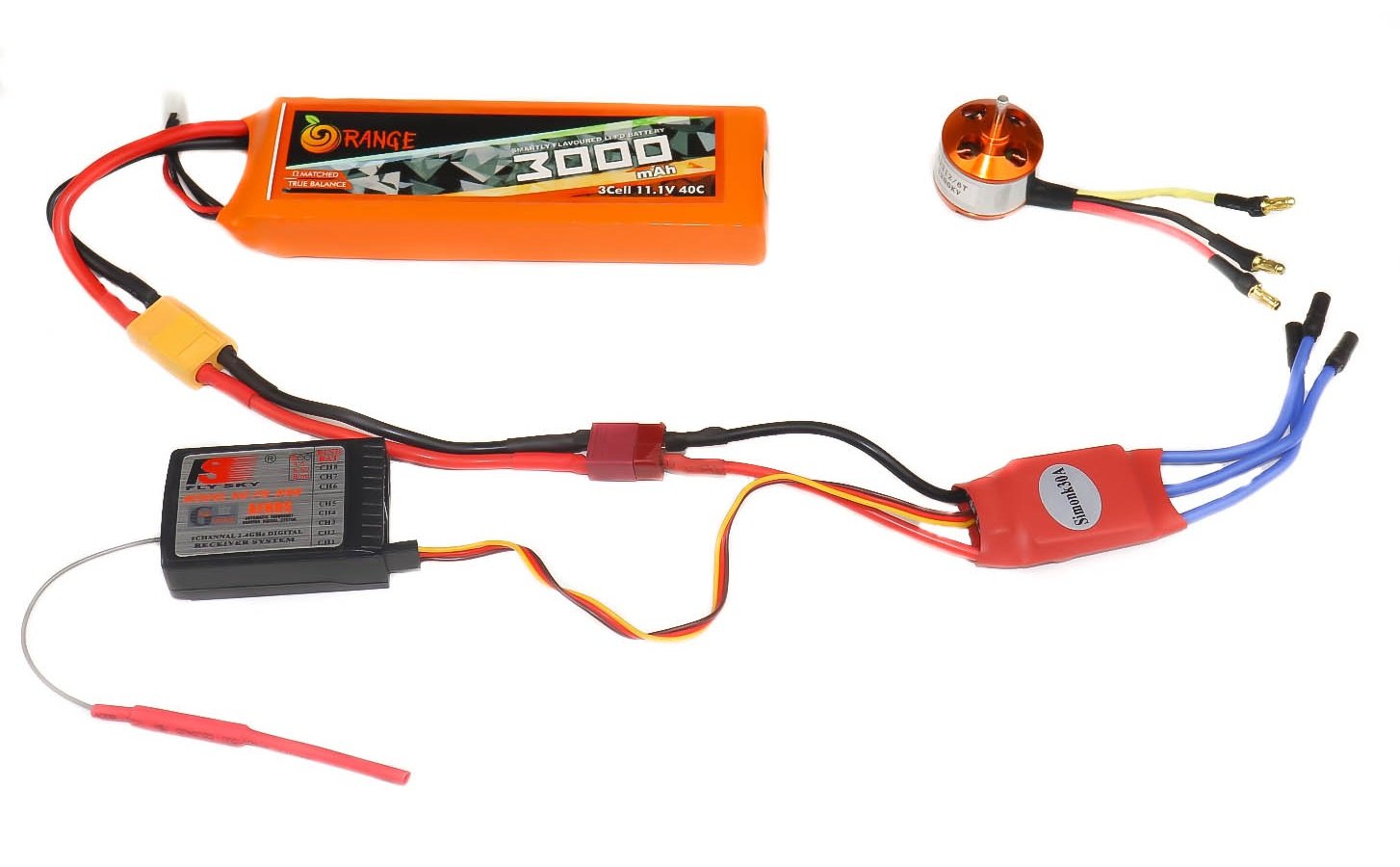
Protocols are like the operating system of the ESC. They determine how fast communication happens between the ESC and FC (flight controller), which plays a major role in the handling and performance of a quadcopter.
Here is a list of current protocols used on quadcopters, from oldest to latest:
- Standard PWM
- Oneshot125
- Oneshot42
- Multishot
- DShot
- ProShot
To know more about it refer to Electronics Speed controller calibration Protocol
Most ESCs use processors from ATMEL, Silabs, and ARM Cortex. All these processors have different features and specifications and support different firmware.
- ATMEL 8-bit is compatible with both SimonK and BLHeli firmware
- SILABS 8-bit is compatible with BLHeli or BLHeli_S only
- ARM Cortex 32-bit (e.g. STM32 F0, F3, L4) can run with BLHeli_3 I hope this article helps you learn about the basics of ESCs. With the help of this article, you can easily choose the perfect ESC for your multirotor.
To calibrate your ESC with the motor and RC transmitter, refer to the tutorial, Connecting motors and calibrating ESCs
The Flight Controller (FC) serves as the brain of the aircraft, equipped with sensors to detect drone movements and user commands. It processes this data to precisely control the motor speed, enabling the drone to maneuver as directed. The primary role of a flight controller is to stabilize the drone during flight, ensuring it remains level and maintains its desired altitude. It achieves this by constantly monitoring the drone’s orientation using onboard sensors such as accelerometers and gyroscopes. These sensors provide real-time data on the drone’s pitch, roll, and yaw, allowing the flight controller to make instant adjustments to maintain stability. Furthermore, a flight controller is responsible for executing various flight modes and maneuvers. These modes can include different levels of stability, such as Manual Mode, where the pilot has full control, or Autonomous Mode, where the drone can follow pre-programmed flight paths or perform automated tasks.
Flight controllers also play a crucial role in implementing safety features to prevent accidents and improve flight reliability. They can include fail-safe mechanisms that automatically initiate emergency landing procedures or return the drone to its takeoff location in the event of a signal loss or low battery voltage.
In addition to controlling the flight, a flight controller interacts with other onboard components, such as the GPS receiver, compass and barometer. These sensors provide vital information for features like position hold, altitude hold, and automatic return to home functionalities.
Pixhawk is an independent open-hardware project providing readily-available, low-cost, and high-end, autopilot hardware designs to the academic, hobby and industrial communities. It is a project for the development of Opensource computer hardware.
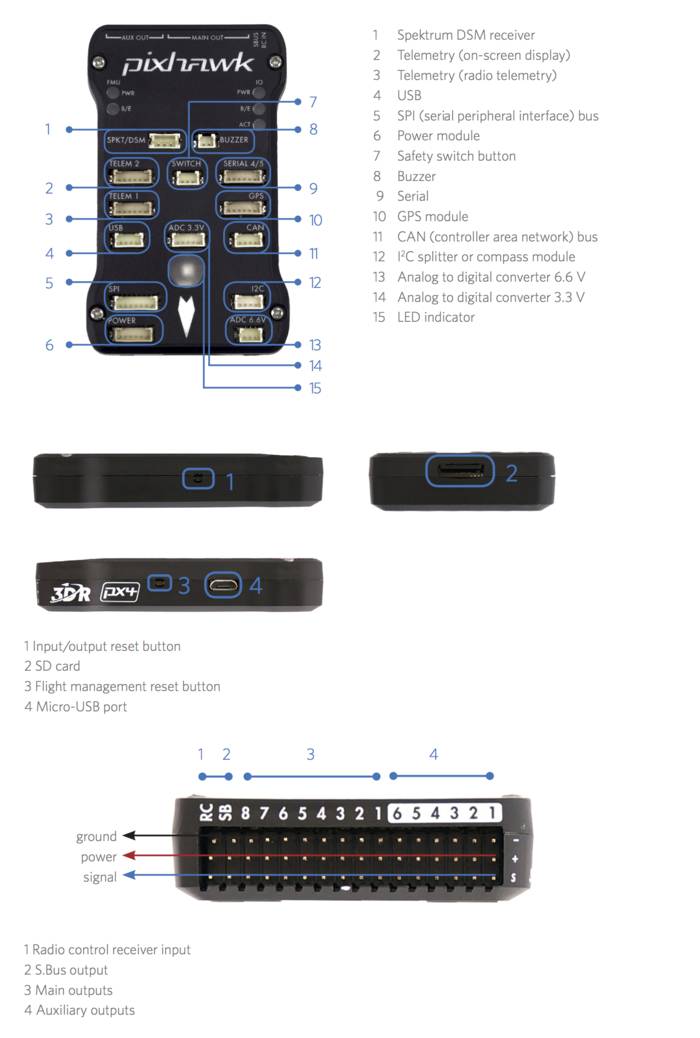
FPV Flight Controllers are designed for drones that are flown using FPV goggles or monitors, which provide a real-time video feed from the drone to the pilot. This setup allows for a more immersive flying experience and is commonly used in drone racing and freestyle flying
NOTE Generally FPV flight controllers cannot be connected onbaord computers and does not support advance sensors

GPS modules operate based on a network of satellites that orbit the Earth. These satellites transmit precise microwave signals. The GPS module receives these signals and uses the data to calculate the user’s exact location.
By combining both the GPS receiver and magnetometer, the GPD module provides longitude, latitude, elevation, and compass heading from a single device. GPS is a vital element for waypoint navigation and various other autonomous flight modes.
Most of the drones enable you to program in a failsafe home point. It means that the drone can fly back to a position if it is disconnected from the remote controller. The requirement of satellites is essential for most drones. If you are going to buy a drone, consider the one that comes with both GPS and Glonass.

Cameras in drones have become an essential component, significantly enhancing the capabilities and applications of drones across various fields. Here’s an overview of the importance and functionalities of drone cameras:
- Aerial Photography and Videography
- Surveillance and Security
- Inspection and Maintenance
- Agricultural Monitoring
- and many more

Let's think of a familiar example to make the concept more digestable!!
Think of your desktop computer. On this desktop computer, you have things like calculators, calendars, internet browsers etc. These are called apps. The developers used the OS sandbox and wrote in new functionality to the computer through their programs.
Well, the same concept applies for drones. What if you wanted to add some higher functionality into your drone that isn’t supplied out of the box, like gesture control, computer vision, python control, 4G drone telemetry, taco delivery etc?
That is where the companion computer steps in. This is the device that we can use to introduce new functionalities onto our drone.
ALso, Companion Computers travel on the vehicle and communicate with (and control) the autopilot. The Companion Computer gets all the MAVLink data produced by the autopilot (including GPS data) and can use it to make intelligent decisions during flight. This enables a broad range of functionality, from computer mediated flight paths, though to very CPU intensive functionality such as vision processing.
Just like flight controllers come in many different forms, so do companion computers.
Here are some just to name a few:
- Raspberry Pi 4B
- Raspberry Pi Zero
- Orange Pi
- Odroid
- Jetson Nano
for introduction purpose this should be enough if you are curious about it then you can check out Companion Computers


- A transmitter is a device that sends signals or data from one location to another. Its primary function is to take low-frequency information (the baseband signal) and transfer it to much higher frequencies by superimposing the baseband signal on a high-frequency carrier (usually a sine wave).
- For drones, the transmitter is the handheld device you use to control your drone. It typically has a set of sticks (joysticks) that allow you to input commands.
- The receiver is installed inside the drone.
- It receives the signals sent by the transmitter.
- Once received, the receiver passes this information to the drone’s flight controller.
- The flight controller processes the data and adjusts the drone’s motors and other components accordingly, making the drone move as per your commands.
Range: The range depends on factors like transmitter power, receiver sensitivity, and antenna quality. Typically, radio links have a range of around 1 km under normal conditions.
Remember, the transmitter-receiver duo is essential for controlling your drone effectively! 🚁✨
Although some sensors like IMU (Inertial Measurement Unit) for determining angular speed and acceleration, a barometer for height, We can find out the information about the drones which are equipped with LIDAR, thermal, and many other types of sensors. Together with other components of a drone, these are mounted onto the device and applied in a variety of sectors.

Thermal Camera

Lidar
Drones, with their innovation in flight, companion computers, control systems, and sensory advancements, are more than just flying machines. They represent human ingenuity and continue to integrate into our daily lives.
Hopefully the info was useful to you Thank you