pyreml is a general-purpose linear mixed model solver. It fits linear mixed models for a wide range of applications: quantitative genetics, spatial statistics, health sciences, among others.
Models are fitted by direct differentiation of the Restricted Maximum Likelihood (REML), using PyTorch for variance parameter estimation. It benefits from PyTorch parallelization and GPU acceleration.
Install pyreml with pip:
pip install pyremlpyreml decomposes each random effect
where:
-
$\mathbf{\Sigma_a}$ is the left-hand factor, i.e. the covariance across the components of the effect -
$\mathbf{K_a}$ is the right-hand factor, i.e. the covariance across its levels.
The two factors are set independently, through left_hand and right_hand arguments of the Random and Residual objects.
The philosophy behind this parameterization is to provide a simple, flexible and unified framework for a large variety of use cases.
pyreml natively supports multivariate (multiple response) analysis,
random regression and heteroscedasticity specification using patsy idiom. Factor-analysis, i.e. the direct estimation of principal components of large
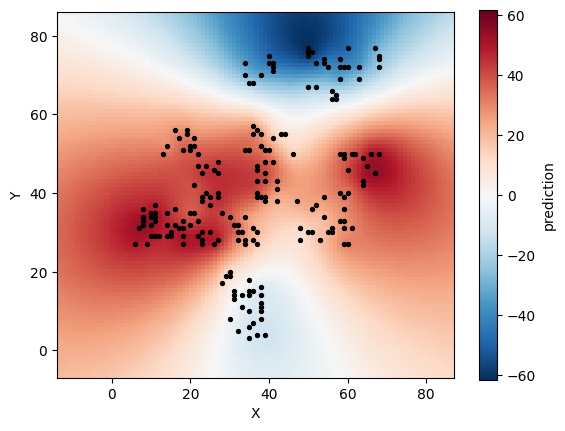
pyreml also enables prediction of unobserved levels of a structured random effect, for instance in this geospatial analysis:
As an illustrative example, let's realize the genetic analysis of
the larix dataset, using the genetic helpers provided by pyreml.
This model provides a heteroscedastic structure to the residuals.
from pprint import pprint
from pyreml import (
    MixedModel,
    Random,
    Residual,
    A_pedigree,
    prepare_pedigree,
    larix as df,
)

df = df[df["year"] == 2000].copy()
ped = prepare_pedigree(df[["ID","SIRE","DAM"]])
K = A_pedigree(ped)

model = MixedModel.from_dataframe(
    data     = df,
    response = "height",
    fixed    = "1 + C(BLOC)",
    random   = Random(
        formula      = "1",
        unit         = "ID",
        right_hand   = "str",
        covariance   = K,
        matrix_index = ped["id"].tolist(),
    ),
    residual = Residual(
        right_hand = "het",
        het_formula = "1 + C(BLOC)",
    ),
    device = "cuda",
)

model.fit()

pprint(model.estimates)
pprint(model.random[0].variance)
pprint(model.residual.variance)
model.random[0].table.head()The documentation is available at this address.
Please cite this package as:
Marchal, A., & Raimondi, D. (2026). pyreml - general-purpose linear mixed model solver [Computer software]. Zenodo. https://doi.org/10.5281/zenodo.21394319
The code is available at this address.
Copyright © 2026 CNRS, University of Montpellier
This program is free software: you can redistribute it and/or modify it under the terms of the GNU General Public License as published by the Free Software Foundation, either version 3 of the License, or (at your option) any later version.
This program is distributed in the hope that it will be useful, but WITHOUT ANY WARRANTY; without even the implied warranty of MERCHANTABILITY or FITNESS FOR A PARTICULAR PURPOSE. See the GNU General Public License for more details.
You should have received a copy of the GNU General Public License along with this program. If not, see https://www.gnu.org/licenses/.