
By Team 3.JS
- Overview
- Problem Statement
- Policy Features
- Mathematical Models
- Application Architecture
- AI Architecture
- Tech Stack
- Adversarial Defense & Anti-Spoofing Strategy
EarnSure Suraksha Policy is a micro-insurance product purpose-built for gig economy delivery partners operating on Q-commerce platforms (Blinkit, Zepto, Swiggy Instamart, etc.). Unlike traditional insurance, EarnSure adapts its premiums and payouts dynamically each week based on actual income, disruption events, and area demand — ensuring that coverage is always proportional, affordable, and fair.
The policy bridges a critical gap: delivery partners face income volatility from weather, traffic disruptions, platform outages, and area-level demand shifts. Existing insurance products are designed for salaried workers with predictable income. EarnSure solves this by tying both premiums and claims directly to real earned income data.
Q-commerce delivery partners face:
- Unpredictable income due to external disruptions (weather, floods, traffic incidents, local shutdowns)
- No income safety net during involuntary low-earning weeks
- Unaffordable traditional insurance with flat premiums that ignore income volatility
- High claim friction due to documentation requirements and slow processing
EarnSure addresses all four issues with adaptive premiums, ML-driven disruption detection, automated claim validation, and instant payouts.
| Feature | Description |
|---|---|
| Weekly Adaptive Premium | Premium is calculated weekly based on actual income and number of prior claims |
| Income-Linked Coverage | Claim amounts scale directly with the worker's predicted weekly income |
| Disruption-Triggered Activation | Claims are only triggered when a verified disruption event hits the worker's area |
| No-Claim Bonus | Workers who complete a 6-month policy period without claims receive a bonus of 25–50% of total premiums paid |
| Month Factor Scaling | Early-period claims (months 1–2) receive slightly reduced payouts to disincentivize gaming at onboarding |
| Claim Waiver Post-Claim | After a valid claim, the next week's premium is fully waived |
| Payment Deadline | Premiums are due every Sunday and are mandatory for coverage continuity |
The weekly premium is a percentage of the worker's income for that week:
P_w = α_n × I_w
Where the premium rate α_n escalates with repeated claims:
α_n = 0.03 + (0.005 × N_c)
| Parameter | Meaning |
|---|---|
P_w |
Weekly premium (₹) |
α_n |
Premium rate (starts at 3%, increases by 0.5% per prior claim) |
I_w |
Actual income earned in week w |
N_c |
Number of claims made so far in the policy period |
Key rules:
- Base premium: 3% of weekly income
- Increases by +0.5% per claim filed
- Payment due: Every Sunday (mandatory)
- If a claim occurs: Next week's premium is waived
The model predicts what a worker should have earned in a given week, forming the baseline for claim calculations:
I_exp = f(past_income_2w, active_days, area_demand_factor)
Inputs:
- Past 2-week average income
- Active days per week
- Area demand factor (derived from Q-commerce platform order volumes)
Output:
I_exp— Predicted Weekly Income (₹)
Determines whether a worker actually suffered meaningful income loss relative to what was expected:
L_r = (I_exp - I_act) / I_exp
Output: Binary flag — 1 if L_r ≥ 0.30, else 0
A loss ratio of ≥30% is required for a claim to proceed. This prevents minor fluctuations from triggering payouts and filters opportunistic claims.
A claim is valid only when all three conditions are simultaneously true:
Claim Valid = (T = 1) ∧ (A = 1) ∧ (M = 1)
| Flag | Meaning |
|---|---|
T = 1 |
A verified disruption event exists in the worker's area |
A = 1 |
The worker was active (logged in, accepting orders) in the affected area |
M = 1 |
The Income Impact Model outputs 1 (loss ratio ≥ 30%) |
All three must be true simultaneously. This is the core gating logic — any single flag failing blocks the claim.
T = 1 is set when a disruption event is detected in the worker's operational area.
Disruption severity D_s is categorized as:
| Disruption Level | D_s Score |
|---|---|
| Partial | 0.5 |
| Moderate | 0.75 |
| Full | 1.0 |
Severity is sourced from a combination of Traffic API data, Weather API alerts, and platform order volume drops.
The coverage multiplier boosts the claim amount based on how severe the disruption was, while penalizing frequent claimers and rewarding income stability:
θ = max(1.0, 1 + 0.15×D_s − 0.02×N_c + S_i)
| Variable | Meaning |
|---|---|
D_s |
Disruption severity (0.05, 0.10, or 0.15 at policy level — mapped from severity table) |
N_c |
Number of prior claims → deduction of 0.02 per claim |
S_i |
Stability bonus: +0.05 if income is stable, else 0 |
Constraint: θ ≥ 1.0 (floor enforced by max)
Base Claim:
C_w = θ × I_exp
Time-Based Adjustment:
C_final = C_w × γ_m
Month Factor γ_m scales with policy maturity — rewarding long-term policyholders:
| Policy Period | γ_m |
|---|---|
| Month 1–2 | 0.80 |
| Month 3–4 | 0.85 |
| Month 5–6 | 0.90 |
At the end of a 6-month policy period, workers who filed no claims receive a refund bonus:
B = η × ΣP_w
| Payment Behaviour | Bonus Rate (η) |
|---|---|
| Paid fully on time | 50% |
| Partial / delayed | 25% |
The consolidated payout formula:
C_final = max(1.0, 1 + 0.15×D_s − 0.02×N_c + S_i) × I_exp × γ_m
| Symbol | Meaning |
|---|---|
C_final |
Final weekly payout (₹) |
D_s |
Disruption severity (0.05/0.10/0.15) |
N_c |
Number of claims made |
S_i |
+0.05 if income stable, else 0 |
I_exp |
Predicted weekly income |
γ_m |
Month adjustment factor |
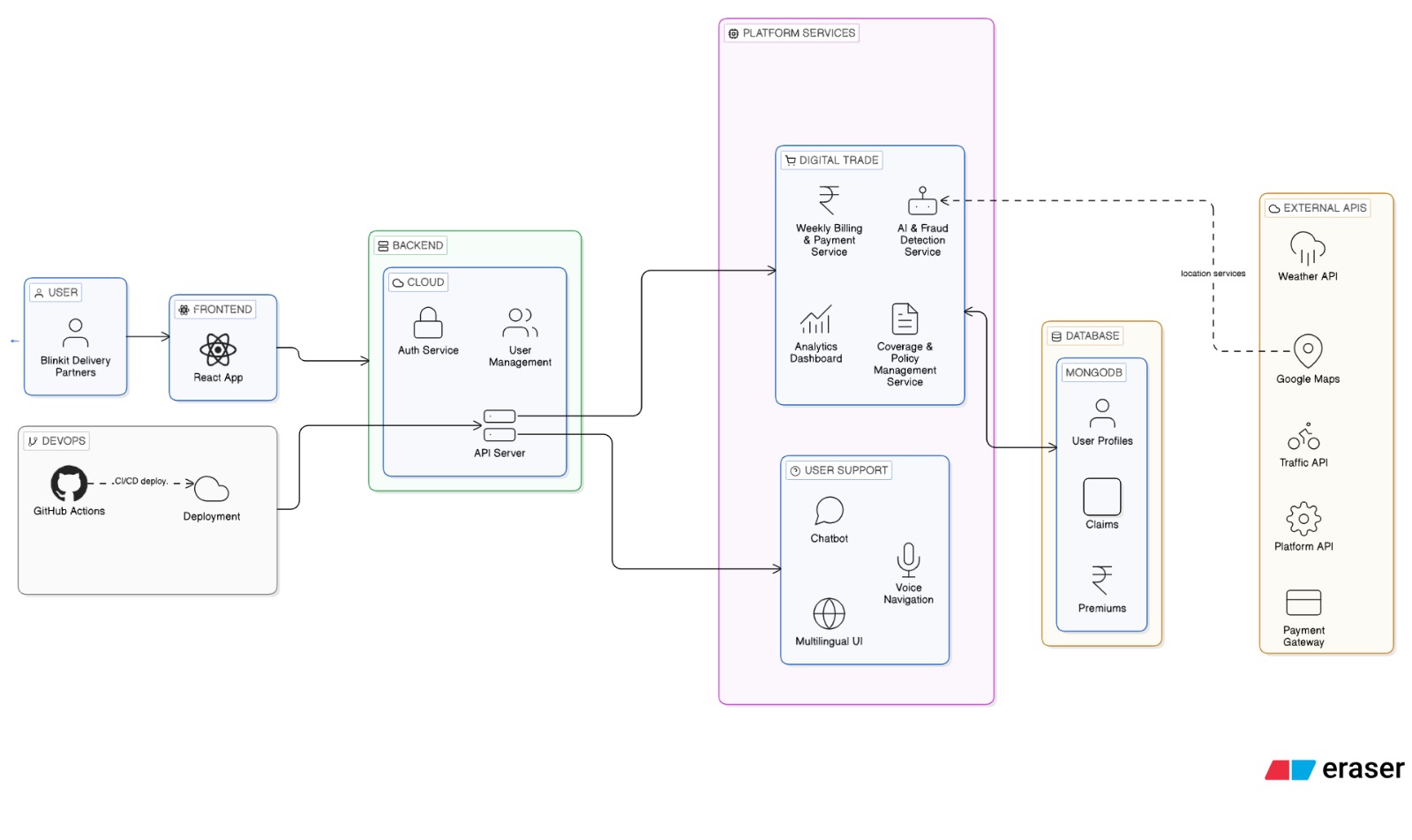
The platform is a React-based SPA for delivery partners, backed by a Flask REST API server, with MongoDB for persistence. External data sources (Weather, Maps, Traffic, Platform) feed into the AI layer for disruption detection and income modeling.
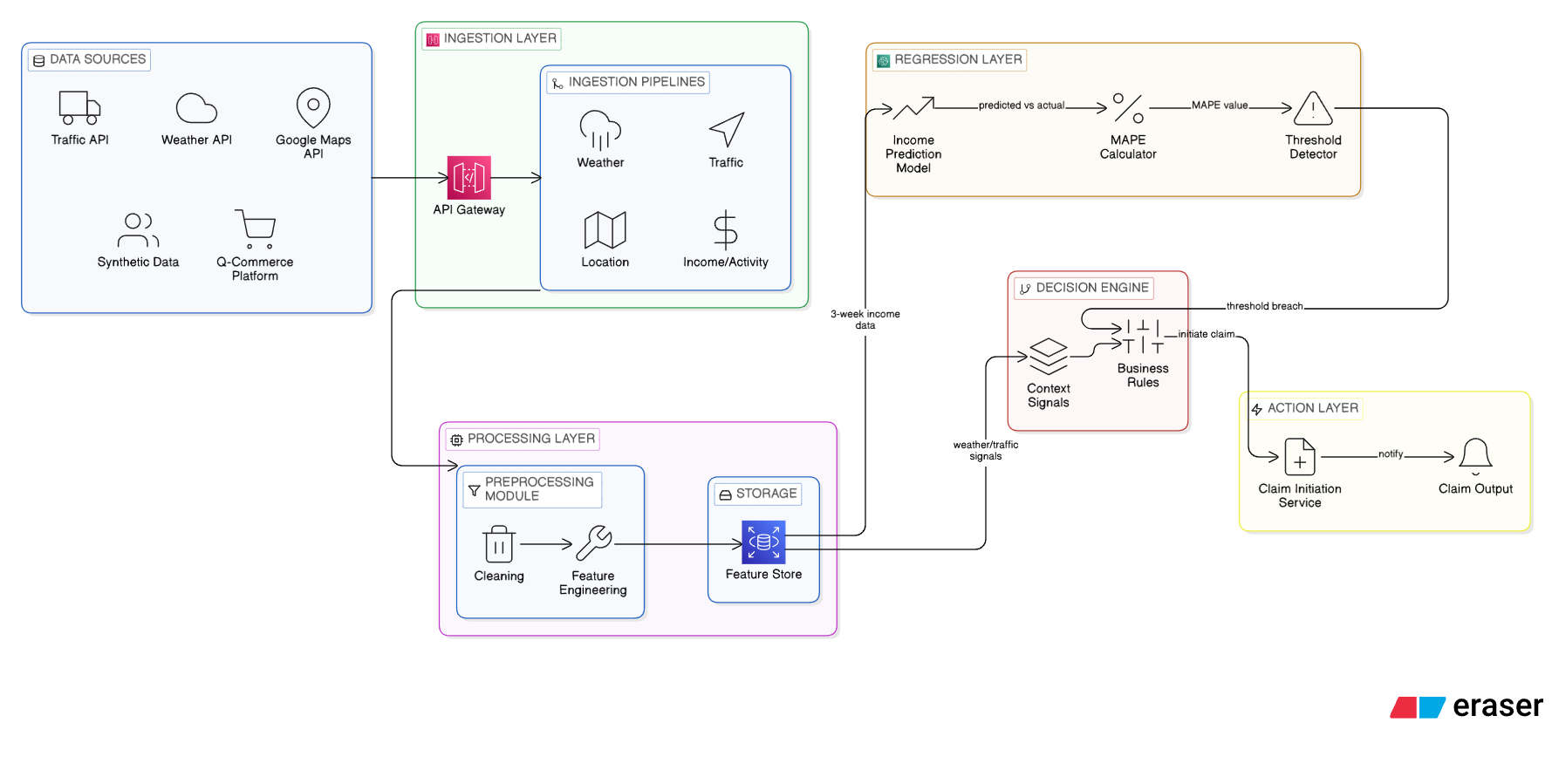
| Layer | Technology |
|---|---|
| Frontend | React (SPA) |
| Backend | Python + Flask, REST API |
| Database | MongoDB |
| AI/ML | Python (scikit-learn / regression models) |
| DevOps | GitHub Actions, Cloud Deployment |
| External APIs | Weather API, Google Maps API, Traffic API, Q-Commerce Platform API, Payment Gateway |
Differentiation: Since claims are auto-triggered by external APIs, spoofing is structurally blocked at the source — a claim only fires when Weather API, Traffic API, and Google Maps jointly confirm a disruption in the worker's registered delivery zone, meaning a bad actor cannot trigger a claim at all without a real, verifiable, hyperlocal disruption event occurring first.
Data Beyond GPS: The system validates every auto-trigger against a multi-source confirmation threshold — Weather API rainfall intensity, Traffic API incident density, Google Maps road closure overlays, Q-commerce platform order volume drop, and news crawler signals must collectively agree before a claim is released, making coordinated fraud impossible without spoofing multiple independent external systems simultaneously.
UX Balance: Since claims are never filed manually, honest workers are never flagged or penalized — the only exception is a soft-hold triggered when a worker's registered zone partially overlaps a disruption boundary, which auto-resolves within 2 hours as APIs update their coverage polygons, ensuring no human intervention is ever needed.
EarnSure Suraksha Policy — Building financial resilience for the gig economy, one week at a time. Team 3.JS