Arianna and Stephen claim that their fancy math gives a better description of change in shape space than some simple-minded approach. But does it? How do they know that -- or even propose to show it? Surely, to do so they must have a set of shapes that they know a priori are a certain relative distance from each other --- and then show that method captures that distance better than some other one.
But they don't have such a set of shapes. So, let's generate one. Starting with an average Mantamados vase, and taking account of the covariance structure among the variables (the y values) I generated a 500 vase lineages of 200 time steps each by a random walk process = 10,000 vases in all. Some of the lineages diverge really far from the original, others do not. Here is one of the most extreme:
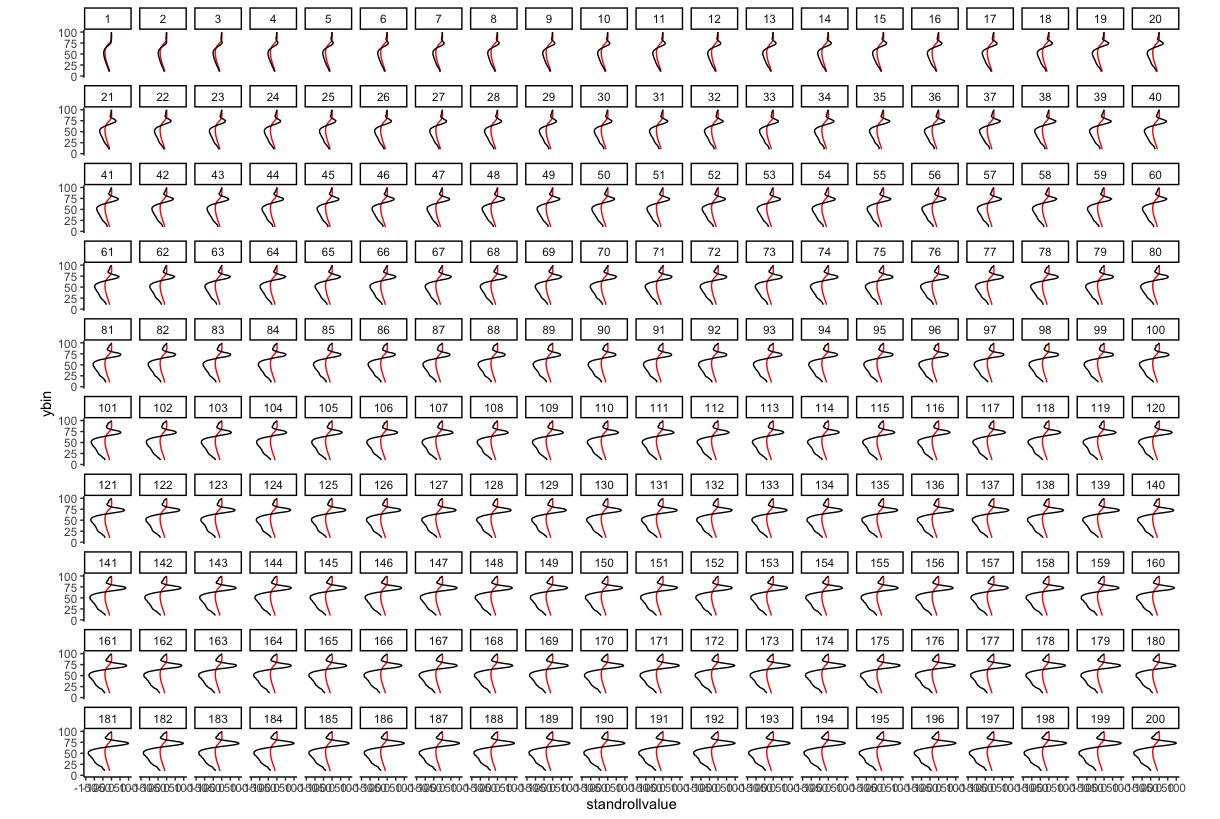
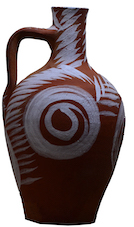
The red vase is the original. You can see that, over time, the vases in this lineage become ever more extreme: in fact, they're evolving from an amphora to something like an arabyllos!
start:
end:
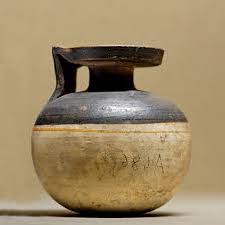
Well, kinda. Anyway, here's the idea: you have 500 lineages, each of which is progressively diverging from the original vase. Since they're evolving by a Random Walk, I believe that they should diverge from the original as a linear function of time. Certainly the variance among lineages should increase linearly with time. I haven't looked at the latter yet, but here's a suggestion of what you might do. For one lineage --- vase series 1, shown above --- I estimate the distance between the vase at each time step and the original and plot it. I estimate the distance in the most simple minded way possible: by euclidean distance:
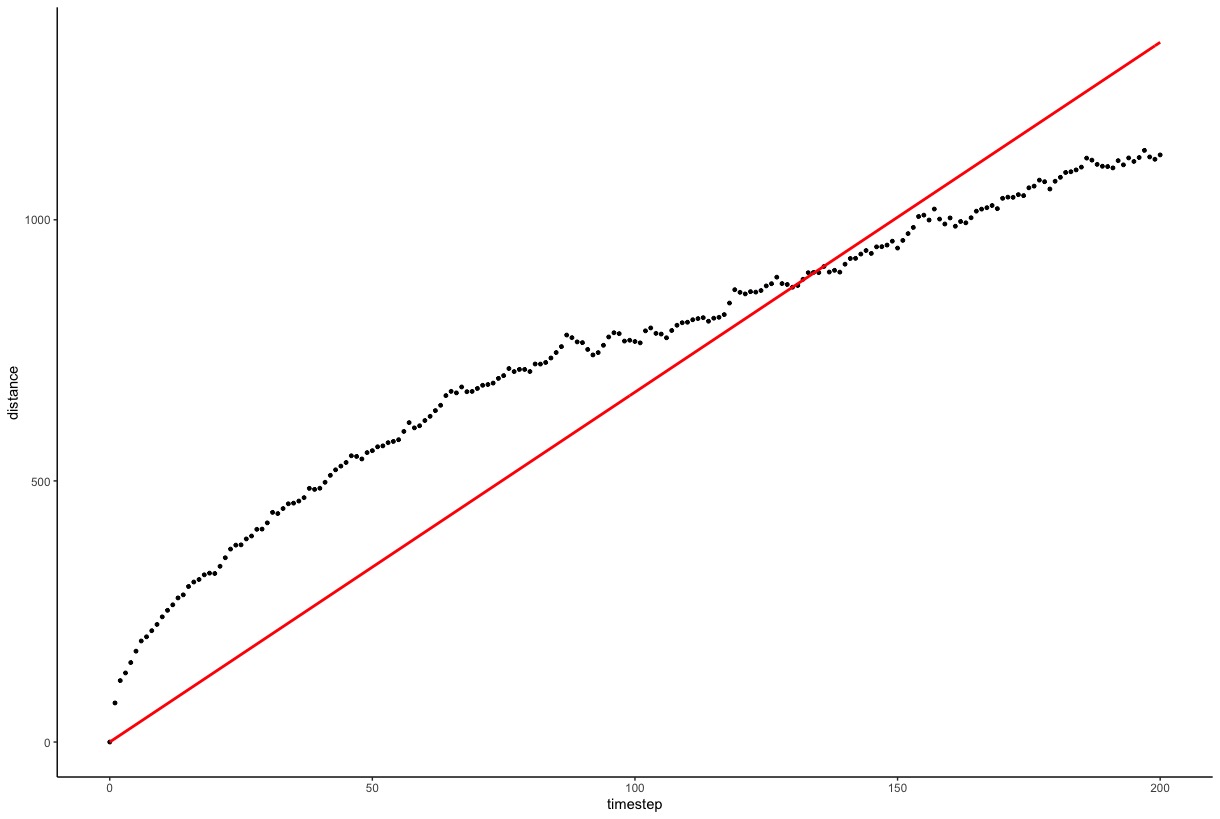
I find that the distance does not increase linearly with timestep (the best-fit linear regression, forced through the intercept is shown in red): instead, over time, the gain in distance per timestep clearly decreases. Hmmm. Could it be that Arianna and Stephen are right when they say that Euclidean distance really doesn't describe evolution in shape space accurately? Should we be looking at shape evolution in non-Euclidean space?!
Now, there was a certain amount of fiddling that went on to make these vases -- including moving averages to make the contours pretty. And I am not totally convinced that the way in which each vase, at each timestep, was generated, really does result in a random walk of shapes (even if each individual variable does so evolve). So I am not totally sure that the asymptoting distances of the lineages aren't an artifact of the way in which the vases were generated. However, for the moment I think not. And here's the thing: I have 10,000 vases of a known evolutionary history for Arianna to test her methods on -- any distance she pleases. Perhaps, on reflection, Arianna's Brunel supervisors where not so silly to insist that she study simulated shapes...
Now, my real interest in generating fake vases is to test evolutionary hypotheses about the production of vase diversity. The data upon which these simulations were based (the COV matrix among the vases) are clearly not good enough for that. But it's a step in the right direction.
Arianna can find the vase data here in a dropbox folder called
simulated vases for Arianna 131119
There are two files: RW_vases_long.csv which has the data in long format, and RW_vases_wide.csv in wide. The original vase is "vaseseries==0". All the rest are simulated vases: vaseseries designates the lineage; timestep designates the timestep; x and y, the coordinates that describe each vase.
Arianna and Stephen claim that their fancy math gives a better description of change in shape space than some simple-minded approach. But does it? How do they know that -- or even propose to show it? Surely, to do so they must have a set of shapes that they know a priori are a certain relative distance from each other --- and then show that method captures that distance better than some other one.
But they don't have such a set of shapes. So, let's generate one. Starting with an average Mantamados vase, and taking account of the covariance structure among the variables (the y values) I generated a 500 vase lineages of 200 time steps each by a random walk process = 10,000 vases in all. Some of the lineages diverge really far from the original, others do not. Here is one of the most extreme:
The red vase is the original. You can see that, over time, the vases in this lineage become ever more extreme: in fact, they're evolving from an amphora to something like an arabyllos!
start:

end:

Well, kinda. Anyway, here's the idea: you have 500 lineages, each of which is progressively diverging from the original vase. Since they're evolving by a Random Walk, I believe that they should diverge from the original as a linear function of time. Certainly the variance among lineages should increase linearly with time. I haven't looked at the latter yet, but here's a suggestion of what you might do. For one lineage --- vase series 1, shown above --- I estimate the distance between the vase at each time step and the original and plot it. I estimate the distance in the most simple minded way possible: by euclidean distance:
I find that the distance does not increase linearly with timestep (the best-fit linear regression, forced through the intercept is shown in red): instead, over time, the gain in distance per timestep clearly decreases. Hmmm. Could it be that Arianna and Stephen are right when they say that Euclidean distance really doesn't describe evolution in shape space accurately? Should we be looking at shape evolution in non-Euclidean space?!
Now, there was a certain amount of fiddling that went on to make these vases -- including moving averages to make the contours pretty. And I am not totally convinced that the way in which each vase, at each timestep, was generated, really does result in a random walk of shapes (even if each individual variable does so evolve). So I am not totally sure that the asymptoting distances of the lineages aren't an artifact of the way in which the vases were generated. However, for the moment I think not. And here's the thing: I have 10,000 vases of a known evolutionary history for Arianna to test her methods on -- any distance she pleases. Perhaps, on reflection, Arianna's Brunel supervisors where not so silly to insist that she study simulated shapes...
Now, my real interest in generating fake vases is to test evolutionary hypotheses about the production of vase diversity. The data upon which these simulations were based (the COV matrix among the vases) are clearly not good enough for that. But it's a step in the right direction.
Arianna can find the vase data here in a dropbox folder called
simulated vases for Arianna 131119
There are two files: RW_vases_long.csv which has the data in long format, and RW_vases_wide.csv in wide. The original vase is "vaseseries==0". All the rest are simulated vases: vaseseries designates the lineage; timestep designates the timestep; x and y, the coordinates that describe each vase.