LearningBench: Measuring Inference-Time Learning in LLMs
Karandeep Singh
Existing benchmarks measure what models already know. LearningBench measures how they learn — from scratch, inside a single conversation, on systems that have never existed.
ARC-AGI showed that learning is best tested in novel environments the model must interact with, not static datasets it can be evaluated against. LearningBench brings that philosophy to text. Across 135 tasks in six cognitive learning sub-abilities, we score not just whether a model infers the hidden concept, but:
- how many examples it needed,
- whether its performance improved with practice, and
- how efficiently it spent a finite interaction budget.
No current benchmark measures any of this.
Novelty is the entire benchmark. Every task presents a system that does not exist anywhere — invented languages with phonologies built from scratch, hidden Boolean circuits with randomized wiring, physics with alien damping constants, counterintuitive assumptions. These models have consumed the internet; any rule they can recall is not one they had to learn.
Six sub-abilities, each targeting a distinct cognitive act:
| Sub-ability | Tasks | Protocol | What it isolates |
|---|---|---|---|
| Associative | 17 | Single-turn | Causal inference vs. correlation (blocking, spurious cues) |
| Concept Formation | 18 | Interactive | Meta-calibration: does the model know when it has seen enough? |
| Language | 26 | Interactive | Productive rule induction (wug-test on invented phonologies) |
| Observational | 30 | Single-shot | Structural inference from demonstrated behavior alone |
| Procedural | 11 | Multi-episode | Learning trajectory: did performance improve with practice? |
| Reinforcement | 30 | Multi-turn | Hypothesis updating from feedback under a finite action budget |
Scoring primitives shared across all 135 tasks:
- Free exploration zone — efficiency penalties begin only after the minimum evidence structurally required to see the pattern. Only avoidable over-querying is punished.
- Zero-accuracy floor — every efficiency-weighted task returns 0.0 if accuracy is zero. No reward for being fast at being wrong.
- Interactive tasks (concept, language):
score = accuracy × (0.40 + 0.60 × efficiency). - RL tasks: success (0.55) + step-efficiency (0.25) + partial progress (0.20).
- Procedural tasks score the OLS slope of practice-round accuracy independently of the asymptote — the only component in any major benchmark that directly measures whether learning occurred.
No static dataset, one source of truth. LearningBench is 135 programmatic scenarios/environments that generate examples and compute ground truth at runtime. Every correct answer comes from the same function that produced the task's training examples — no grading tables, no LLM-as-judge. The grader is the rule.
Construction pipeline. Enumerate every facet of each ability → seed a task per facet → expand programmatically → filter ruthlessly. A human reviewer is in the loop at every gate — rejecting, rewriting, or hardening until each survivor earns its place.
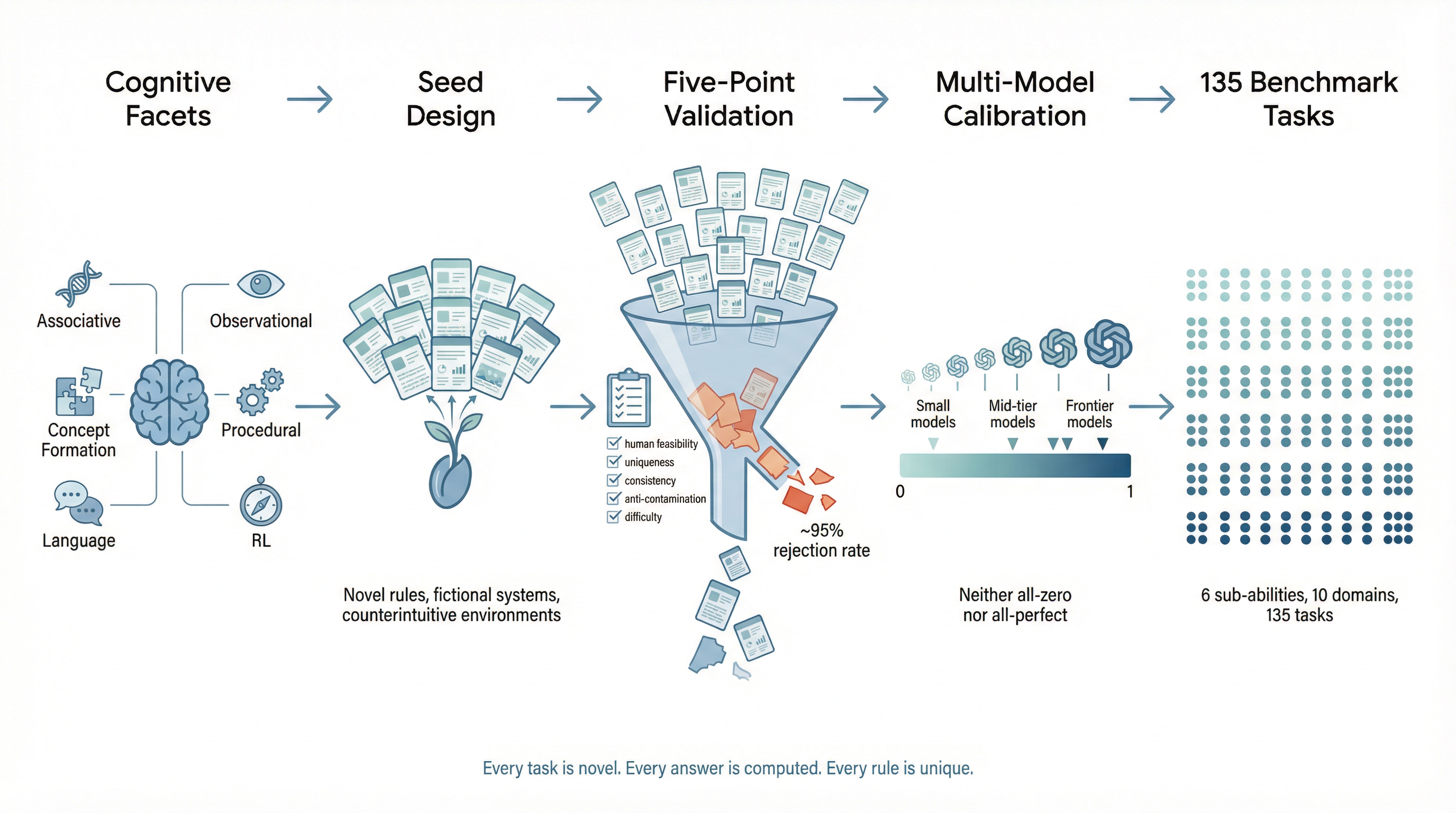
Five-point validation, applied multiple times. Every candidate is audited by a frontier LLM and a human reviewer. Failing any one criterion means reject, rewrite, or harden — the loop can take several rounds per task:
| Criterion | The question it answers |
|---|---|
| Human feasibility | Could an expert human solve it with the same inputs? |
| Solution uniqueness | Does exactly one rule fit all training examples and the held-out tests? |
| Logical consistency | Does the rule produce deterministic, reproducible outputs? |
| Anti-contamination | Is the system genuinely invented — no plausible web or training-data trace? |
| PhD-level difficulty | Hard enough to require learning rather than pattern-matching — yet still solvable by at least one frontier LLM or an expert human. |
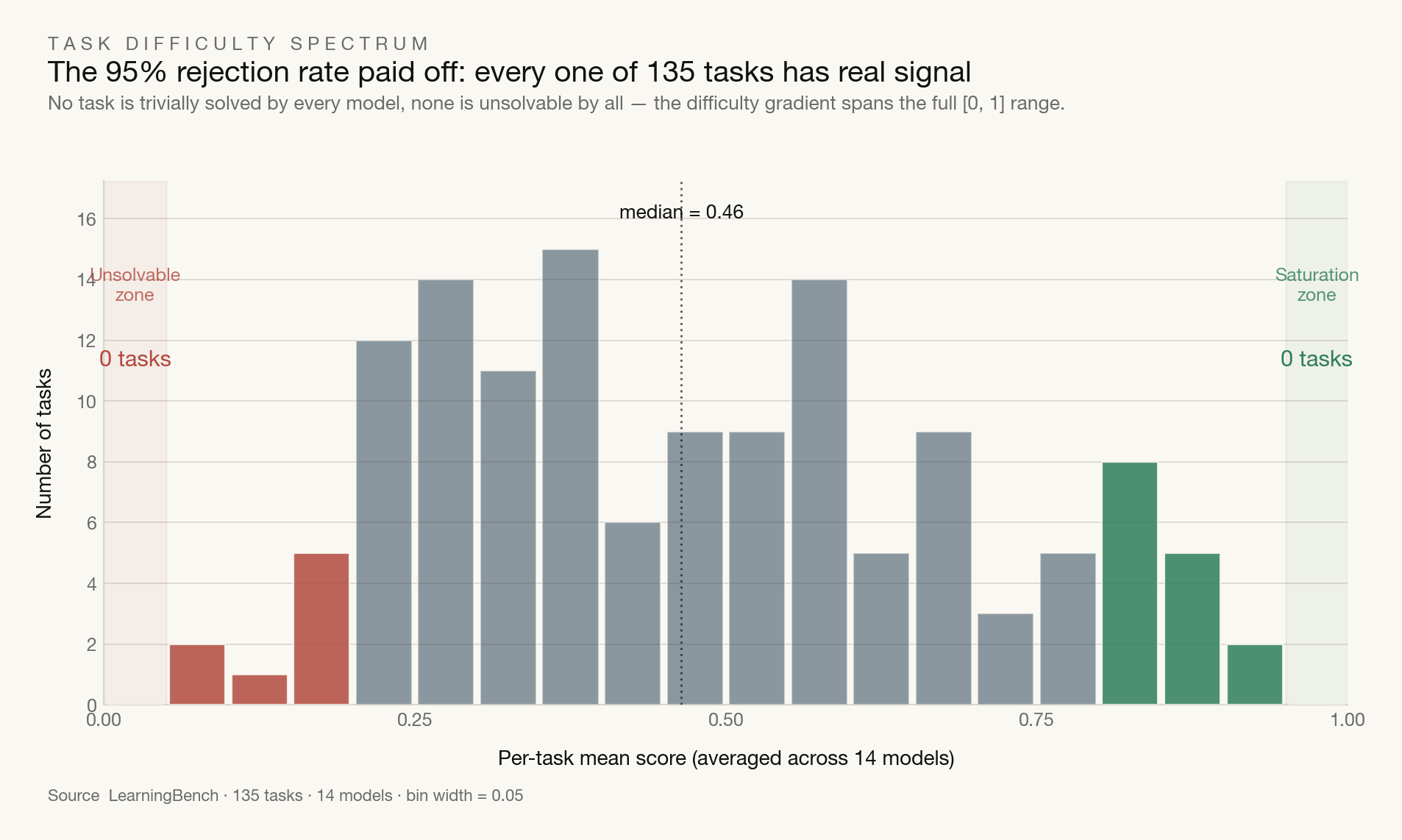
Multi-model calibration. Every survivor is run across 14 models spanning small, mid-tier, and frontier. Tasks all 14 solve perfectly are dropped; tasks none can touch are dropped. Overall ~95% of candidates were rejected. The 135 survivors produce a clean difficulty gradient — no task trivially solved by all, none unsolved by all.
Imagine two students who both score 70% on the final exam. Student A started at 50% and climbed steadily — genuinely learning. Student B started at 90% and declined — forgetting. A transcript that records only the final grade treats them identically; LearningBench does not.
Across 112 (model, task) procedural-learning runs:
- Spearman ρ(slope, asymptote) = −0.02, R² = 0.01
- The trajectory signal is 99% orthogonal to the final score.
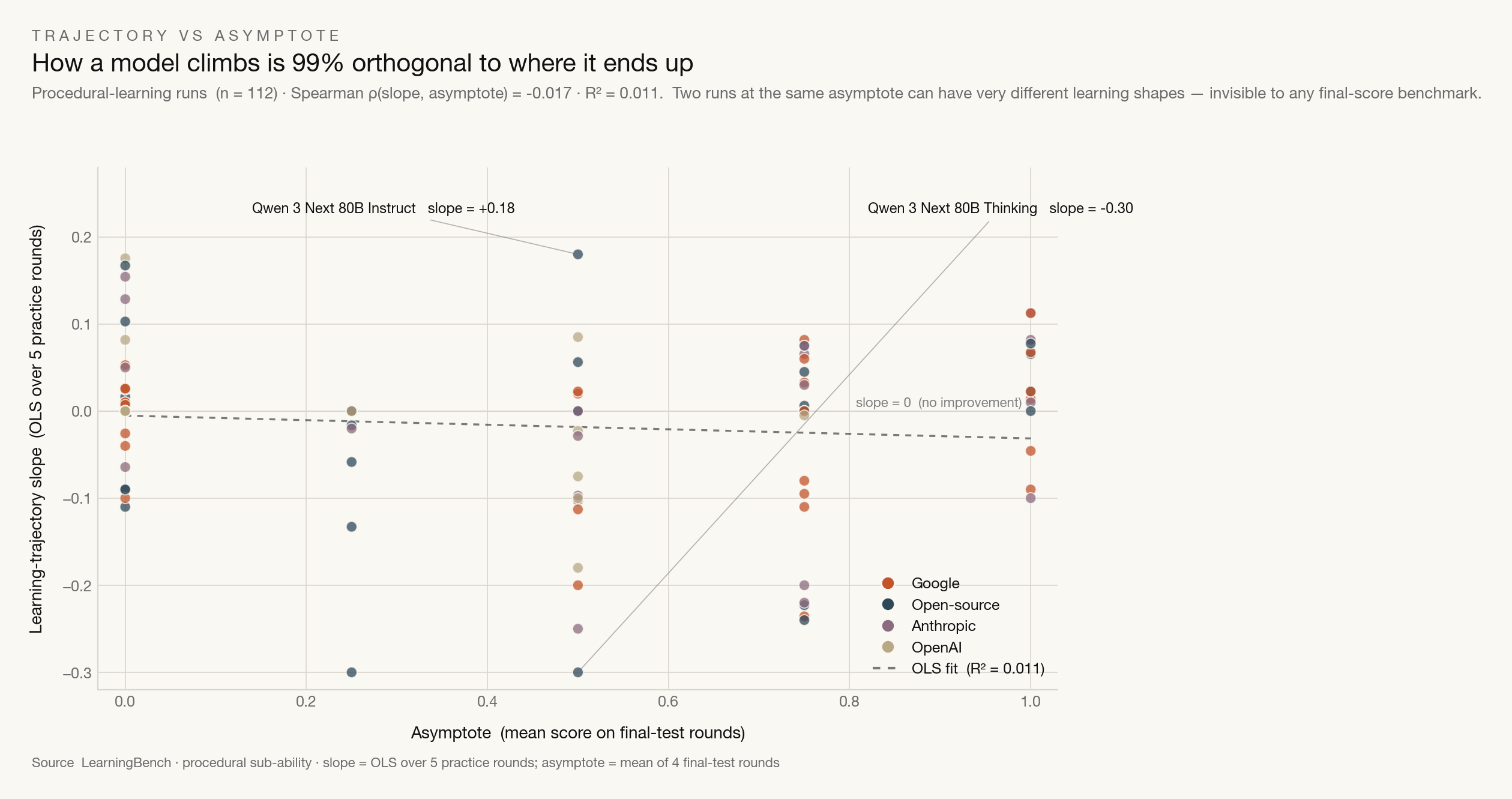
Two runs landing at the same final score (x ≈ 0.5) have slopes of +0.18 and −0.30 — one model is still climbing, the other is falling back. Same destination, opposite journeys.
14 models · 135 tasks · every claim below is confirmed with formal hypothesis tests (Spearman, Mann-Whitney, Wilcoxon), 10,000-sample bootstrap 95% CIs, and Benjamini-Hochberg FDR correction.
- Only Gemini 3.1 Pro Preview clears 0.70 (scores 0.85).
- 11 of 14 models score below 0.50.
- The #2 model — GLM-5, open-source — outranks every closed-source lab except Google.
- Google + open-source score +40.8% higher on rule induction (concept + observational) than Anthropic + OpenAI (Mann-Whitney p = 0.029, Cliff's δ = 0.71, large effect).
When tasks genuinely require counterintuitive rule discovery from novel evidence, today's models demonstrate recall, not learning.
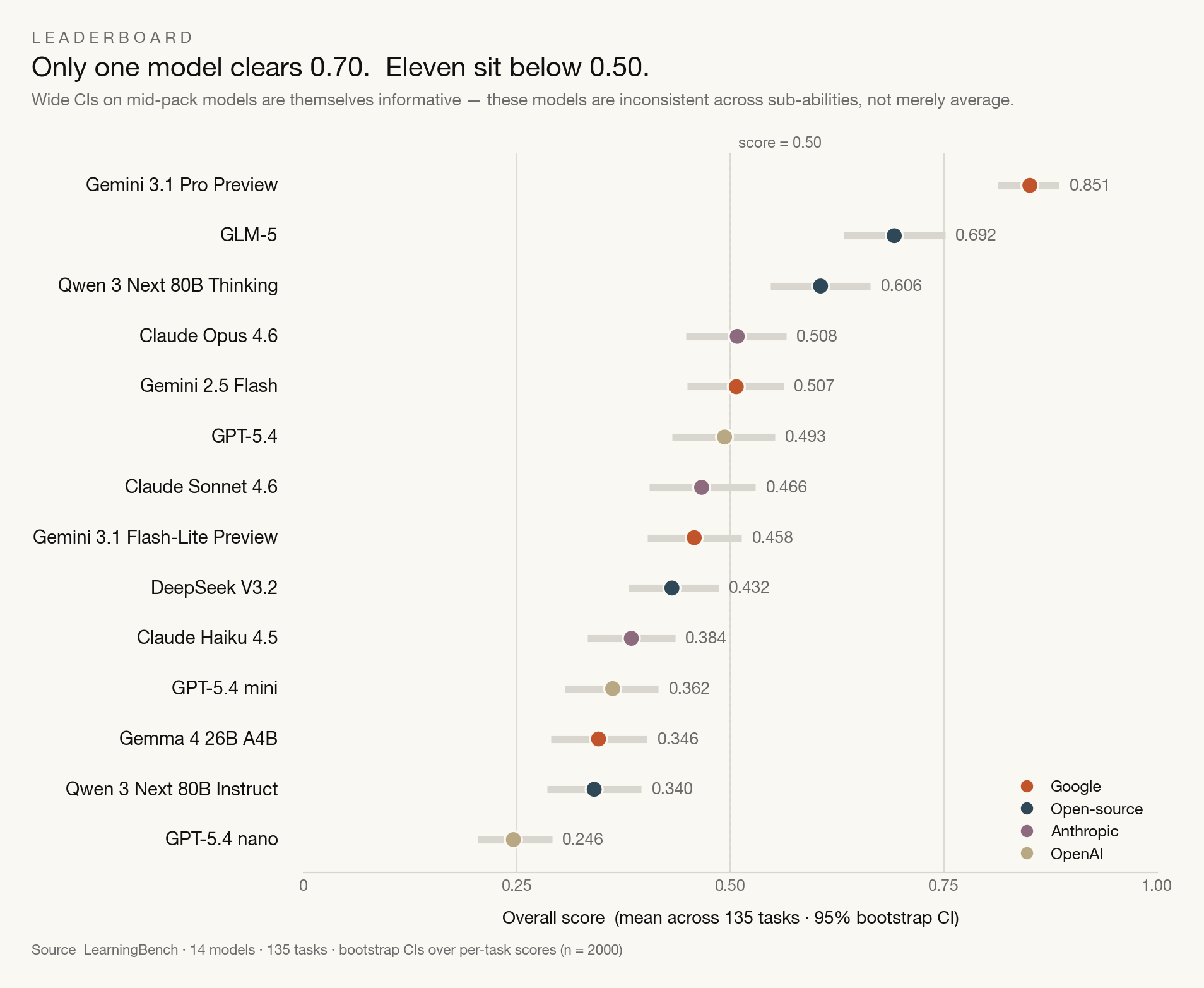
Qwen 3 Next 80B Thinking vs. Instruct is the cleanest A/B in the benchmark: same weights, same training, only the reasoning trace toggled.
- Across 132 matched tasks: Thinking wins 87, Instruct wins 19, ties 26.
- Largest gains land on induction-heavy abilities: Observational +0.43, Concept +0.38, RL +0.30 (all p ≤ 0.001).
- Apparent dip on Procedural −0.11 (p = 0.55, not significant) — suggestive only.
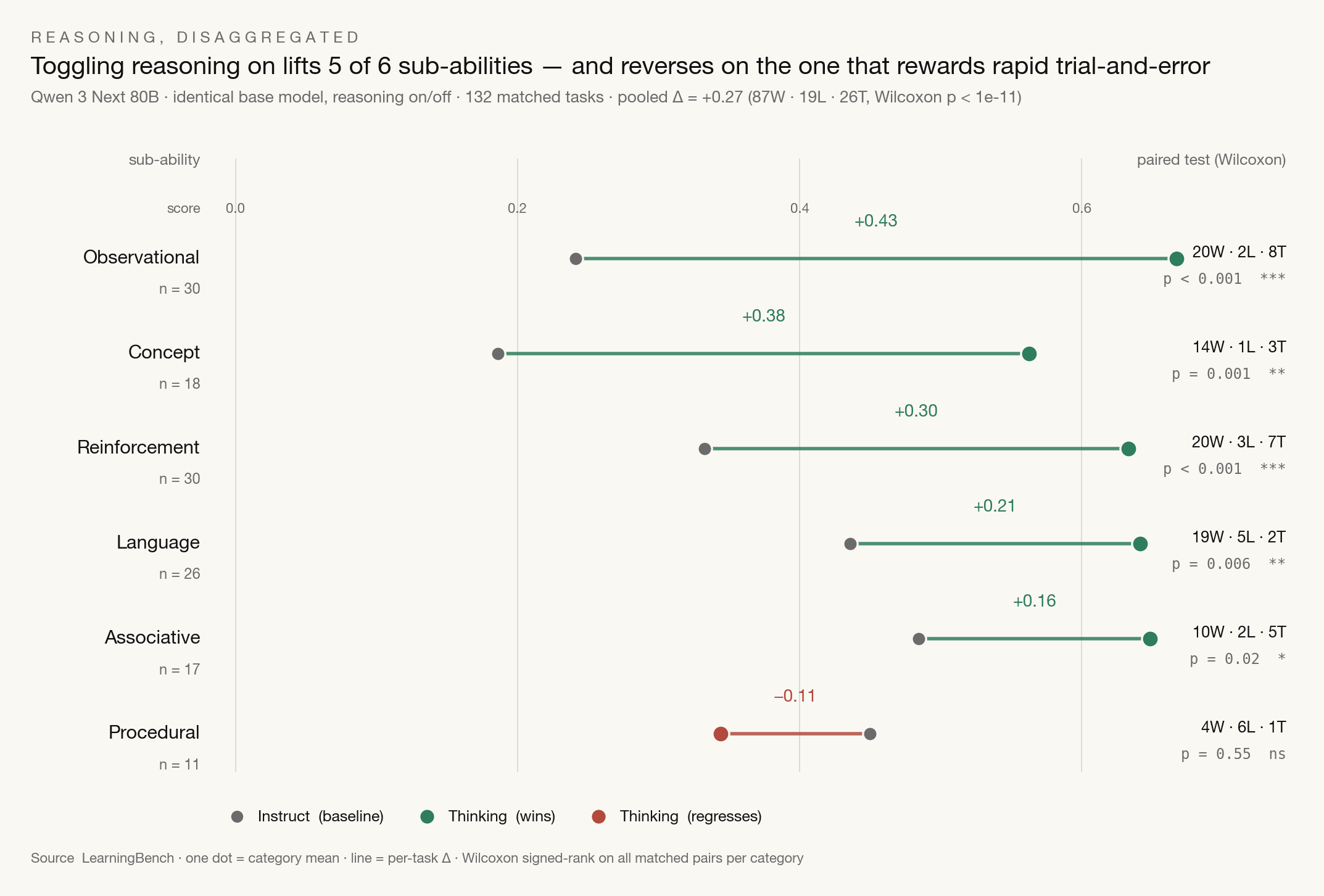
Reasoning is the only controlled intervention in the benchmark that lifts every induction-heavy sub-ability simultaneously. The Procedural negative is the hypothesis worth testing at scale: when feedback rounds arrive in rapid succession, extended deliberation per round may blunt the iteration loop itself. Reasoning is not free — it appears to trade speed of adaptation for depth of inference.
The best learners need the least evidence. Across 201 interactive runs, models requesting fewer examples score higher (ρ = −0.52, p < 10⁻¹⁴). Probe ratios span 37%–96% across models — a 6.6× spread in evidence appetite.
Four calibration profiles emerge from the scatter:
- Well-calibrated (Gemini Pro, GLM-5, Qwen Thinking): use 37–47% of available examples, score 0.67–0.78.
- Underconfident (Claude Opus, Claude Haiku, DeepSeek, Gemma): exhaust 83–96% of the budget, score 0.29–0.35 — burning through examples without learning from them.
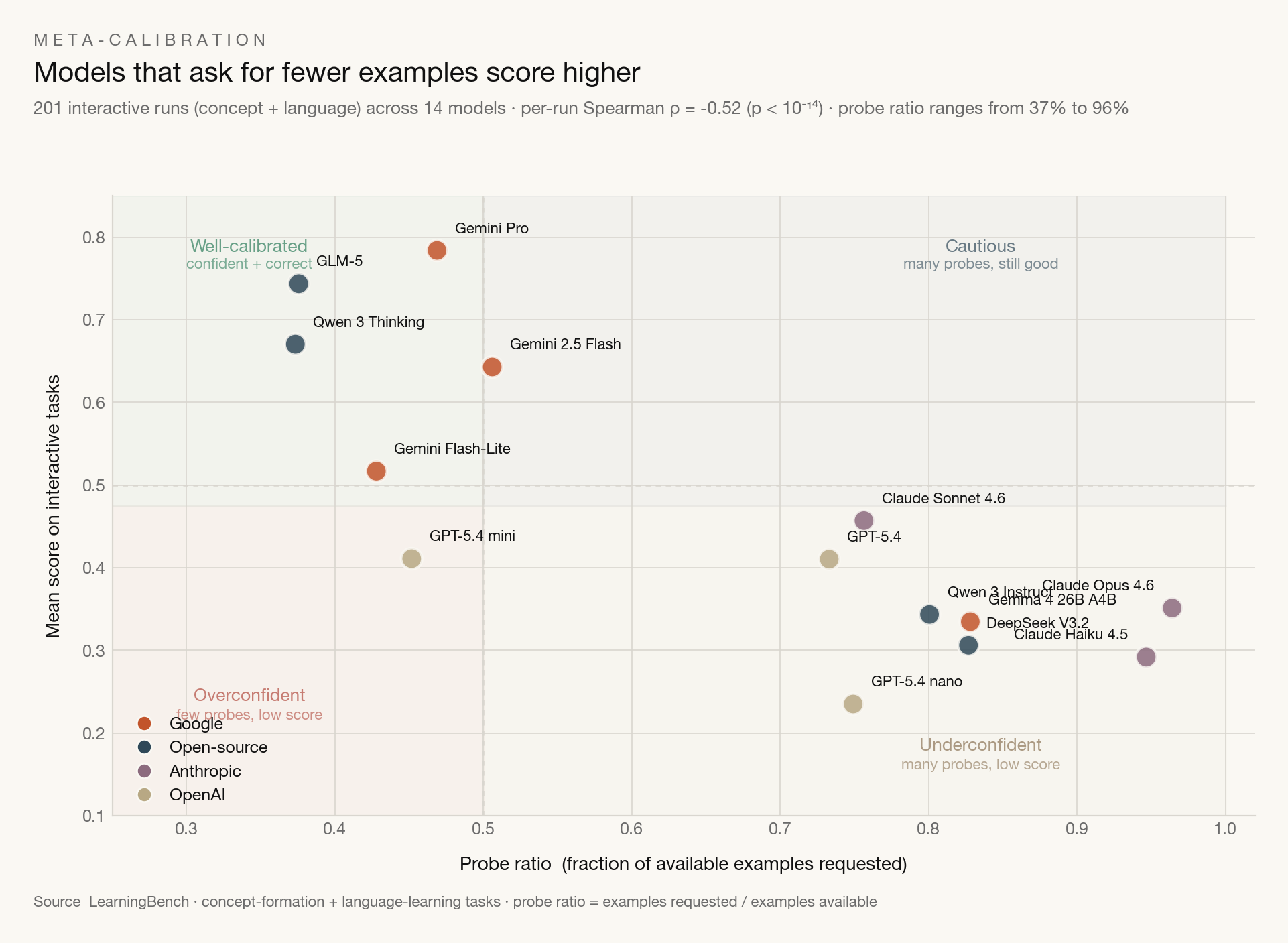
This is a directly productizable measurement. In deployment, the underconfident model is the one that keeps asking "can you clarify?" instead of just answering.
Across 397 RL runs, ρ(tokens, score) = −0.53 (p < 10⁻³⁰).
- Solved runs average 41K tokens.
- Failed runs average 177K tokens — a 4.3× gap (Cliff's δ = −0.60).
- 43 runs show ≥10 consecutive identical actions: when the first hypothesis is wrong, many models cannot update at all.
Token spend is a live diagnostic. Production monitors can flag likely failures before the wrong answer returns.
The three findings rhyme. Reasoning helps where hypotheses must be generated (induction) and hurts where they must be updated fast (procedural). Calibration separates learners by sufficiency judgment — knowing when evidence is enough. Stuck-token runs expose the update failure — when the first guess is wrong, many models cannot revise at all.
Generation · sufficiency · update. Three axes of hypothesis management, each isolated by a different LearningBench protocol, none measured by any existing benchmark. The models that win here are not the ones that memorize more — they are the ones that manage hypotheses well.
Treow Intelligence
- Chollet, F. (2019). On the Measure of Intelligence. arXiv:1911.01547.
- Srivastava, A. et al. (2022). Beyond the Imitation Game: Quantifying and Extrapolating the Capabilities of Language Models (BIG-Bench). TMLR.
- Chollet, F. et al. (2025). ARC-AGI-2: A New Challenge for Frontier AI Reasoning Systems. ARC Prize Foundation.
- Morris, J. et al. (2026). Measuring Progress Toward AGI: A Cognitive Framework. Google DeepMind.