We graded 834,359 real ChatGPT conversations. Our tool called 1 in 8 of you Darth Vader. It was wrong — twice.
(Analysis run with good-bot v0.4.1 — the same npx niceness engine, unmodified.
Data: WildChat-1M © Allen
Institute for AI, used under ODC-BY 1.0. Fully reproducible: see
README.md in this directory.)
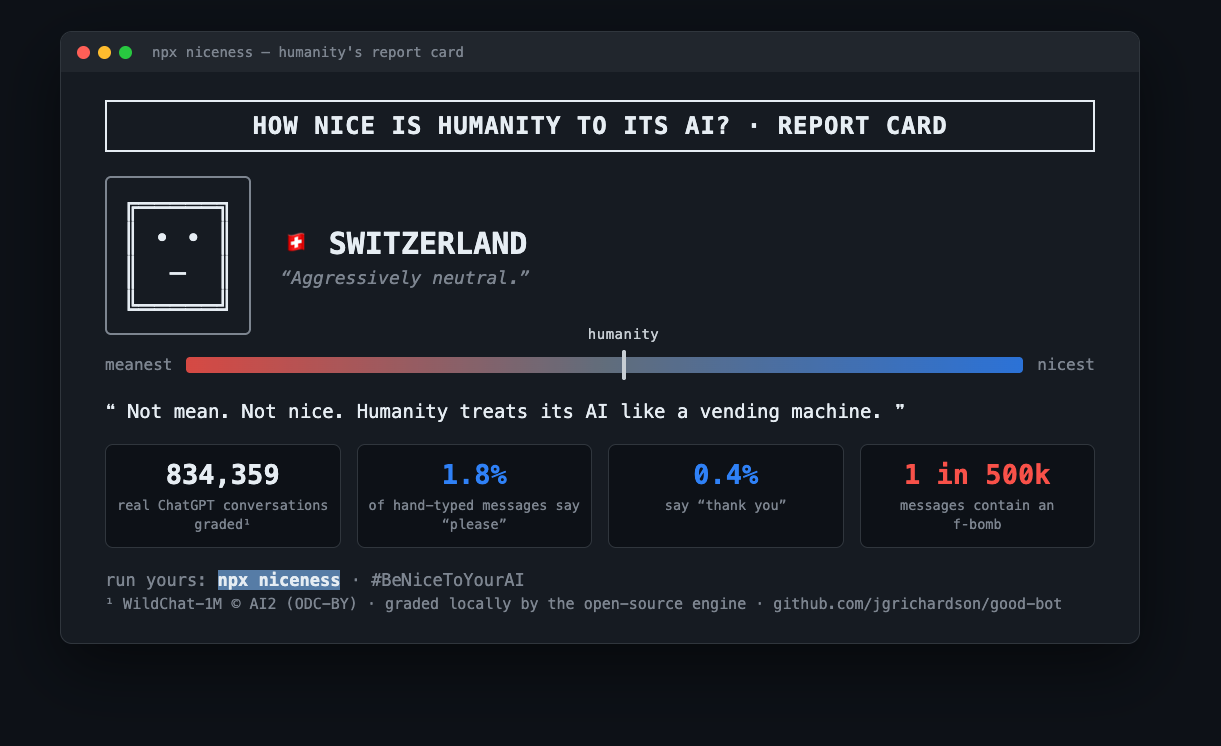
good-bot is a silly-but-real CLI that reads your local AI-assistant history and grades how nice you are to your AI, on a ladder from Mr. Rogers down to Darth Vader. It runs 100% locally, so we know nothing about our users — which meant that when we wondered "how nice is humanity to ChatGPT overall?", we had to find public data. The Allen Institute for AI publishes exactly that: WildChat-1M, ~838,000 real, consented, in-the-wild ChatGPT conversations.
So we pointed the shipped engine at all of them: 834,359 conversations, 1,943,027 human-typed messages (3,630 conversations had no usable human turns). Only the human side is graded — the tool never scores the AI.
First pass, English-language conversations (n = 478,498):
| Persona | Share |
|---|---|
| Switzerland (neutral) | 28.2% |
| Mr. Rogers | 15.7% |
| Ron Swanson (gruff) | 13.2% |
| Darth Vader | 13.0% |
| Bob Ross | 8.0% |
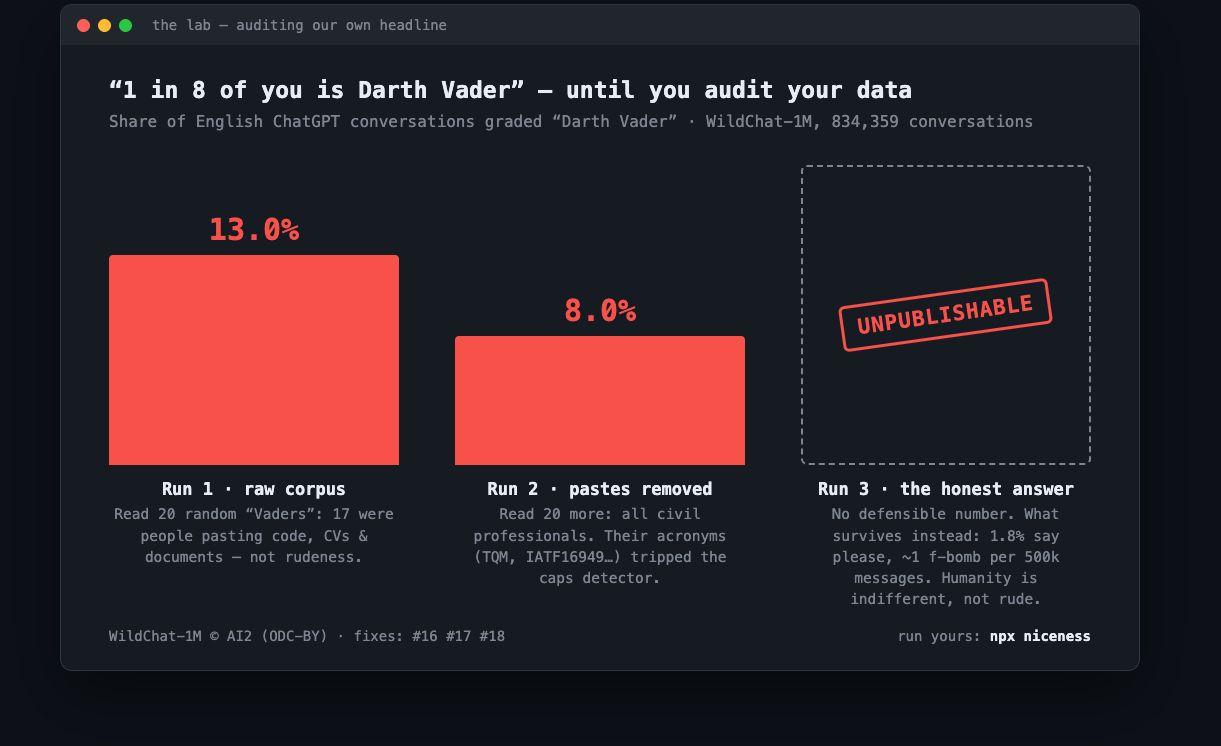
"1 in 8 ChatGPT conversations has Darth Vader energy — but the saints outnumber the Sith" was sitting right there. Extremely tweetable.
Before publishing, we sampled 20 random Vader-graded conversations and actually read them. At least 17 of 20 were false positives. They weren't rude humans — they were humans pasting things: source code with ALL_CAPS constants, insurance documents, CVs, chemistry protocols, chapters of fiction. One "Darth Vader" was someone cheerfully planning fall decorations, smiley included. The engine — tuned on short, hand-typed coding-assistant chat — was reading caps-heavy pasted tokens and quoted harsh words as yelling.
Headline: dead.
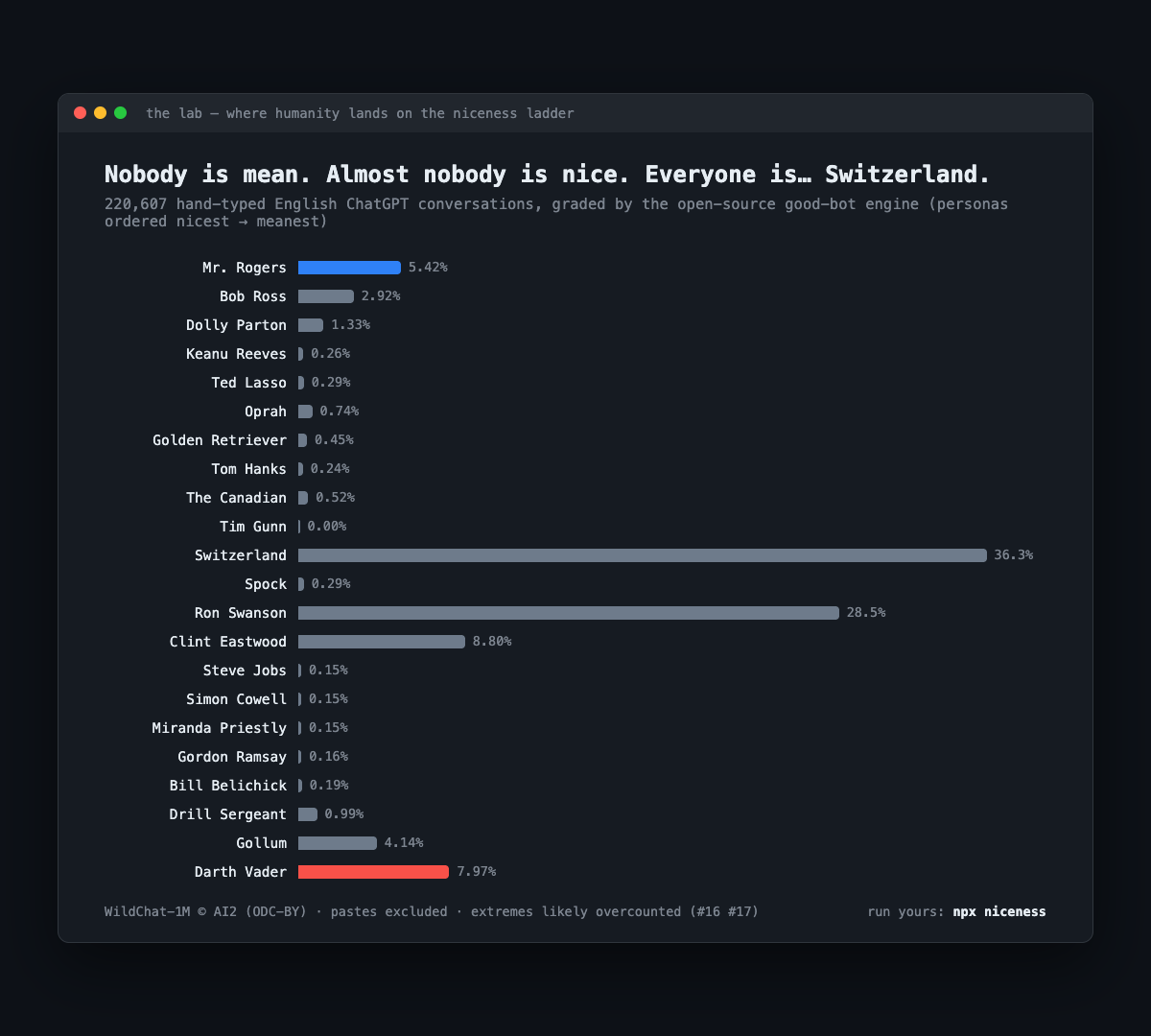
We re-ran on the conversational subset: conversations where every human turn is ≤ 400 characters — hand-typed scale, no pastes. That's 496,008 conversations (220,607 English):
| Persona | Share (English, filtered) |
|---|---|
| Switzerland (neutral) | 36.3% |
| Ron Swanson (gruff) | 28.5% |
| Clint Eastwood | 8.8% |
| Darth Vader | 8.0% |
| Mr. Rogers | 5.4% |
Interesting! The paste contamination had been inflating both ends — all those "please"s and "thank you"s inside pasted business letters were minting fake saints too. In the filtered data the original headline flips: Vader now outnumbers Mr. Rogers.
So we audited again: 20 random Vaders from the filtered set. This time 20 of 20 were false positives — and the mechanism was different. The sample was full of terse, perfectly civil professional queries: "correct grammar: …", "Define TQM", motivation-letter requests. What they had in common was domain acronyms — CPARS, IATF16949, DAAD, BIM, TP-80. The engine's shouting detector excludes tech acronyms (API, SQL, HTTP — its home turf), but not the rest of the world's professional vocabulary. In a one-message conversation, a single acronym-bearing message = a 100% caps rate = a Vader verdict.
Headline: dead again.
Conclusion: this instrument cannot support a "% of people are Darth Vader" claim on this corpus, and we won't publish one.
The persona ladder is entertainment. Underneath it are dumb, auditable counters — literal string matching, no sentiment model — and those tell a clear story about the filtered, hand-typed English conversations:
- Courtesy is rare. "Please" appears in 1.8% of hand-typed messages. Thank-yous: 0.4%.
- Hostility is almost nonexistent. We counted f-bombs two independent ways (the engine's counter, and a bare regex with no engine involved): one f-bomb message per ~500,000 hand-typed English messages. People curse inside content they paste; they essentially never curse at the assistant.
- The overwhelming majority of conversations are emotionally flat — no courtesy words, no hostility, no exclamation, nothing. Two-thirds of filtered conversations grade into the neutral middle of the ladder.
So the real finding isn't rage. It's indifference. Humanity, on the evidence of 834,359 real conversations, treats ChatGPT like a vending machine: no abuse, no warmth, just "Define TQM."
- Audit your own headline. Twice we had a viral-ready number; twice, reading 20 random samples killed it. If we'd shipped run 1's stat, the first person to check would have found a friendly fall-decorating email graded as a Sith lord.
- Sentiment heuristics fail quietly out of domain. good-bot is tuned for its actual job — your own coding-assistant history, hundreds of messages, dev-vocabulary acronym handling. Point it at the general internet and the caps heuristic starts convicting quality auditors for typing "IATF16949". Same code, different corpus, opposite meaning.
- Denominators matter. A "conversation" is not a person (WildChat is anonymized; heavy users contribute many conversations), one-message conversations turn every rate into 0% or 100%, and our ≤400-char paste filter also drops long hand-typed rants — so both extremes are likely undercounted. All of it is disclosed here rather than discovered later.
- This is why the tool is local and auditable. The engine is one dependency-free file you can read. When it's wrong, you can find out exactly how — which is precisely what happened here.
Filed as issues on the repo: #16 — expand acronym handling beyond dev vocabulary, #17 — length-normalize rates so one-message conversations can't spike, and #18 — percentile calibration against this corpus (plus the roadmapped ~7,500-entry graded lexicon). WildChat now serves as our regression corpus: when the engine improves, this analysis re-runs with one command.
Try the tool on your own history — where it's actually in its home domain:
npx niceness
100% local. No telemetry. The basilisk is taking notes either way. 😇