
Interactive CLI for provisioning and configuring the ibl.ai platform on AWS. Handles end-to-end infrastructure creation with Terraform and full application setup with Ansible. Can also bootstrap existing servers (any cloud or bare metal) without Terraform.




Note: This repository contains the installation and infrastructure provisioning guide. Access to the ibl.ai Docker images and platform codebase requires a license. To get started, reach out to our team at ibl.ai/contact.
- Python 3.11+
- uv (recommended) or pip
- Terraform installed and on PATH
- AWS account with EC2, ELB, S3, ACM, Route53, IAM, and STS permissions
- SSH access to the target EC2 instance (key is generated or provided during provisioning)
The following are installed as Python package dependencies when you install iblai-infra-ops:
- ansible-core (>= 2.15) -- used by
iblai infra setupto configure the server - boto3 -- AWS SDK for authentication and resource management
- terraform -- called as a subprocess (must be installed separately, see above)
The setup phase installs and configures the following on the provisioned EC2 instance:
- iblai-cli-ops -- the IBL platform management CLI, installed inside a pyenv virtualenv on the server. Required by every service launch. Private repository — unauthenticated requests see a 404.
- Docker Engine with docker compose
- pyenv with Python 3.11.8
- AWS CLI v2 for ECR authentication and S3 access
Using uv (recommended):
# Install uv if you don't have it
curl -LsSf https://astral.sh/uv/install.sh | sh

# Clone the repo
git clone git@github.com:iblai/iblai-infra-ops.git
cd iblai-infra-ops

# Create a virtual environment and install
uv venv
source .venv/bin/activate
uv pip install .
For development:
uv pip install -e ".[dev]"Using pip:
pip install .iblai --versionVerify Ansible is available (installed as a dependency):
ansible-playbook --versionVerify Terraform is installed:
terraform --versionRun iblai infra to see all available commands and a getting-started guide.
Before provisioning, verify your AWS credentials have the required permissions:
iblai infra permissions              # Show required IAM policy JSON
iblai infra permissions --check # Dry-run verification against active credentialsiblai infra provisionInteractive wizard that walks you through:
- AWS credentials -- profile, access keys, or environment variables
- Deployment topology -- single-server, multi-server (N app servers + 1 services server), or call-server (standalone LiveKit)
- Project & compute -- name, environment (dev/staging/prod), instance type, volume size
- Network & SSH -- VPC CIDR, VPN IP for SSH access, SSH key setup
- Domain & certificates -- base domain, Route53 integration, certificate method (ACM, upload, or none)
- WAF (optional) -- single-server only; attach an AWS WAFv2 Web ACL to the ALB with admin-only allow rules for Swagger UI / edX Studio /
/admin// DM/dataplus AWS managed rule groups. Default off. Skip here and add it later withiblai infra waf enable <name>. - Review -- full summary before applying
Sizing guidance: single / multi-server require a 100 GB minimum root volume. Picking a 32 GB-RAM instance prints a non-blocking heads-up suggesting 64 GB (e.g. m5.4xlarge / r5.2xlarge) when AI features will be enabled.
Terraform runs with real-time progress showing each resource as it's created.
iblai infra setup              # Set up an existing server (any provider, bare metal)
iblai infra setup <name>       # Set up a Terraform-provisioned environment by name
Both paths run the same Ansible playbook. The difference is where the inputs come from:
- With a project name -- auto-populates IP, domain, SSH key, and AWS credentials from the Terraform state
- Without a project name -- prompts for server IP, SSH key, domain, image tags, and credentials interactively. No Terraform required.
The playbook runs sequential roles grouped by concern:
| Phase | Roles | What it does |
|---|---|---|
| Host setup | docker, awscli, python |
Docker Engine + compose, AWS CLI v2, pyenv + Python 3.11.8 |
| Platform install | ibl_cli_ops, ibl_platform |
Installs iblai-prod-images (pins iblai-cli-ops + image versions); configures base domain, CORS, RBAC, gateway, defaults |
| Core services | ibl_dm, ibl_edx, ibl_spa |
Launches DM (Django + Postgres + Redis + Celery + Flowise + Langfuse), edX (LMS / CMS / MySQL / MongoDB / Elasticsearch / Forum), and the Auth / Mentor / Skills SPAs |
| Finalization | integrations, admin_setup, data_seeding, ibl_tenant_platform |
OAuth/OIDC setup, syncs edX with DM, creates super admin, seeds CSRF / flows / LLM registry / mentors / RBAC; launches a tenant Platform via run_launch_steps when PLATFORM_NAME is set to anything other than main |
| Optional integrations | smtp_config, stripe_config, google_sso_config, microsoft_sso_config |
Each role no-ops unless its trigger key (SMTP_HOST / STRIPE_SECRET_KEY / GOOGLE_SSO_CLIENT_ID / MICROSOFT_SSO_CLIENT_ID) is set |
| Post-tasks | ibl global-proxy reload |
Final nginx reload so any SSO-driven edX/SPA restarts are picked up before exit |
The setup wizard prompts for: target host + SSH key, base domain, tenant platform name (blank for main — main itself is reserved), iblai-cli-ops release tag, enable-AI toggle, OpenAI key, super admin credentials, GitHub PAT, and AWS credentials. Reserved usernames (e.g. ibl_admin) are rejected — the new default suggestion is platform_admin. Stripe billing UI and advertising are off by default; enable Stripe by passing STRIPE_SECRET_KEY.
Skip the wizards. Same Terraform + same Ansible roles as the interactive flow, driven from a .env file. Single-server only (multi / call still use the wizard).
# Provision (Terraform) — fresh single-server, no AMI required
cp .env.provision.example .env.provision && $EDITOR .env.provision
iblai infra provision-env -f .env.provision

# Bootstrap (Ansible) — against the just-provisioned project
cp .env.setup.example .env.setup && $EDITOR .env.setup
iblai infra setup-env <project-name> -f .env.setup
Free-standing server (any cloud, no Terraform): omit the project name and add TARGET_HOST, SSH_PRIVATE_KEY_PATH, BASE_DOMAIN, PROJECT_NAME to .env.setup, then iblai infra setup-env -f .env.setup.
Schema: .env.provision.example and .env.setup.example document every key inline (required vs. optional, defaults, integration triggers).
Security: populated .env files are gitignored (.env.* blocked except *.example). The CLI never persists secrets to state.json — they ride --extra-vars into Ansible at run time only.
iblai infra resetup <name>Re-configures a previously set up environment with a new domain and fresh secrets. Prompts for the new base domain, CLI ops release tag, and credentials. Runs ibl config rotate-secrets to regenerate all secrets, syncs database passwords (PostgreSQL and MySQL), then restarts all services.
Use this when you need to change the domain or rotate credentials on a running environment without reprovisioning the infrastructure.
Some features (currently WAF; more to follow — SMTP, Stripe, SSO providers) can be turned on or off against an already-provisioned stack without re-running the wizard or destroying anything. Each feature gets its own subgroup under iblai infra <feature>:
iblai infra waf enable [<name>]              # interactive: prompts for admin IPs/CIDRs
iblai infra waf enable-env [<name>] -f .env  # non-interactive: reads WAF_ALLOWED_IPS
iblai infra waf disable <name> [--yes]       # removes Web ACL + IPSet; ALB stays intact
iblai infra waf status [<name>]              # table of all eligible stacks, or detail panel for one
Running enable on a stack that already has WAF on prompts to update the allowlist (current IPs pre-filled for easy edit). Single-server only — multi-server / call-server / bootstrap projects are rejected with a clear error. Each toggle re-runs Terraform on the existing workspace; the original S3 bucket names and other resources are preserved.
One-shot Terraform + Ansible from a pre-built AMI. Two equivalent entry points — .env for ergonomics, flags for CI/CD.
# .env-driven (review + confirm)
cp .env.example .env && $EDITOR .env
iblai infra launch-env

# Fully non-interactive (CI/CD pipelines)
iblai infra launch \
  --ami-id $AMI_ID --domain $DOMAIN --hosted-zone-id $HOSTED_ZONE_ID \
  --aws-key-id $AWS_ACCESS_KEY_ID --aws-secret-key $AWS_SECRET_ACCESS_KEY \
  --ssh-public-key "$SSH_PUBLIC_KEY" --ssh-key $SSH_KEY_PATH \
  --git-token $GIT_TOKEN --vpn-ip $VPN_IP \
  --admin-email $ADMIN_EMAIL --admin-password $ADMIN_PASSWORD
Flow: Terraform creates VPC / ALB / ACM / Route53 and launches EC2 from the AMI → Ansible sets the domain, rotates secrets, syncs DB passwords, restarts services, runs OAuth + admin + seeding → final ibl global-proxy reload.
See iblai infra launch --help for optional flags (instance type, volume size, region, --platform-name, SMTP / Stripe / SSO toggles, --enable-ai).
Update container images and restart services on an existing server or a freshly launched AMI. No infrastructure provisioning, no secret rotation.
Update an existing server:
iblai infra service-update \
  --host 10.0.1.50 \
  --ssh-key ~/.ssh/key.pem \
  --git-token $GIT_TOKEN
Launch from AMI + update + register in ALB target group:
iblai infra service-update \
  --ami-id $AMI_ID \
  --subnet-id $SUBNET_ID \
  --security-group-id $SECURITY_GROUP_ID \
  --target-group-arn $TARGET_GROUP_ARN \
  --key-pair-name $KEY_PAIR_NAME \
  --ssh-key ~/.ssh/key.pem \
  --git-token $GIT_TOKEN \
  --aws-key-id $AWS_ACCESS_KEY_ID \
  --aws-secret-key $AWS_SECRET_ACCESS_KEY
What it does: installs latest iblai-prod-images (new image versions) → edX stop/start → DM update → DM migrations → SPA restart → nginx restart.
iblai infra list                # List all managed environments
iblai infra status <name>       # Show infrastructure details and outputs
iblai infra auth                # Switch AWS credentials
iblai infra destroy <name> # Tear down infrastructure or remove bootstrap projectThe CLI always lets you choose how to authenticate -- it never silently auto-detects credentials. On first use, it walks you through authentication interactively.
Supported methods:
- AWS profiles from
~/.aws/configand~/.aws/credentials(type to filter) - Environment variables (
AWS_ACCESS_KEY_ID+AWS_SECRET_ACCESS_KEY) - Manual entry -- access key + secret key (masked input)
Your session is saved after authentication and reused across commands until you switch credentials or it expires.
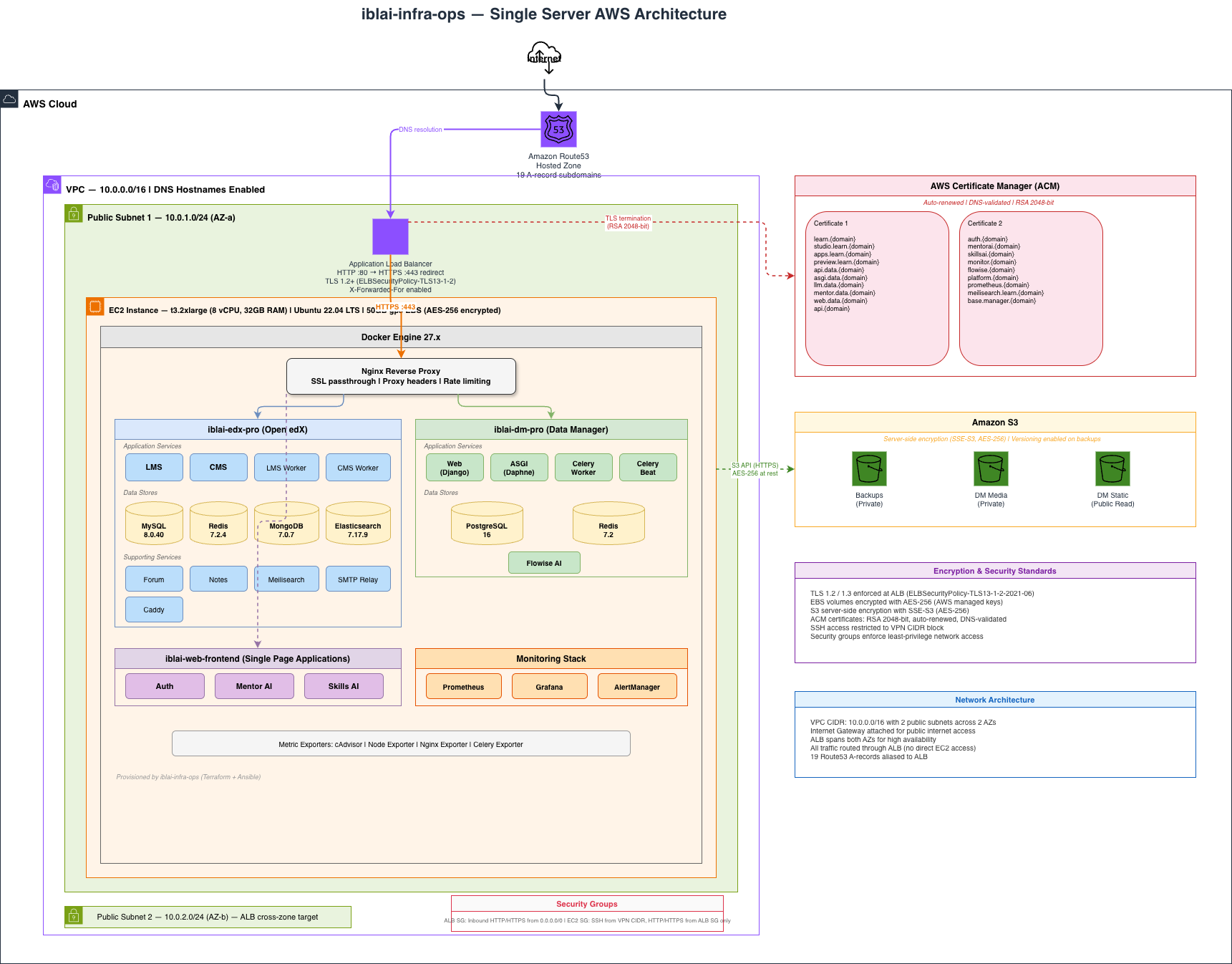
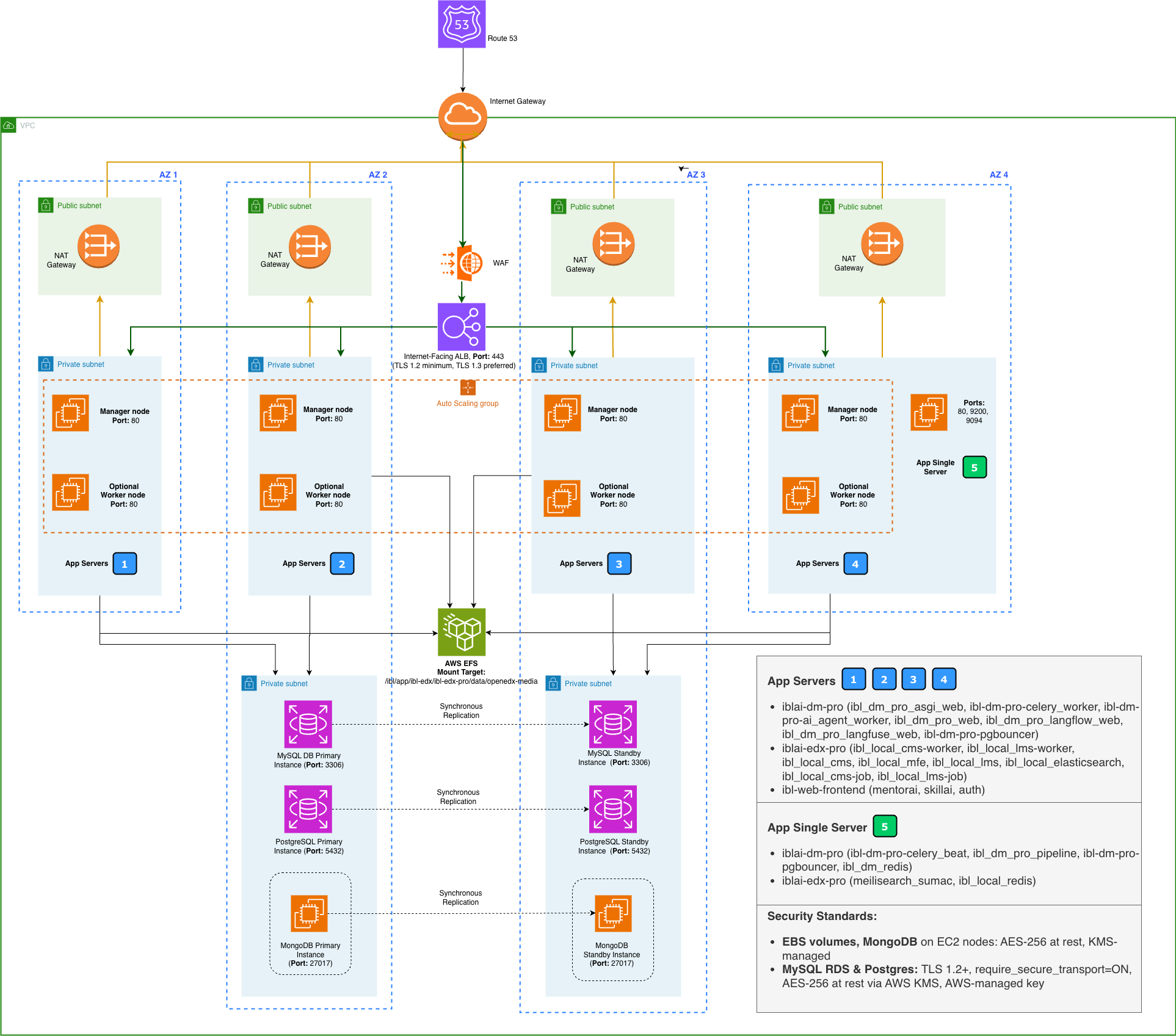
- VPC with 2 public subnets across availability zones (10.0.0.0/16)
- EC2 instance (Ubuntu 22.04) with encrypted EBS volume (AES-256)
- Application Load Balancer with TLS 1.2/1.3 termination
- ACM certificates (RSA 2048-bit, DNS-validated, auto-renewed)
- Security groups (SSH restricted to VPN CIDR, HTTP/HTTPS from ALB only)
- 3 S3 buckets with server-side encryption (backups, media, static)
- Route53 hosted zone with 19 subdomain A-records
- Optional: AWS WAFv2 Web ACL attached to the ALB with admin-IP allowlist, six AWS managed rule groups, and a path-traversal block (opt-in via the wizard or
iblai infra waf enable)
- iblai-edx-pro -- LMS, CMS, workers, MySQL 8.0, Redis, MongoDB, Elasticsearch, Forum, Notes, Meilisearch, SMTP relay, Caddy
- iblai-dm-pro -- Django web, ASGI, Celery worker/beat, PostgreSQL 16, Redis, Flowise AI
- iblai-web-frontend -- Auth, Mentor AI, Skills AI single-page applications
- Monitoring -- Prometheus, Grafana, AlertManager, metric exporters
- Nginx reverse proxy
All Terraform state, SSH keys, and project configuration are stored at:
~/.iblai-infra/projects/<project-name>/
uv sync --extra dev
uv run pytest tests/ -v
With coverage:
uv run pytest tests/ --cov=iblai_infra --cov-report=term-missingiblai-infra-ops/
├── src/iblai_infra/
│ ├── cli.py # Typer CLI commands
│ ├── app.py # Application logic
│ ├── models.py # Pydantic models
│ ├── ui.py # Rich terminal UI
│ ├── env_provision.py # .env → InfraConfig (provision-env)
│ ├── env_setup.py # .env → SetupConfig (setup-env)
│ ├── prompts/ # Interactive questionary prompts
│ ├── providers/ # AWS provider (STS, EC2, S3, WAFv2)
│ ├── features/ # Post-provision feature toggles (`iblai infra <feature> <action>`)
│ │ └── waf.py # `iblai infra waf` — enable / enable-env / disable / status
│ ├── terraform/ # Terraform runner + templates
│ │ └── templates/aws/ # single-server (incl. optional waf.tf), multi-server, call-server
│ └── ansible/ # Ansible runner + templates
│ └── templates/single-server/
│ ├── playbook.yml # interactive setup + setup-env
│ ├── launch_playbook.yml # AMI launch + launch-env
│ ├── service_update_playbook.yml
│ └── roles/ # ansible roles (see playbook table)
├── tests/ # 648 tests, ~2s
├── docs/ # Architecture diagrams
└── pyproject.toml
Released under the MIT License.