When the algorithm has stopped using the ‘feature selected twice’ stopping condition, the selected subset seems to still include the lastly selected feature, i.e. a duplicate feature. See the log output below.
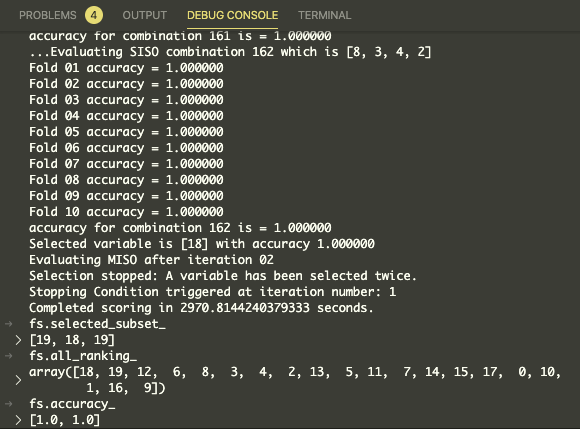
You can see that the selected subset contains feature no. 19, 18 and, again, 19.
→ Presumably the last-added feature should be removed when the stopping condition is triggered, like is done in the other stopping conditions:
|
self.selected_subset_ = self._all_selected_variables[:-1] |
|
self.complete_subset_ = self._all_selected_variables[:-1] |
|
self.accuracy_ = self.accuracy_[:-1] |
Like in #1, I execute FeatBoost using same setup as test.py:
    # Setup estimator
    xgboost_ensemble = XGBClassifier(max_depth=3, learning_rate=0.1,\
        n_estimators=200, silent=True, objective='binary:logistic',\
        booster='gbtree', n_jobs=1, nthread=None, gamma=0, min_child_weight=1,\
        max_delta_step=0, subsample=1, colsample_bytree=1, colsample_bylevel=1,\
        reg_alpha=0, reg_lambda=1, scale_pos_weight=1, base_score=0.5,\
        random_state=0, seed=None, missing=None)
    # Setup FS method
    fs = FeatBoostClassification(estimator=[xgboost_ensemble,\
        xgboost_ensemble, xgboost_ensemble], number_of_folds = 10,\
            siso_ranking_size = 8,\
            max_number_of_features = 100,\
            siso_order=4,\
            epsilon=1e-18,\
            verbose=2)

    # Run Feature Selection
    fs.fit(X, y)
When the algorithm has stopped using the ‘feature selected twice’ stopping condition, the selected subset seems to still include the lastly selected feature, i.e. a duplicate feature. See the log output below.
You can see that the selected subset contains feature no. 19, 18 and, again, 19.
→ Presumably the last-added feature should be removed when the stopping condition is triggered, like is done in the other stopping conditions:
FeatBoost/feat_boost.py
Lines 335 to 337 in 0bfd11a
Like in #1, I execute FeatBoost using same setup as
test.py: