- History – Forks & compatibility
- Reaching X: API Usage
- Subscriptions in QuaX
- Likes & Saved Posts in QuaX
- Privacy & Security
Note
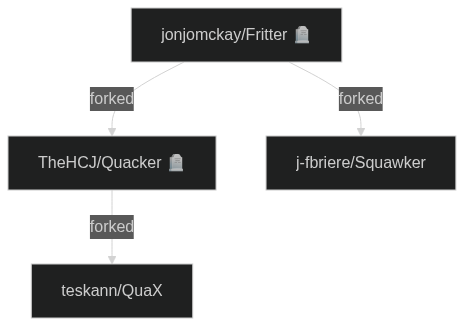
QuaX and Squawker sometimes share patches.
QuaX and Squawker share a lot in common, since both apps stem from the same codebase. Because of this, importing a Squawker backup into QuaX will likely work to some extent, but it's not guaranteed. Some settings may be lost along the way, and you may run into bugs. It's not something we'd recommend.
X provides APIs that require credentials for access, but they are very expensive to use. To work around this, QuaX uses unofficial X GraphQL APIs, which are the same ones used by web browsers when accessing X.
The advantage of these APIs is that they are free and should remain so. Without them, navigating X from a web browser would not be possible for free.
However, these APIs are neither official nor documented, and their use requires reverse-engineering. This is why QuaX may stop working occasionally. X can change its APIs at any time, and we will only be informed when we see the app stop functioning. That being said, major changes to these APIs are rare, and the application has been relatively stable since its launch in 2025.
Tip
Essentially, QuaX makes X believe that the access is coming from a web browser.
QuaX is forked from @jonjomckay Fritter. Originally, no Twitter account was required to use Fritter. It was fully designed to work without any login. In 2023, Twitter changed its policies and required authentication to use their APIs. As a consequence, Fritter became unusable and was progressively abandoned.
This is why QuaX requires you to be logged into an account to work properly. But it doesn't have to be your account. It needs any account.
All settings are independent of the account you're logged into. This is why we recommend logging into an account that has been created specifically for the use of QuaX. You can then import the subscriptions from your real account, although this is limited.
Tip
It's also possible to log into several accounts. In this case, QuaX prefers a healthy account for each request rather than a purely random one, and automatically retries on another account when one fails. An account is deprioritised (but still used as a fallback, so a request is always attempted) when:
- it is rate limited (
429) for that specific endpoint — X applies rate limits per endpoint, so an account limited on search can still load replies. Avoided until the reset time reported by X (or 15 minutes if X doesn't provide one). This is tracked in memory only. - it returned
404three times in a row (usually a sign it is no longer correctly authenticated) — avoided for 6 hours.
QuaX only shows an error after actually attempting a request:
- if every account is rate limited on the requested endpoint, it shows a "rate limited" message inviting you to retry later or add an account;
- if every account it tried returned a 404 (usually a sign they are no longer correctly authenticated), it suggests signing in with another account;
- if you have no account at all, QuaX still tries an unauthenticated (guest) request first, and only invites you to add an account if that also fails.
Retrying always sends a fresh request.
In July 2025, X introduced a requirement for the x-client-transaction-id
header in all HTTP requests. Without a valid header, the server would return a
404 error. To address this, a team developed
the XClientTransaction
project to enable computation of this header in Python.
XClientTransaction has been ported to Dart
and fully integrated into QuaX. The x-client-transaction-id header is computed
directly within the app, ensuring better performance and privacy.
Initially, QuaX relied on XClientTransaction, which was wrapped into a server by the developers, simplifying integration since it was implemented in Python. By default, this external service pointed to the developer's instance, but users could configure a different endpoint in the settings.
This server was contacted before each request to generate a valid header.
Subscriptions are completely unrelated to the subscriptions of the account you are logged into. They are stored on the device. Subscribing to a profile in QuaX won't impact the subscriptions of your X account.
To fetch feeds, QuaX runs an advanced searched request with special keywords to filter results on people you follow.
Though X cannot know exactly who you follow in QuaX, it could deduce it from the requests that are made everytime you refresh your feed.
Both saved posts and likes in QuaX are entirely local. They live only in the app's on-device database and are never sent to X.
Important
Liking a post in QuaX is not the same as liking it on X. Tapping the heart does not send anything to X: it does not register a like on your X account, the author receives no notification, and X has no way of knowing you liked it. It is a private, on-device favourite.
- Liked posts appear under the Likes filter of the Saved tab.
- Saved posts work the same way and can be organised into folders you create locally. The Saved tab lets you filter by folder, and you can reorder, rename, hide or delete these tabs as you like.
Because this data lives on the device, it stays private — but it is also tied to your QuaX installation. You can carry it between devices with the backup export/import feature, which covers your saved posts, folders and likes along with the rest of your settings.
QuaX collects no data and contains no trackers. Compared to using X in a web browser, QuaX only sends the strictly necessary requests and ignores all tracking when opening a link.
The source code is 100% open source, and official APKs are built using GitHub Actions workflows that are also fully open source and publicly auditable. APK signing certificate fingerprints are published alongside each release so users can independently verify the authenticity and origin of every build.
QuaX checks for available updates on every startup. It also regularly updates its dependencies and Flutter/Dart toolchain, and targets the latest Android SDK to benefit from the most recent platform security improvements. You can check the required Flutter here and the targeted SDK here.
QuaX requires very few Android permissions to operate:
- Required permission for the app to work:
android.permission.INTERNET
- Optional permissions to download medias (legacy, you can download without
them):
android.permission.READ_EXTERNAL_STORAGE(for Android <= 10)android.permission.WRITE_EXTERNAL_STORAGE(for Android <= 10)android.permission.MANAGE_EXTERNAL_STORAGE(for Android 11 and above)
Note
QuaX has never undergone a formal security audit. The project is far too small to justify the cost of one. Use it with that in mind.
F-Droid builds apps from source using its own infrastructure and signs them with its own keys, meaning the APK you'd download wouldn't be signed with the developer's keys. This creates a security concern: users would have no way to verify that the build actually comes from this project's maintainer. On top of that, F-Droid updates tend to lag behind releases by days or even weeks, which is particularly problematic for an app like QuaX that may need quick fixes when X changes its APIs.
The only way QuaX could be on F-Droid without these drawbacks is through a reproducible build — a process that lets F-Droid build the app from source while still producing a binary identical to the one signed by the developer. This is something we haven't gotten around to setting up yet.
Even if QuaX were eventually available on F-Droid via a reproducible build, the recommended way to install and keep the app up to date would still be through Obtainium combined with App Verifier, which lets you pull releases directly from GitHub and independently verify the APK signature.