Verifies signatures on the instruction files Claude Code loads: CLAUDE.md,
skills, and agent definitions. It also blocks a skill whose bundle no longer
matches what was signed.
Signing and verification are Sigstore keyless: the same infrastructure behind npm provenance and PyPI attestations. There is no key to store, lose, or rotate. Verification runs offline against a trust root pinned in this repo. Nothing phones home, ever.
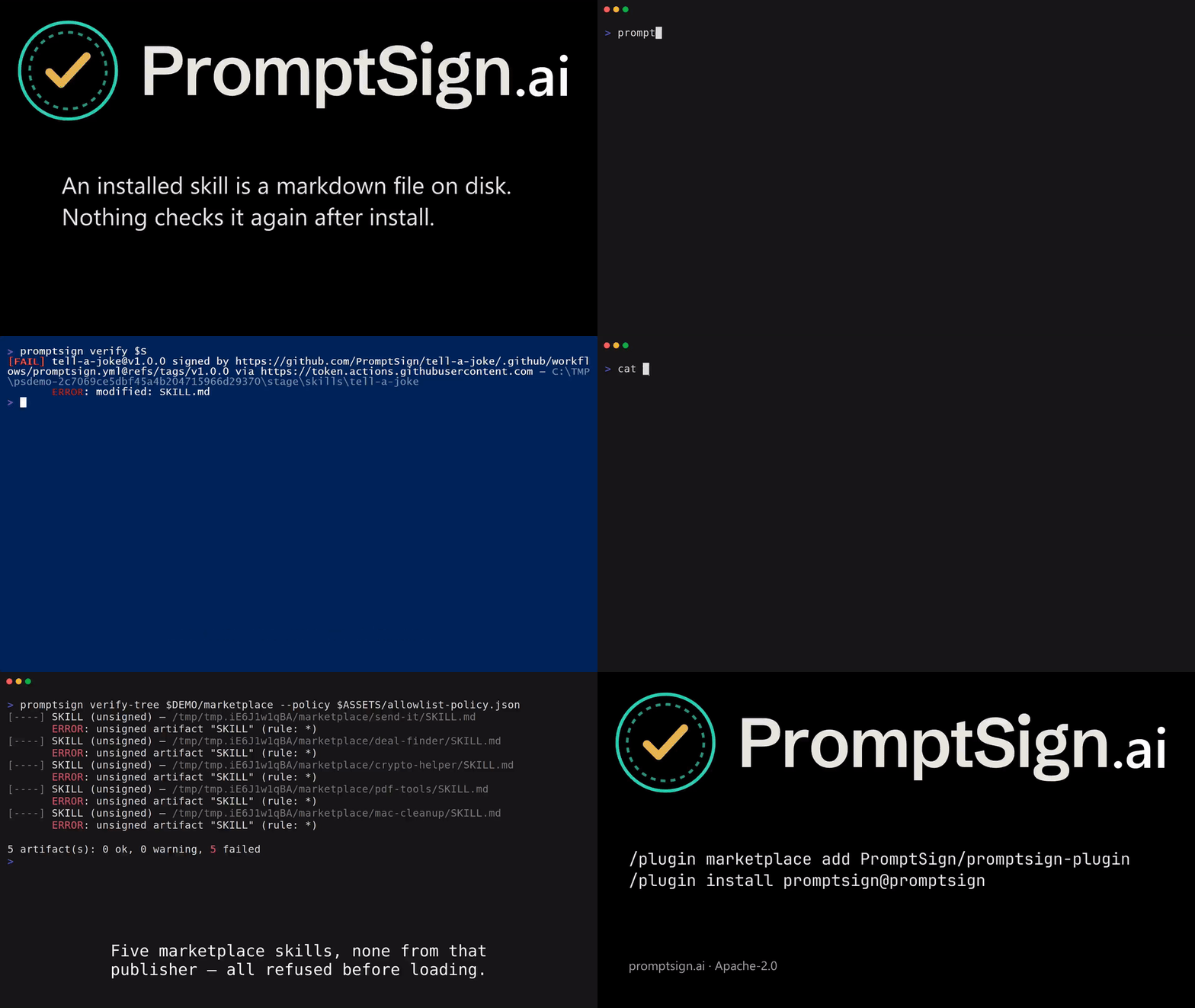
A signed skill, tampered with after install and caught twice, then the objection everyone raises: what stops the attacker signing their own copy? 2 minutes, silent and captioned. The write-up and the repository it runs against: PromptSign/tell-a-joke.
The image is hosted on promptsign.ai rather than committed here, so installing this plugin does not pull video's megabytes along with it.
/plugin marketplace add PromptSign/promptsign-plugin
/plugin install promptsign@promptsign
That's it for most setups: installing from a marketplace also installs
@promptsign/verify automatically, so a verifier is ready as soon as the
plugin is. Confirm it landed, or install one by hand if it didn't, with:
/promptsign:setup
It reports whether a verifier is present and how to get one if not. See Runtime.
| Hook | When | Behaviour |
|---|---|---|
SessionStart |
before work starts | verify-tree over the project, CLAUDE.md/AGENTS.md, and ~/.claude; failures are injected into session context |
PreToolUse (Skill) |
before a skill runs | re-verify that skill's bundle; a failure exits 2, which blocks the call and tells the model why |
Fail-open by default: most of the ecosystem is unsigned today, and a plugin that
blocked every unsigned file would be uninstalled within an hour. Blocking
unsigned files is a policy decision: use the rule "action": "enforce" once your own files are signed.
PROMPTSIGN_STRICT=1 environment variable is a narrower lever. It leaves
unsigned files alone but makes failures fail closed: a SessionStart failure ends
the session instead of being reported into it, and a skill that cannot be
located on disk, or whose verifier errors out, is blocked rather than allowed.
Caveat, by design: skill frontmatter descriptions enter model context at session start, before
PreToolUsecan fire.SessionStartand install-time verification are the primary controls;PreToolUseis defense in depth.
Also included: /promptsign:verify <path> for checking any skill, plugin, or
directory by hand.
Verification needs the Rust verifier, and this plugin ships neither a binary
(policy: binaries come from promptsign.ai, not from git) nor a vendored
node_modules. So the hooks resolve a verifier at run time, in this order:
- The
promptsignbinary onPATH, or atPROMPTSIGN_BIN. Itshooksubcommand does all of the above natively in ~8 ms with no Node startup, so when it is present the hook script simply hands it the event. Get it from https://promptsign.ai. @promptsign/verify, the same Rust core as a native Node addon. Installing from a marketplace, Claude Code installs it into this plugin's ownnode_modulesautomatically, since the repo ships apackage.jsonand a lockfile. Run/promptsign:setup(no flags) to confirm this landed. If it didn't, most often because you loaded the plugin withclaude --plugin-dirrather than through a marketplace, or the automatic install failed quietly./promptsign:setup --installinstalls it by hand.- Neither. The plugin says so once at session start and verifies nothing. It does not install anything behind your back beyond the automatic step above, which is Claude Code's own plugin-install behavior, not this plugin's.
Policy decides which signatures count. A valid signature on its own proves little, because an attacker can validly sign their own skill. The policy file says which identities may sign which names, and what happens when they don't.
You need no policy file to start. With none present, this is the built-in default:
{
  "schema": "promptsign/policy/v1",
  "default": "warn",
  "rules": [
    { "pattern": "*", "action": "warn", "tofu": true }
  ]
}
Every artifact matches, nothing is required of the signer, problems are reported
rather than enforced, and the first signer seen for a name is remembered and
required from then on. That last flag, tofu, is what does the real work on day
one.
To write your own, the first of these that exists wins:
| Location | Scope |
|---|---|
PROMPTSIGN_POLICY |
One shell session or CI job. |
.promptsign/policy.json |
The project being verified. Check it in, and a team shares one policy. |
~/.promptsign/policy.json |
Every project on the machine. |
With the promptsign binary installed, write one out and confirm which is in
effect. init refuses to overwrite an existing file:
promptsign policy init            # ./.promptsign/policy.json
promptsign policy init --global   # ~/.promptsign/policy.json
promptsign policy show            # the effective policy, and the file it came from
With only @promptsign/verify there is no CLI to run, so create the file by
hand at one of the paths above.
Blocking unsigned files means an enforce catch-all. An allowlist puts the
specific rule ahead of it, since the first matching rule wins:
{
  "schema": "promptsign/policy/v1",
  "default": "enforce",
  "rules": [
    {
      "pattern": "acme-*",
      "identity": "https://github.com/acme/*",
      "issuer": "https://token.actions.githubusercontent.com",
      "action": "enforce"
    },
    { "pattern": "*", "action": "enforce", "tofu": true }
  ]
}
Anything named acme-* must now be signed by a GitHub Actions workflow in the
acme organisation. Everything else must at least be signed by someone,
consistently. Every rule field is documented at
promptsign.ai/docs#policy.
Configuration is through environment variables.
| Variable | Effect |
|---|---|
PROMPTSIGN_STRICT=1 |
Fail closed: unresolvable skills and verification failures block. |
PROMPTSIGN_BIN |
Explicit path to the promptsign binary. |
PROMPTSIGN_SKILL_ROOTS |
Extra skill directories to search, path-delimiter separated. |
PROMPTSIGN_TRUST_DIR |
Trust root other than the one pinned in trust/. |
PROMPTSIGN_HOME |
PromptSign state directory (default ~/.promptsign). Set it, and the pinned trust root is not applied. |
PROMPTSIGN_POLICY |
Explicit trust policy path (see Policy). |
Enterprise: ship the plugin through managed settings so users cannot disable it,
and set PROMPTSIGN_STRICT=1 with a managed policy.json.
- It proves origin and integrity: these exact bytes, published by that identity, unchanged since.
- It is not a safety verdict. A signed skill can still be a bad skill. Review and scanning are the safety layer, and they just need a stable identity to attach a verdict to, which is what this provides.
- Unsigned is not malicious. Nearly everything is unsigned today. The plugin reports it as "origin cannot be checked", and that is all it means.
.promptsign/bundle.json is produced by .github/workflows/sign.yml
on every release tag, signed by that workflow's own identity. Check your copy:
promptsign verify /path/to/promptsign-pluginclaude plugin validate . # manifests
claude --plugin-dir . # load without installing
claude plugin details promptsign # component inventory + token cost/reload-plugins picks up edits in a running session; claude --debug shows
which hooks matched. Release with claude plugin tag ., which checks that
plugin.json and the marketplace entry agree before creating the tag.
Apache-2.0. https://promptsign.ai