Figure 7 — SLAP2 glutamate column (panels C, G, K): event-based QC across all 20 sessions, feedback welcome #172

Replies: 1 comment 1 reply

|
Nice! Two quick thoughts: (1) Instead of "Low SNR", "Intermediate", and "High SNR", maybe use a color gradient that maps to the actual SNR values? (2) I am a bit confused about what "events" represents. In the mesoscope data, I assume they are putative de-convolved spikes (action potentials)? And here for SLAP2, "events" are single glutamate vesicles? |

|
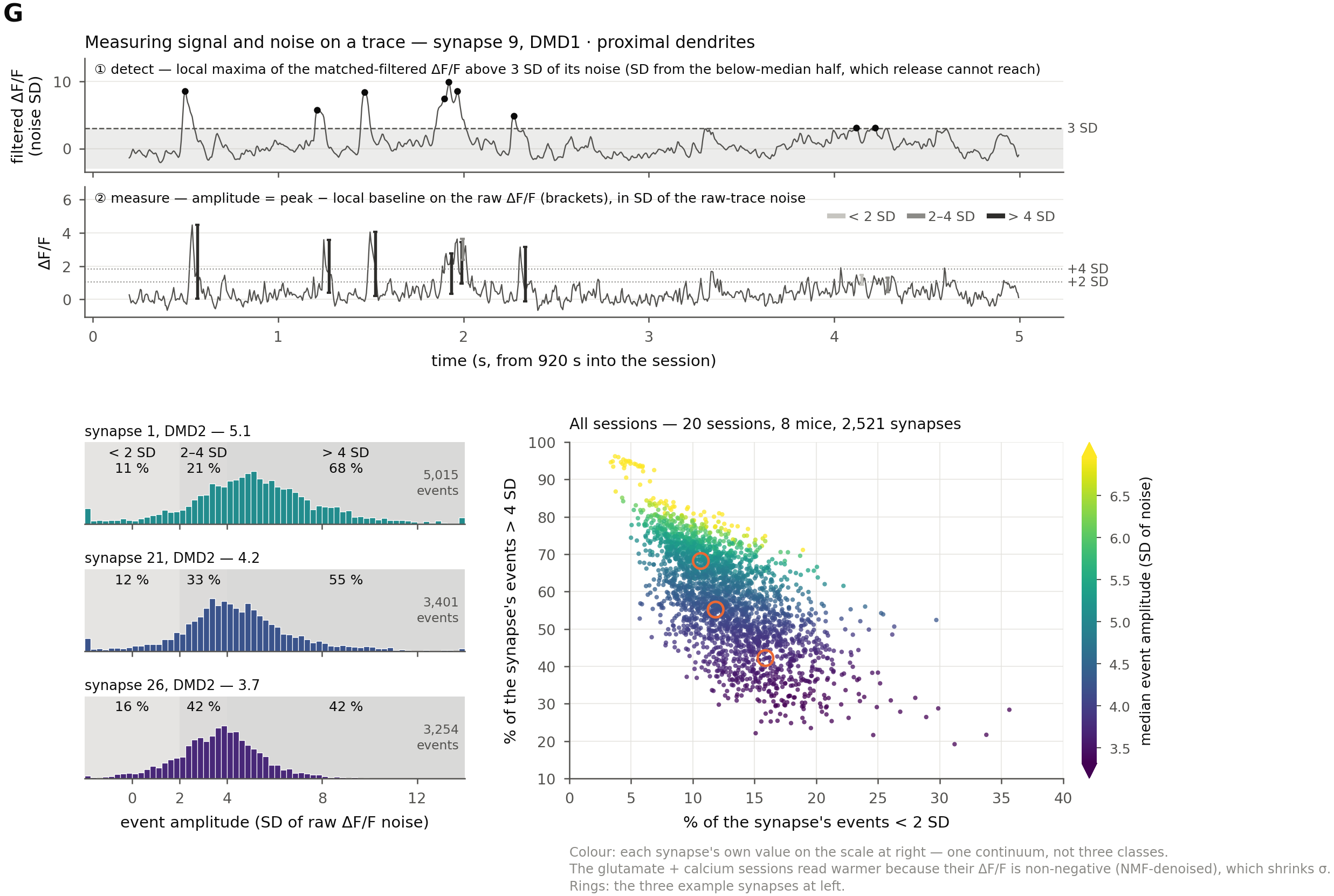
Thanks for the feedback! (1) Color Gradient: I've added it as a variant of C and G (viridis on the median event amplitude in noise SD). I had used labels because I thought the point was to create SNR classes for the cross-column comparison (#156), so these still appear in K.
(2) Events: in the mesoscope data, these are indeed putative OASIS-deconvolved spikes. In SLAP2, they should be putative glutamate transients per synapse, i.e., one or a few vesicle releases. |


Uh oh!
There was an error while loading. Please reload this page.
Following the mesoscope QC scheme discussed in #156, here is a first full draft of the SLAP2-glutamate
column of Figure 7 (panels C, G, K), built from all 20 iGluSnFR4f sessions of DANDI 001424
(8 mice, 2,540 synapses). Code, tables and a walkthrough notebook are in PR #171
(
code/data-access/slap2_glutamate_*.py,docs/notebooks/slap2_glutamate_figure7_panels.ipynb).How the metrics are built
noise; the noise SD comes from the below-median half of the trace, which glutamate release cannot reach.
raw-trace noise, binned < 2 / 2–4 / > 4 SD — the same bins as the mesoscope.
Low / Intermediate / High SNR by the centroid's > 4 SD fraction.
The panels
C — example session (sub-794237, 2025-05-08): both imaging planes with every synapse coloured by
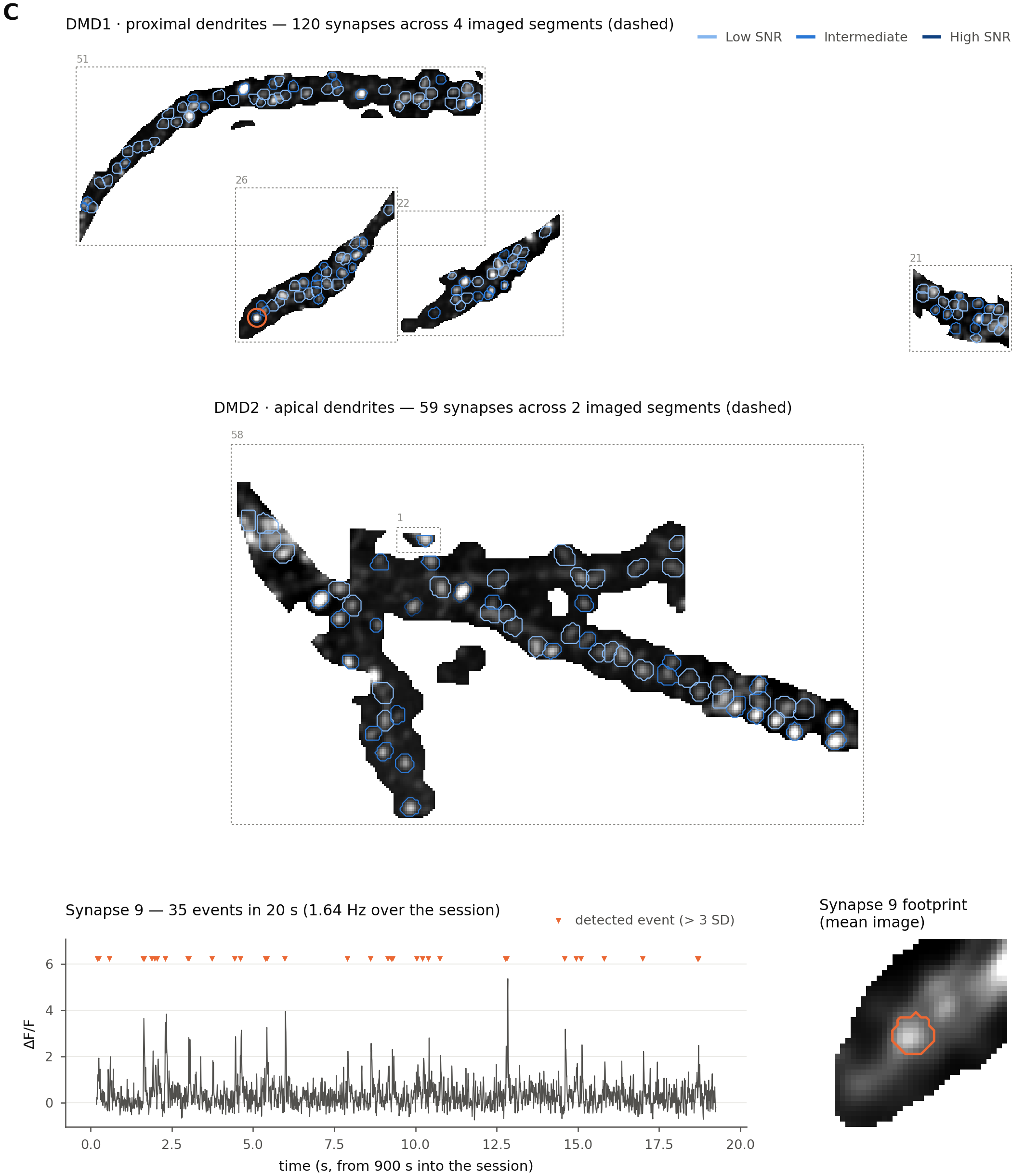
class, one footprint, 20 s of ΔF/F with detected events.
G — the two measurement steps on a trace; one example synapse per class with its bin fractions;
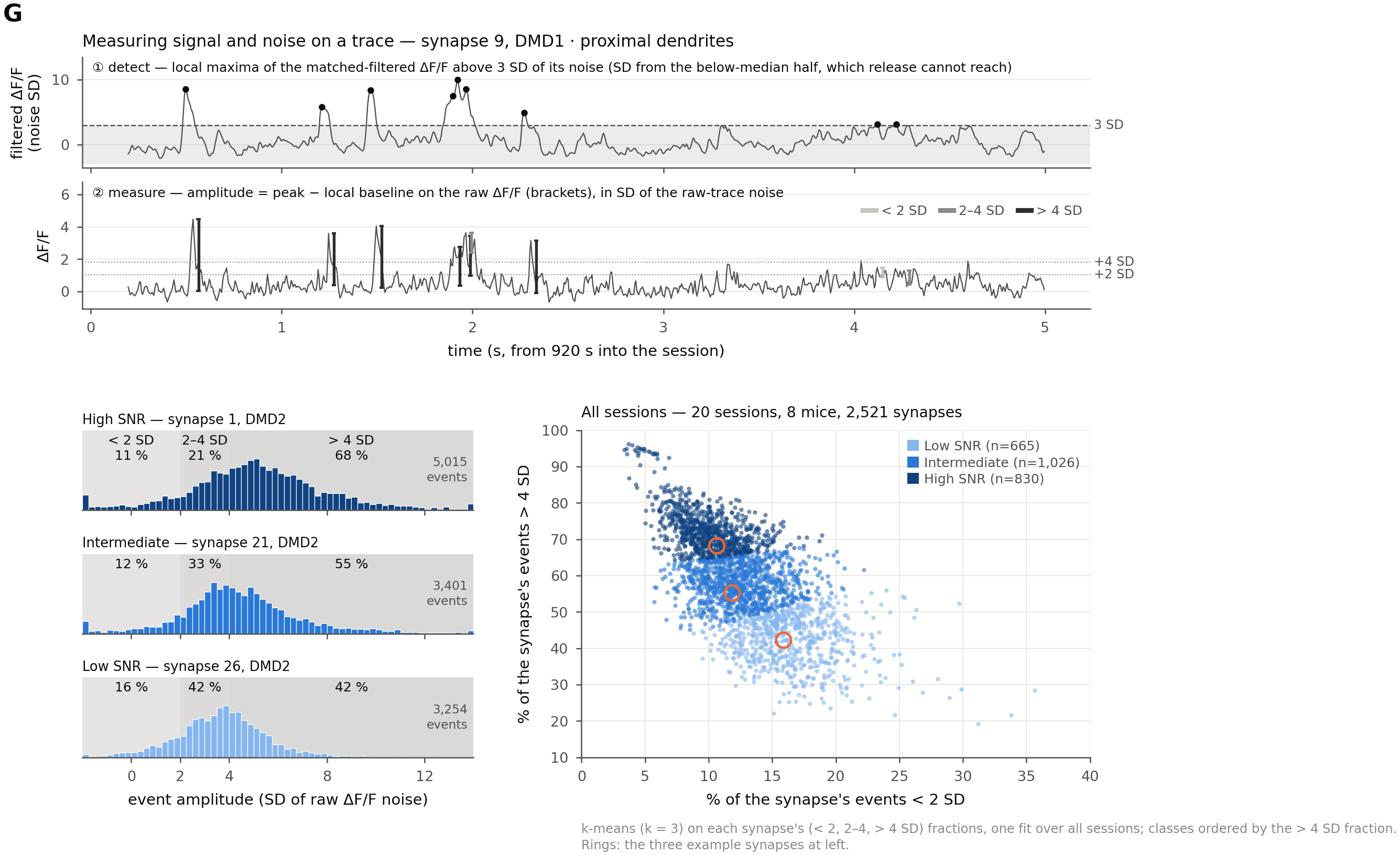
every classified synapse of the archive in the (< 2 SD %, > 4 SD %) plane, one axis per cohort.
K — event rate by stimulus context per class (12 standard-paradigm sessions | 8 sessions with
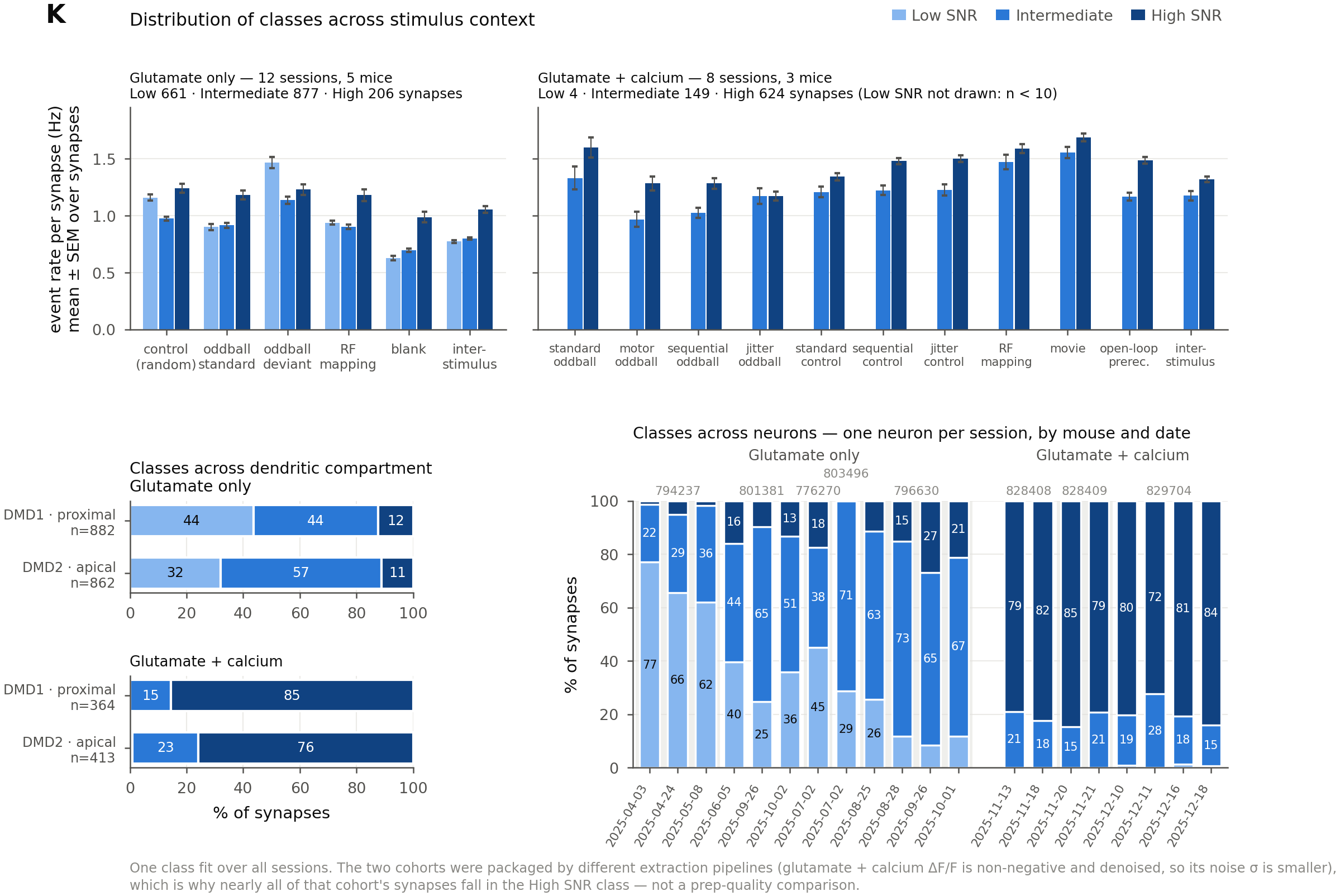
named blocks); class composition by dendritic compartment and per neuron (one neuron per session).
What they show
38 / 51 / 63 %), while event rate barely differs between classes (0.77–0.86 Hz) — the class is
about event amplitude, not activity.
oddball standard ≈ RF mapping > inter-stimulus > blank.
sessions) and are consistent within a mouse.
One decision I'd like eyes on
Classes are fitted per acquisition cohort. The 12 glutamate-only sessions ship two-sided ΔF/F,
the 8 glutamate + calcium sessions ship non-negative, NMF-denoised traces (> 4 SD fraction 0.72 vs
0.53, 95/50 SNR 3.3 vs 2.4). One k-means over all 20 sorts synapses by pipeline rather than by
quality (the dual cohort came out 80 % "High SNR"), so the panels use a per-cohort fit and say so.
Is that the right call, or would you rather see one global fit with the cohort marked?
All reactions